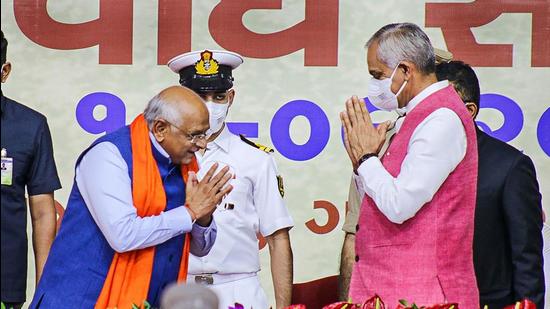
A year before elections in Gujarat, the Bharatiya Janata Party (BJP) got Vijay Rupani to resign as chief minister (CM), and then, in a surprise choice, appointed Bhupendra Patel as CM. On Thursday, after intense internal battles, it picked an entirely new council of ministers — and did not repeat any minister from the last state government.
The BJP’s strategy is clear. The party, under Narendra Modi and Amit Shah, has often been ruthless before elections to ward off anti-incumbency.
A year before elections in Gujarat, the Bharatiya Janata Party (BJP) got Vijay Rupani to resign as chief minister (CM), and then, in a surprise choice, appointed Bhupendra Patel as CM. On Thursday, after intense internal battles, it picked an entirely new council of ministers — and did not repeat any minister from the last state government.
The BJP’s strategy is clear. The party, under Narendra Modi and Amit Shah, has often been ruthless before elections to ward off anti-incumbency. This has usually taken the form of replacing a range of candidates and picking new faces. The most glaring example of this was the municipal election in Delhi in 2017, where no incumbent was given a ticket and the BJP went on to sweep the polls with fresh faces.
Also Watch | Gujarat Cabinet Rejig: CM Patel gets brand new ministers amid power tussle
In the case of Gujarat, the party is obviously seeking to project fresh energy, while keeping the caste calculus in mind. But there is a larger context. The BJP is not just battling discontent that may have emerged in the past six years against Mr Rupani; it will have been in power for 27 years by 2022, and there will inevitably be accumulated resentment.
As long as Mr Modi was CM, the promise of continuity — rather than change — won votes. Now, in a sign of the party’s challenge in the post-Modi phase, the promise of change — rather than continuity — is expected to deliver electoral benefits. The reason the BJP is able to get away with such a large-scale change — in any other party, it would spark an internal rebellion and lead to factional fights in each seat — is because of a premium on organisational discipline and Mr Modi’s control. But only 2022 will tell whether the strategy has worked.
One Subscription.
Get 360° coverage—from daily headlines
to 100 year archives.
Archives
HT App & Website