It is tempting to see Thursday’s vote in the Karnataka assembly — when Chief Minister (CM) HD Kumaraswamy has to prove his majority on the floor of the House — as the culmination of a period of instability that began with the desertion of the Members of Legislative Assembly (MLAs) from the ruling alliance on July 6. But the vote is actually an outcome of the persistent instability in the state for close to a year, ever since the Congress-Janata Dal (Secular) alliance took office. Karnataka had thrown up a hung verdict. The Bharatiya Janata Party (BJP) was the single largest force with 105 MLAs, but that was not enough in the 224 member assembly. The Congress and JD(S) quickly came together to form a government, which, at the time, was celebrated as a moment of Opposition unity.
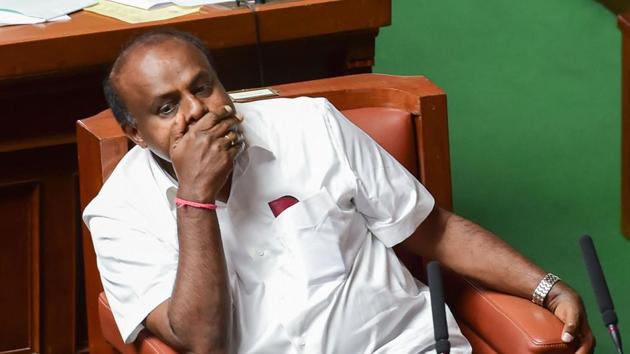
But the alliance has been in trouble ever since its inception. The Congress’ former CM, Siddaramaiah, was upset at losing power. He shares an old rivalry with the JD(S) supremo, HD Deve Gowda, and was keen to undercut the alliance. Within the Congress, those who did not become ministers increasingly began dissenting. Mr Kumaraswamy was unable to impose his authority. Governance took a backseat, even as crony capitalism and alleged corruption reared their heads. The BJP’s leader, BS Yeddyurappa, who believes this is his last shot at power, played on these internal contradictions, wooing disgruntled MLAs with a range of inducements. The government has been in crisis throughout its tenure. The Lok Sabha results, in which the BJP won 25 of the 28 seats in the state, energised the party even more, while causing disarray in the ranks of the ruling alliance. The fact that the Congress, with Rahul Gandhi’s resignation, is bereft of leadership at the top, did not help. It is not a coincidence that five weeks after the results of the general elections were announced, the Karnataka alliance started coming apart and 16 MLAs have, by now, resigned, though their fate hangs in the balance and is dependent on the Speaker’s decision.
Irrespective of the outcome on Thursday, the Karnataka episode must rank as one of the most disgraceful episodes of recent Indian democratic history. On the one hand, there is a ruthless BJP, which believes in getting to power at all costs, and has cynically exploited possibilities of power, irrespective of ideology or principles. On the other hand -- and greater culpability rests here -- is the rank opportunism of the Congress-JD(S). It was an alliance born in a shoddy compromise, in which power was the only glue. It was unable to manage its own internal differences. It has run an ineffective government. The (admittedly fractured) mandate of 2018 has all but been squandered and the solution perhaps lies in fresh elections. Citizens deserve better.
{{/usCountry}}Irrespective of the outcome on Thursday, the Karnataka episode must rank as one of the most disgraceful episodes of recent Indian democratic history. On the one hand, there is a ruthless BJP, which believes in getting to power at all costs, and has cynically exploited possibilities of power, irrespective of ideology or principles. On the other hand -- and greater culpability rests here -- is the rank opportunism of the Congress-JD(S). It was an alliance born in a shoddy compromise, in which power was the only glue. It was unable to manage its own internal differences. It has run an ineffective government. The (admittedly fractured) mandate of 2018 has all but been squandered and the solution perhaps lies in fresh elections. Citizens deserve better.
{{/usCountry}}