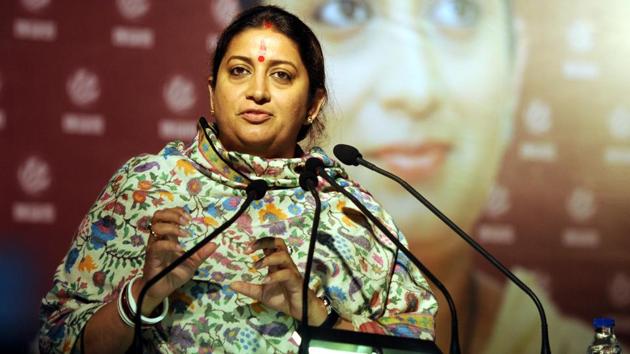
Never one to shy away from straight talking, textile minister Smriti Irani severely dampened the self-congratulatory mood at the Indian Science Congress by calling out the inherent gender bias in the scientific community that is denying opportunities and jobs to women. Addressing scientists, who work in fields that value rationality, objectivity and meritocracy, Ms Irani used data to put the spotlight on the deeply entrenched gender bias in research and the workspace that pushed women to the margins. Of the 280,000 scientists and engineers employed in research and development institutions across India, only 39,200 (14%) are women. A high number of women face irrational gender based prejudice at work. Four out of every five women working in STEM (science, technology, engineering and mathematics) sectors in India say they face pervasive gender bias that affects hiring, performance evaluation, promotion, salary and perks. This discrimination also denies women funding opportunities and leadership positions, driving them away from careers in science.
While the Department of Science & Technology’s Women Scientist Scheme under the KIRAN division offers funding and opportunities to women who took a career break to help them return to mainstream science — including the agriculture and allied sciences; health, food and nutrition; and engineering and technology sectors — the gender gap in employment will narrow only when STEM professions offer a level playing field for all genders. Over the past two decades, the number of women opting to study STEM subjects that offer the best paid jobs has steadily reduced across the world, with the disparity in wages in favour of men persisting. In the US, 50 million women working full time in 2017 had median weekly earnings of $770, compared to 63 million men with median weekly earnings of $941. Women working in computing and engineering occupations earned $1,235, compared to $1,552 form men, according to US Department of Labour data.
If admission to the 23 Indian Institutes of Technology (IITs) is an indication in India, the number of women studying STEM courses has registered a steady drop, which led the government to take affirmative action and add 946 supernumerary seats exclusively for women in the 2019 academic session, up from 779 in 2018. With these women-only seats at IITs going up from 14% in 2018 to 17% in 2019, women IITians may cross 2,000 for the first time this year. More than affirmative action, however, what women need is equal opportunity and wage parity to thrive in the classrooms, laboratories and workplaces.
{{/usCountry}}If admission to the 23 Indian Institutes of Technology (IITs) is an indication in India, the number of women studying STEM courses has registered a steady drop, which led the government to take affirmative action and add 946 supernumerary seats exclusively for women in the 2019 academic session, up from 779 in 2018. With these women-only seats at IITs going up from 14% in 2018 to 17% in 2019, women IITians may cross 2,000 for the first time this year. More than affirmative action, however, what women need is equal opportunity and wage parity to thrive in the classrooms, laboratories and workplaces.
{{/usCountry}}