By cracking the whip after Saturday’s dreadful train accident in Muzaffarnagar, railways minister Suresh Prabhu has addressed what had remained a crying need: Of holding the top rail bureaucracy accountable for its acts of omission and commission.
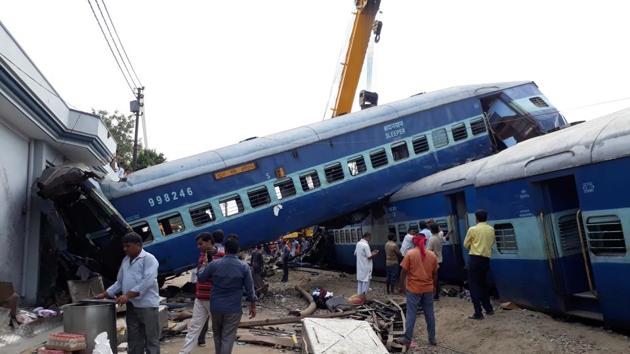
Only on two occasions in the 70 years of the country’s Independence has administrative action been initiated against the Grade-A officers of the Indian Railways after an accident. The last time such a development happened was in 2010, when a divisional railway manager was suspended following a train tragedy. Strangely, the suspension order was revoked within two days of the order.
Section 175 of the Railways Act of 1989 insulates Class-I category officers from culpability in train accidents, as it holds rail employees such as permanent way inspectors or supervisors as being responsible for accident ‘violations’. It can be argued that certain accidents could have been prevented, had the senior rail bureaucracy — from the general manager downwards — been more vigilant or particular in adhering to the schedule of on-line inspections.
Mindsets are an issue; but there are other serious challenges to rail safety. In the 64-year period from 1950 to 2016, passenger and freight traffic grew by 1,344% and 1,642% respectively, while the network increased by a mere 23% — causing huge network congestion. With the time available to carry out routine repairs (overhead signaling systems or tracks) having shrunk, short-cut methods — of the kind that caused the Muzaffarnagar accident — are being routinely resorted to.
{{/usCountry}}Mindsets are an issue; but there are other serious challenges to rail safety. In the 64-year period from 1950 to 2016, passenger and freight traffic grew by 1,344% and 1,642% respectively, while the network increased by a mere 23% — causing huge network congestion. With the time available to carry out routine repairs (overhead signaling systems or tracks) having shrunk, short-cut methods — of the kind that caused the Muzaffarnagar accident — are being routinely resorted to.
{{/usCountry}}The situation has worsened on account of the low spending on safety works. In 2009-10, for instance, Rs 1,102 crore was allocated for safety works (revised to Rs 923 crore), while the actual spending was Rs 906 crore. The following year, Rs 1,302 crore was allocated (revised to Rs 998 crore), while the actual spending was Rs 911 crore.
Manpower shortages have also not helped. Against the total sanctioned strength of 746,676 employees, 122,736 safety category posts (or 16% posts) are vacant; official records show. The need for setting up an independent safety regulator has also remained unaddressed.
To his credit, Mr Prabhu has made an effort to bring about a transformation in the way the transporter does its business. A rail safety fund with a corpus of Rs 1 lakh-crore has also been created. But, until these initiatives begin to bear fruit, the threat of a possible repeat of the Muzaffarnagar kind of mishaps will continue to hang.