The first part of this series discussed how Assam is India’s most troubled state when it comes to demographics. The second part of the series will look at how the BJP has come to dominate Assam’s politics, which until 2016 was firmly under the Congress’s control and what it will take for the Congress to reclaim Assam.
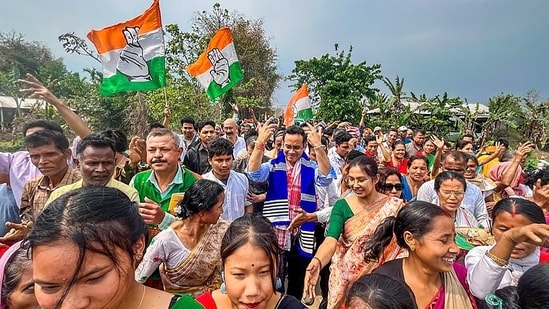
Can Congress pull off a delicate balancing act in Assam?
- The fall, rise and fall of the Congress in AssamLike in other Indian states, the Congress also came to power in Assam at the time of independence. Assam was among the most troubled states even at the time of independence, not just on account of communal troubles but also tensions from neighbours in India’s near east. It also had a traumatic experience during the 1962 war against China. These disruptions however did not dislodge the Congress from power in the state until 1978. Things only became worse for the Congress in the 1980s when it faced a defeat from a bunch of student activists leading the Assam agitation. The Congress, under the leadership of former chief minister Tarun Gogoi slowly recovered its ground in the state and formed three back-to-back governments from 2001 onwards before losing power to the BJP in 2016. Since then, it has been a downward slope and the Congress’s latest assembly election performance was among its worst in the state.
- The BJP’s rise has been at the cost of the Congress and the weakening of the AGPOne of the most remarkable features of Tarun Gogoi’s emphatic victory – the Congress won 78 out of the 126 ACs – in 2011, was the complete division of the anti-Congress Hindu vote in Assam. The All-India United Democratic Front (AIUDF), primarily a party of Bengali Muslims in Assam , was the second largest party in the state with 18 MLAs and a 12.6% vote share. The Asam Gana Parishad (AGP) and BJP had just 15 MLAs between them despite a combined vote share of 27.8%. The AIUDF increased its vote share in the 2016 elections. The Congress saw its seat share fall drastically with an eight-percentage point loss of vote share and a significant rise in the degree of opposition unity in the state: the BJP, AGP and the Bodoland People’s Front fought together in 2016. The 2016 assembly elections also saw the AGP becoming a junior partner of the BJP for the first time. It should not be surprising that Assam’s current chief minister was a minister in the Tarun Gogoi government.
- Congress made a large dent in the AIDUF’s support base in the 2024 electionsThe AIUDF first weakened its assertion in Assam by allying with the Congress in the 2021 assembly elections. The alliance helped neither the Congress nor the AIUDF. In 2024 the Congress parted ways with the AIUDF and decimated it in the Lok Sabha elections. AIUDF’s vote share fell to an all-time low in this election. However, the Congress’s growing influence into the AIUDF (primarily Bengali Muslim) base also meant that it is appearing to be a more Muslim party in Assam. This can be seen from the fact that while the share of Muslim MLAs in Assam has remained similar since 2011, this number has increased significantly for the Congress.
- Conclusion...The Assam BJP’s attempts to dial up the communal rhetoric is nothing but an attempt to nudge the Congress into reacting to it so that the BJP can label the Congress primarily as a party drawing on Muslim support. While the strategy can be described as morally reprehensible, it is not entirely counter-intuitive in a state with deep communal fault lines. What the Congress needs to do in order to win back Assam is to manage a reconciliation between its new found Muslim support and the Assamese Hindu support it lost in the last decade. This will take more than plain vanilla assertions of secularism and communalism.
Unlock a world of Benefits with HT! From insightful newsletters to real-time news alerts and a personalized news feed – it's all here, just a click away! -Login Now!
Unlock a world of Benefits with HT! From insightful newsletters to real-time news alerts and a personalized news feed – it's all here, just a click away! -Login Now!
Advertisement
{{/htLoading}}{{#usCountry}}