
 E-Paper



HT@100 | 1960-1969: Conflict & change
The country battles a weak economy, famine and China’s incursions into its territory; government takes strong steps

 Prefer HTon Google


The ’60s, marked by the 1962 Sino-Indian war, the India-Pakistan war in 1965, a deadly famine in Bihar, the death of two Prime Ministers in office, and internal uprisings from Nagaland to Punjab and Tamil Nadu, was by no means a restful decade for India.
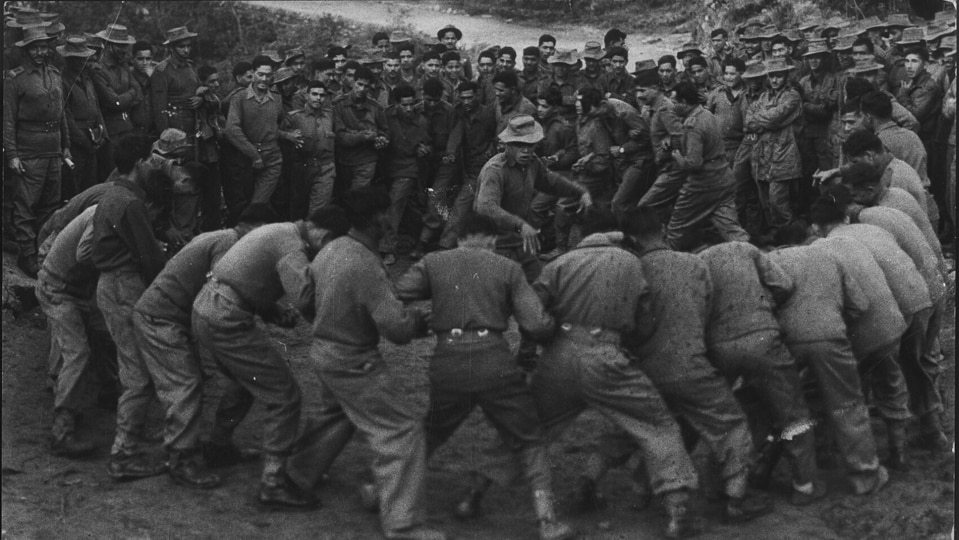
On October 23, 1962 — three days after the Sino-Indian war began — GD Birla wrote to Prime Minister Jawaharlal Nehru and, according to GD’s biographer Ram Niawas Jaju, asked, “...How [might I] use the extra energy at my disposal?... What is needed is proper cooperation between the government and industrialists.” He started by donating GBP 3,200 (approximately ₹91 lakh today) to the National Security Fund. He also offered to help build clubs and canteens for soldiers in northeast India.
On November 22, 1962, China announced a unilateral ceasefire after India had suffered a series of reverses.
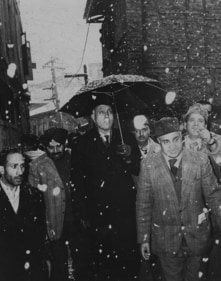
It wasn’t just India’s northeastern border that came under fire. Within the country, bonfires were lit by protestors, as battles, pegged on linguistic and cultural identities that sought to redraw state boundaries, raged. The 1960s began with the liberation of Goa from Portuguese rule, and the formation of two states, Maharashtra and Gujarat, after five years of agitation. By the mid-60s, the Dravida Munnetra Kazhagam (DMK), which wanted English to remain part of government correspondence, launched a statewide campaign during which Hindi books were burnt, signage with Hindi lettering was blackened, and angry students took to the streets. Up north, the Punjabis demanded their own state. Protests broke out in 1960 and ’61 and thousands of Akali agitators were arrested, putting immense strain on the Centre’s resources. But it was only in 1966 that a threefold division of Punjab into Himachal Pradesh, Haryana and Punjab was undertaken.
The decade also witnessed the deaths of two prime ministers of the country — Jawaharlal Nehru on May 27, 1964, and his successor, Lal Bahadur Shastri, a day after signing the Tashkent Agreement that brokered peace between India and Pakistan, in 1966.
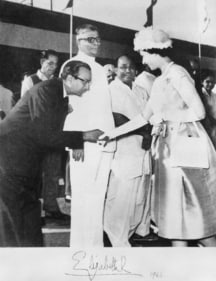
Indira Gandhi’s appointment as PM caused a rift in the Congress. In Shastri’s Cabinet, she had been given the information & broadcasting portfolio. After his death, the Congress split into two camps — one wanted Morarji Desai to be PM, the other backed Indira. On January 19, 1966, Gandhi won the fight, 355 to 169 votes, in the Congress Parliamentary Party.
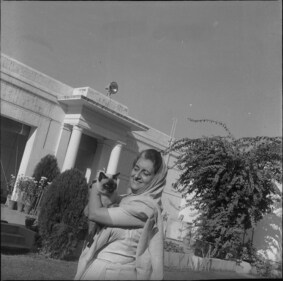
The Hindustan Times edit the following day remarked on her landslide win. “It was necessary in the national interest that the new leader should be assured of the party’s solid support. It was necessary in the party’s own interests that its pledge of support should express, and should be seen to express, the conscious choice and deliberate judgement of its individual members.”
A foreign exchange crisis led the PM to devalue the rupee on June 6, 1966. Indira was widely criticised by her party and Indian scholars and economists but an op-ed in HT on June 10, titled “Anatomy of a Decision” by HT editor Krishan Bhatia took a contrary stand: “The decision to devalue the rupee is yet another landmark on the path of economic realism to which the government took recently. Notwithstanding the enormous hazards to which it might expose the country, devaluation is a big step away from the empty slogans and impracticable policies that the government was prisoner of for the past 15 years.”
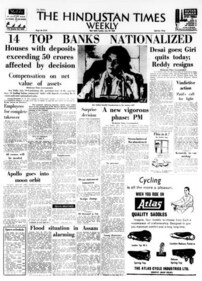
Indira Gandhi was not one for small measures. In 1967, guided by her trusted aide Parmeshwar Narayan Haksar, she began talking about her socialist agenda for the country. She proposed the nationalisation of banks, and the abolition of the privy purses of the princes of India’s erstwhile royal houses. The top edit in HT on July 21, 1969 — two days after 14 banks were nationalised — said that the decision was “dictated by political considerations rather than by the intrinsic economic merits of the measure.”
But there were more pressing challenges. Food scarcity was a perennial problem, with demographers predicting widespread starvation by the end of the decade. Repeated crop failure meant that larger and larger swathes of India were threatened with crop failure — and famine.
In the HT newsroom, chief photographer Kishor Parekh’s heartbreaking photos of the famine in Bihar in 1966 drummed up public awareness and led to the setting up of a famine relief fund. In November that year, HT published a full-page photo essay of Parekh’s work and brought in a culture of visual storytelling in news.

In an office of the Indian Agricultural Research Institute in New Delhi in 1966, a junior cytogeneticist Mankombu Sambasivan Swaminathan wrote a letter inviting his American plant scientist friend, Norman Borlaug, who had developed a high-yielding, short-stalked wheat crop at the International Maize and Wheat Improvement Center in Mexico, to bring the varieties to India. As more farmers began to rely on these seeds, India’s wheat yields rose. From 12 million tonnes in 1964, it became 17 million tonnes in 1968 — and famine was averted.
Writing for HT’s Sunday special, The Hindustan Times Weekly Review, in August 1969, Swaminathan outlined the areas that policymakers needed to concentrate on to sustain what became known as the Green Revolution. In the page one piece titled “Beyond the Green Revolution,” Swaminathan wrote, “India must plan to develop itself into a nation providing those parts of the world which are not favourably endowed for crop growth with agricultural produce of the highest quality”.


