Would India be better off than today if it had chosen the American camp at the time of its independence? This is one of the most animated counterfactuals often posed in India. Counterfactuals and those who pose them have the luxury of ignoring Marx’s famous dictum. “Men make their own history, but they do not make it as they please; they do not make it under self-selected circumstances, but under circumstances existing already, given and transmitted from the past,” he
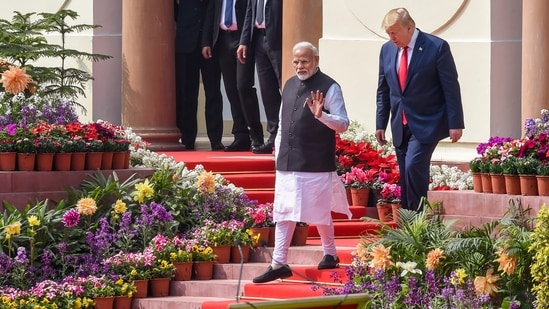
Prime Minister Narendra Modi with US President Donald Trump. (PTI File)
India and US@250: A friendship in America’s winter?
India is late to the “export to US and get rich” party
One trait the great economic historian Charles P. Kindleberger laid down for a global economic leader was a willingness to open its domestic markets to foreign exporters. For a large part of its period of dominance, especially post-war, the US did that for a range of countries—starting from Japan and ending with China—and made them rich in that process. India clearly missed out on this initial opportunity. Can it make up for this in its belated embrace of the US? The US is increasingly pivoting away from its willingness to welcome exports toward mercantilism. Opportunities, no matter how good a deal India strikes, will not be like the past now.
Joining the US gun-boat alliance might vitiate India’s guns versus butter balance
The US has shed a lot of its manufacturing advantage compared to the 1960s and 1970s. But there is one area where it is still a clear winner: selling military equipment to the rest of the world. A lot of the US advantage in arms exports is not just the cutting-edge weaponry it makes. It is also the breadth of the US security umbrella in the world. It is here that India has been the source of great frustration for the American military industrial complex. India, barring the sudden surge in Ukraine’s military buying recently, has been the biggest importer of military equipment in the world for a long time. But US has managed a very small share of the Indian market, which has historically been dominated by Russia. Even smaller countries, such as France and Israel sell more military hardware to India than the US does. Trump wants India to increase its military purchase of American hardware, but it will also mean buying more expensive arms. This will test India’s already precarious guns versus butter balance and the tension will continue to haunt Indo-US relations.
Neither of the two means India can afford to decouple from the US
Can India become agnostic to the US at a time when it has little to offer in terms of export markets, and is forcing India to buy expensive weaponry and other American things? Anybody who thinks so is only seeing half of the problem. India might not have aced the merchandise trade route to the US, but it has made large gains from the human resource/service export route to the US. Not only has it created an extremely prosperous cohort of Indian Americans in the US -- among the most well educated and wealthy in all of America -- it has also gained a large number of jobs in the Indian economy in sectors such as, but not only, IT thanks to this demographic alliance. The process has brought large incomes via the service export/remittance route. Any rash decoupling with the US can seriously jeopardise these gains. This is especially the case, because India is unlikely to have even a fraction of the warmth it still has with the US with China, the only country which can replace the US’s dominance in technological knowledge. China has had a history of military conflict with India, continues to have a border dispute and is extremely unlikely to be welcoming of foreign migrants like the US is even today, despite all its recent misgivings.
Roshan Kishore is the Data and Political Economy Editor at Hindustan Times. He heads the newsroom's data journalism team, which produces Number Theory, a daily data-driven feature for the print edition and the HT app. Number Theory uses data analysis and story-telling based on it to add value to the newsroom’s daily coverage by putting stories in a larger context on a range of issues, including politics, macroeconomy, markets, global affairs and climate. Under his leadership HT’s data journalism work has established itself as a niche product in Indian journalism and pushed the boundaries of marrying academic rigour with news sense and speed. Along with writing and editing data stories, he has also been writing a weekly political economy column called Terms of Trade for HT Premium. A trained economist with an MPhil degree from Jawaharlal Nehru University, Kishore has also been a visiting fellow at the Centre for Advanced Studies of India (CASI) at the University of Pennsylvania. Along with his journalistic work, his writings have also appeared in journals such as the Economic and Political Weekly and working papers for CASI and UNESCAP.
Sreedev Krishnakumar is a data journalist who specialises in stories at the intersection of the economy, geopolitics, politics and finance. His work combines data analysis, reporting and visual storytelling to explain complex issues through evidence-based journalism, with a focus on making public data accessible and meaningful for readers. He joined the Data and Political Economy team at Hindustan Times in 2024 after working as a correspondent/data journalist at Moneycontrol, where he covered macroeconomics, markets, public finance and business. Over the course of his career, he has developed expertise in analysing large datasets, building interactive visualisations and using computational methods to uncover trends and patterns that inform public debate. Sreedev holds a Postgraduate Diploma in Integrated Multimedia Journalism from the Asian College of Journalism. His reporting interests include finance, economics, geopolitics, trade, technology and development.
Unlock a world of Benefits with HT! From insightful newsletters to real-time news alerts and a personalized news feed – it's all here, just a click away! -Login Now!
Unlock a world of Benefits with HT! From insightful newsletters to real-time news alerts and a personalized news feed – it's all here, just a click away! -Login Now!
Home/Editors Pick/India and US@250: A friendship in America’s winter? | Number Theory
{{^htLoading}}
Advertisement
{{/htLoading}}
SHARE THIS ARTICLE ON
{{#usCountry}}{{/usCountry}}
Notifications
Get breaking alerts directly from the newsroom
Notifications are on!You'll be notified when news breaks