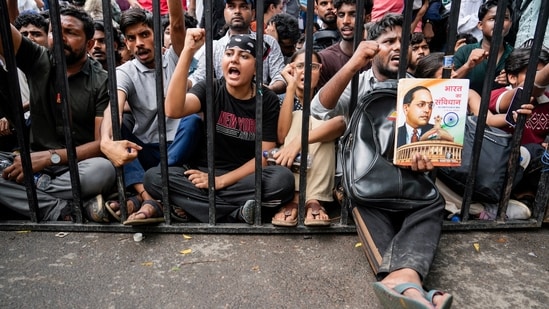
The recently concluded students’ protests in India under the banner of the “Cockroach Janata Party” were the biggest in a long time in the country. They were also remarkable in another respect. The defining C in Indian politics, namely caste, did not exist as an antagonistic fault line in this movement. By contrast, two of India’s biggest students’ unrests were built exclusively along caste lines, when the V.P. Singh and Manmohan Singh governments implemented Other Backward Class (OBC) reservations in
Cockroach Janata Party supporters raise slogans at Jantar Mantar in New Delhi. (PTI)
Locating the other C(aste) in the Cockroach movement
Upper castes have a bigger relative share in the ranks of unemployed and out-of-labour-force in India than SC, ST or OBCs
Reservations are now widely accepted as a fait accompli in India irrespective of one’s ideological position. That the current government also rolled out reservations for Economically Weaker Sections (EWS) among communities ineligible for caste-based reservations in 2019, and that this evoked almost unanimous support across political lines, was essentially a rejection of the so-called meritocratic (and pejorative) argument against reservations. With the debate largely settled on reservations, students are perhaps more focused on the state of play as it exists. Here, the so-called upper caste students – those who do not belong to Scheduled Caste (SC), Scheduled Tribe (ST) or OBC groups – have reason to believe that they are the worst affected by the broken link between India’s education and employment as their relative share (adjusted for share in population) is the highest among major groups in both unemployed and out-of-labour-force population. To be sure, this lack of privilege comes from a privilege, as explained below.
Among the college educated, the probability of being unemployed flips against SC-ST-OBCs
As we explained in these pages last week, unemployment in India is primarily a result of holding out for a job that matches expectations. Education is a key driver of such expectations. If one were to compare social-group-wise relative share among the unemployed among the college educated, it is the SC, ST, OBCs who do badly than the non-SC-ST-OBCs. The latter group, in fact, is the least likely to be unemployed, underlining the socio-economic hierarchy in India. The short point is that educated communities eligible for caste-based reservations are also angry with the education system.
Upper castes also perform well in getting quality jobs both in government and private sector
A basic social disaggregation of jobs data makes this clear. If one were to look at relative share in best quality and worst-quality government and private salaried jobs in India, the basic social hierarchy remains intact. Non-SC-ST-OBC workers have a larger relative in share in best quality jobs – which offer a written contract, paid leaves or social security – in both government and private sector and the lowest relative share in worst quality salaried jobs which offer none of these perks. On the other hand, SCs fare the worst on this count in both government and private jobs.
Conclusion
Because the recent protests were triggered by paper leaks for medical entrance exams, they were seen as misappropriation of the cake itself rather than a skewed distribution of it in favour of one social group or another. This might explain its pan-caste appeal rather than the movement being antagonistic toward one social group or another. As the data above shows, when the issue at hand seems to be hurting everyone equally then Indian society and its youngest stakeholders are capable of burying their distributional hatchet – otherwise justified by objective data – to mount a wider challenge to the government. This is exactly what makes dissatisfaction around conduct of examinations a big threat to the government of the day: it can transcend both cynical and justified social fissures to show unprecedented momentum.
Roshan Kishore is the Data and Political Economy Editor at Hindustan Times. He heads the newsroom's data journalism team, which produces Number Theory, a daily data-driven feature for the print edition and the HT app. Number Theory uses data analysis and story-telling based on it to add value to the newsroom’s daily coverage by putting stories in a larger context on a range of issues, including politics, macroeconomy, markets, global affairs and climate. Under his leadership HT’s data journalism work has established itself as a niche product in Indian journalism and pushed the boundaries of marrying academic rigour with news sense and speed. Along with writing and editing data stories, he has also been writing a weekly political economy column called Terms of Trade for HT Premium. A trained economist with an MPhil degree from Jawaharlal Nehru University, Kishore has also been a visiting fellow at the Centre for Advanced Studies of India (CASI) at the University of Pennsylvania. Along with his journalistic work, his writings have also appeared in journals such as the Economic and Political Weekly and working papers for CASI and UNESCAP.
Abhishek Jha is Assistant Editor-Data at Hindustan Times. He uses statistical programming to generate newsworthy insights from large datasets. He is part of the team that produces Number Theory, a daily data story feature of the paper’s print edition. Since March 2024, he has been writing Weather Bee, a weekly column for the Hindustan Times website. He is a chemical engineer by training, who specialises in stories related to weather, climate, and the environment. Jha has been at HT since 2018, where he offers data-driven perspective and analysis on politics, environment, weather, climate, economy and society. His work includes data coverage of elections in India and abroad, including the 2019 and 2024 Lok Sabha elections; the disasters and extreme weather resulting from changing climate, such as floods, droughts, heat waves, cold waves, and dwindling snow cap in the Himalayas; the factors that drive poor air quality in northern India; the changing patterns of land use; the Covid-19 pandemic and its impact on labour market conditions; the changing pattern of consumer spending seen in the new consumer spending surveys; and social norms seen in the surveys such as the National Family Health Survey.
Unlock a world of Benefits with HT! From insightful newsletters to real-time news alerts and a personalized news feed – it's all here, just a click away! -Login Now!
Unlock a world of Benefits with HT! From insightful newsletters to real-time news alerts and a personalized news feed – it's all here, just a click away! -Login Now!
Home/Editors Pick/Locating the other C(aste) in the Cockroach movement | Number Theory
{{^htLoading}}
Advertisement
{{/htLoading}}
SHARE THIS ARTICLE ON
{{#usCountry}}{{/usCountry}}
Notifications
Get breaking alerts directly from the newsroom
Notifications are on!You'll be notified when news breaks