
 E-Paper



Monsoon rain headline numbers are misleading | Number Theory
.
Updated on: Jun 27, 2025, 08:39:32 IST

 Prefer HTon Google
Share via


Copy link

The southwest monsoon season --- it runs officially from June to September and accounts for 75% of India’s annual rainfall --- is about to complete its first month. A summary analysis of the monsoon’s performance this year shows that India has had 10% surplus rainfall this season so far. But there is more than one reason why this number could be misleading.

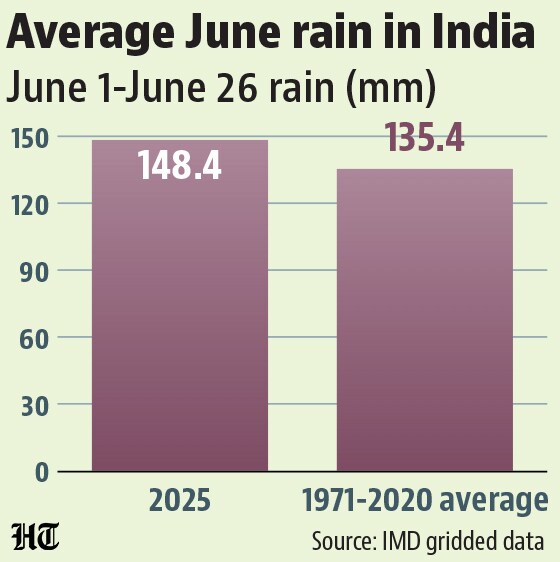
 Overall, India has around 10% surplus rainfall until June 26Up to June 26 (the weather office publishes rainfall data for 24-hour periods ending at 8.30am on a particular date), India received 148.4mm rain this month, according to the gridded data of the India Meteorological Department (IMD). This is 9.6% more than the 1971-2020 average for the first 26 days of June, and the 36th highest rainfall for this part of June since 1901, the earliest year for which IMD has published gridded data. If one were to make recent comparisons, the 2025 monsoon performance is only the best after 2021 for the same period. The IMD considers the 1971-2020 average as the Long Period Average (LPA) of rain currently, and uses it to track the performance of rain. Chart 1:
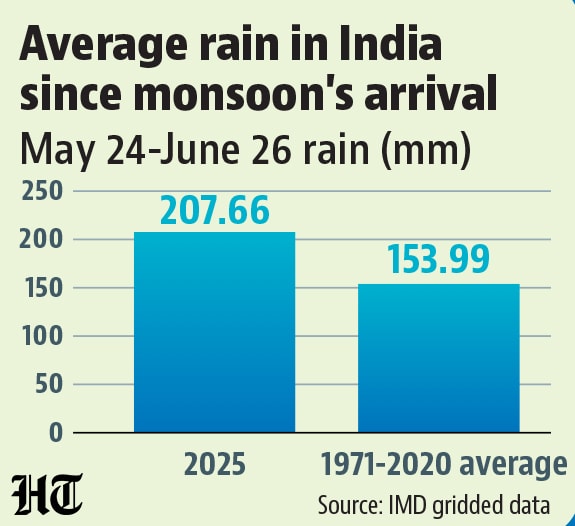
- But actual monsoon rainfall is higher once we factor in the early arrival of the monsoonThe monsoon arrived on May 24 in Kerala this year. This means that the June 1 threshold actually excludes eight days of monsoon rainfall. If one were to look at the performance of cumulative rain from May 24, the early arrival has indeed created a big surplus in the 34-day period since May 24. May 24-June 26 rain is 34.9% more than the LPA for this period, and the sixth highest rain for this 34-day period. See Chart 2:
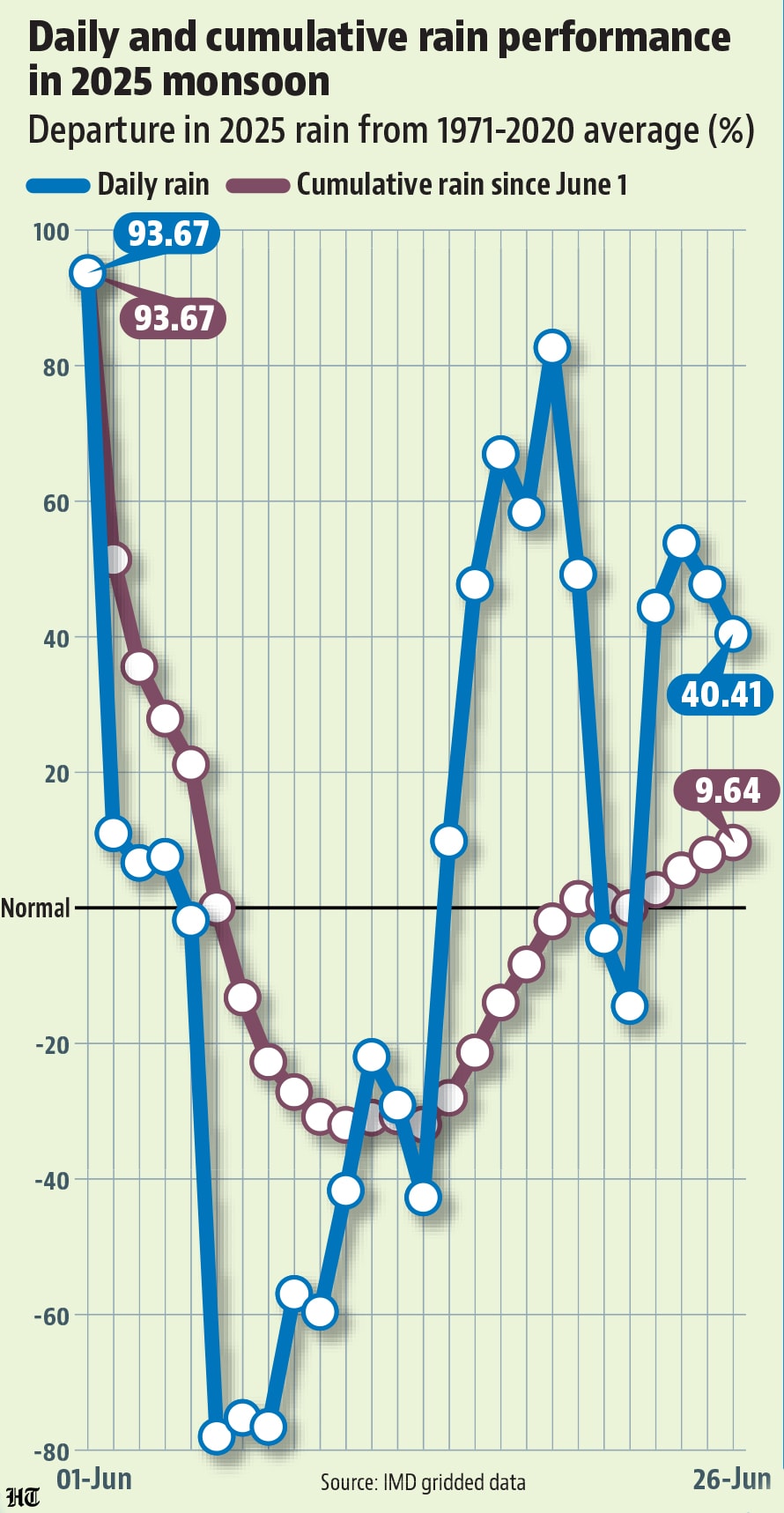
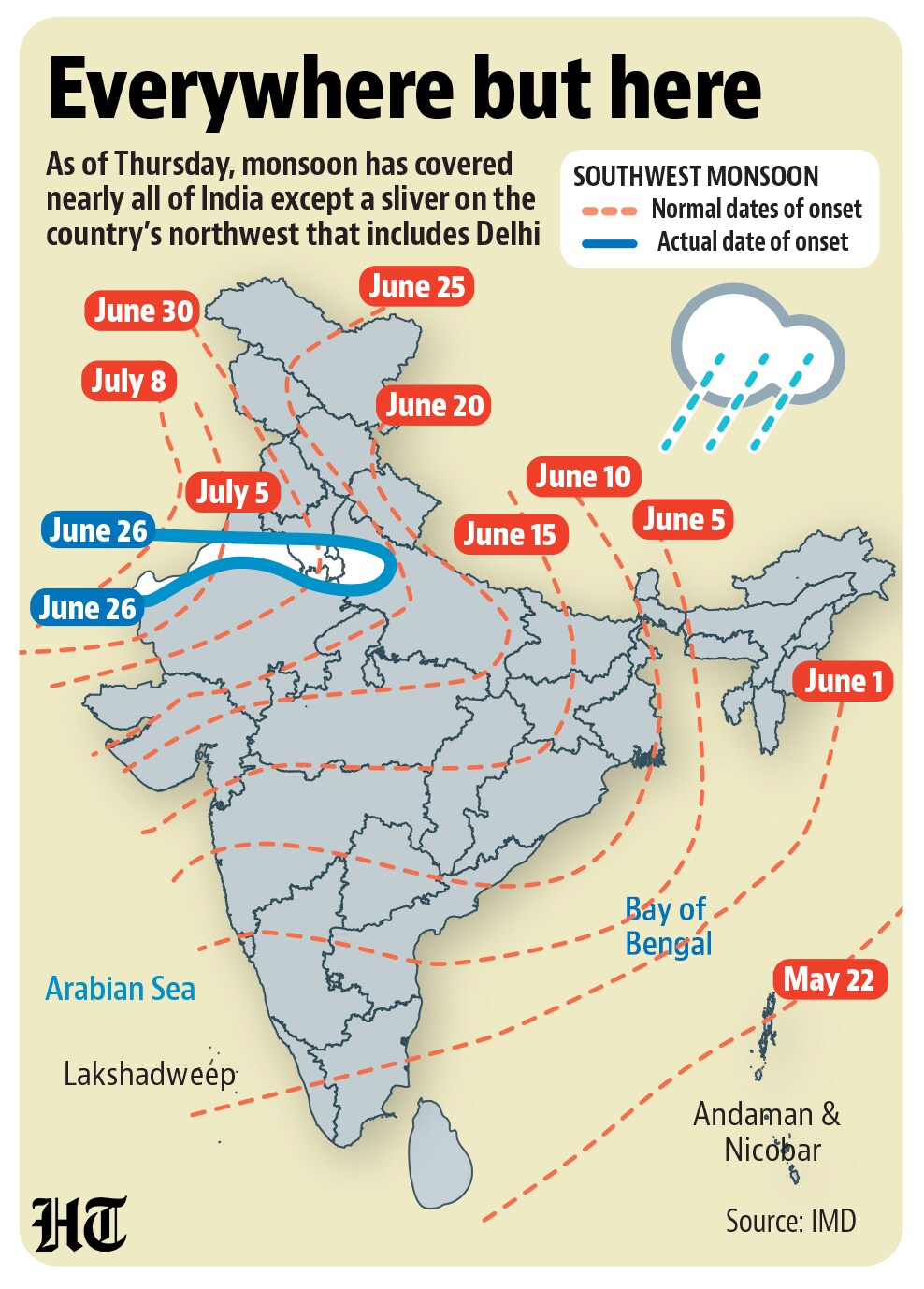
- The monsoon arrived early but stalled for almost 20 daysAfter its early arrival in Kerala and rapid progress up to Maharashtra on the west coast and north-eastern states on the east – the monsoon is expected to cover India like a parabola – it suffered a long stall and stayed stationary for 20 days up to June 15. While IMD does not publish long-term statistics on monsoon’s arrival in different parts of the country, a visual inspection of IMD’s onset maps since 1961 (some of these are illegible and smudged) suggests 2025 may have seen the ninth longest pause in monsoon’s advance since 1961, the earliest year for which the map was available. This is in keeping with the fact that daily trends in June rain show big deficits from June 6 to June 15, when the eastern arm of the monsoon should have made progress over parts of Bihar but did not. The 9.6% surplus overall exists despite the pause because the monsoon made rapid progress and early onset over the remaining parts of the country after June 15, which led to big surpluses in daily rain. Chart 3
- What we have as a result is a large geographical skew in rainThis fact does not change whether one is looking at June 1-June 26 rain or May 24-June 26 rain, although the latter period shows a larger area being very wet compared to the former. The May 24-June 26 period shows 52% of the area with a surplus of 20% or more, which is considered “excess” or “large excess” in IMD’s classification of local rain. On the other hand, 24% of the country’s area has a deficit of 20% or more, considered “deficient” or “large deficient”. In June rain, the area under the different excess categories is 37% and that under the different deficient categories is 39%. The big surplus areas in June are largely places where the arrival this year happened in the June 16-June 26 period, but where the normal arrival date is in late June to early July, such as western and central regions. The month is dry in places where either the arrival happened on time in June (such as Bihar and eastern Uttar Pradesh) or where the arrival happened before June, such as north-eastern states, the peninsular region, and interior Maharashtra. The latter look less dry when one is looking at the cumulative rain from May 24.


Unlock a world of Benefits with HT! From insightful newsletters to real-time news alerts and a personalized news feed – it's all here, just a click away! -Login Now!


