E-Paper



Number Theory: A complex poll contest takes shape in Maharashtra
.
Published on: Nov 19, 2024, 09:49:18 IST

 Prefer HTon Google
Share via


Copy link

All 288 assembly constituencies (ACs) in Maharashtra go to polls on Wednesday. Maharashtra’s political landscape, thanks to a political realignment – Shiv Sena quit the National Democratic Alliance (NDA) after the 2019 assembly elections to join the Congress and the Nationalist Congress Party (NCP) – and the subsequent splits in the Shiv Sena and the NCP – a faction each is allied to the Congress- and BJP-led alliances – has become extremely complicated. How have these events this changed the state of play as far as the elections are concerned? Here are four charts that try to answer this question.
A complex poll contest takes shape in Maharashtra
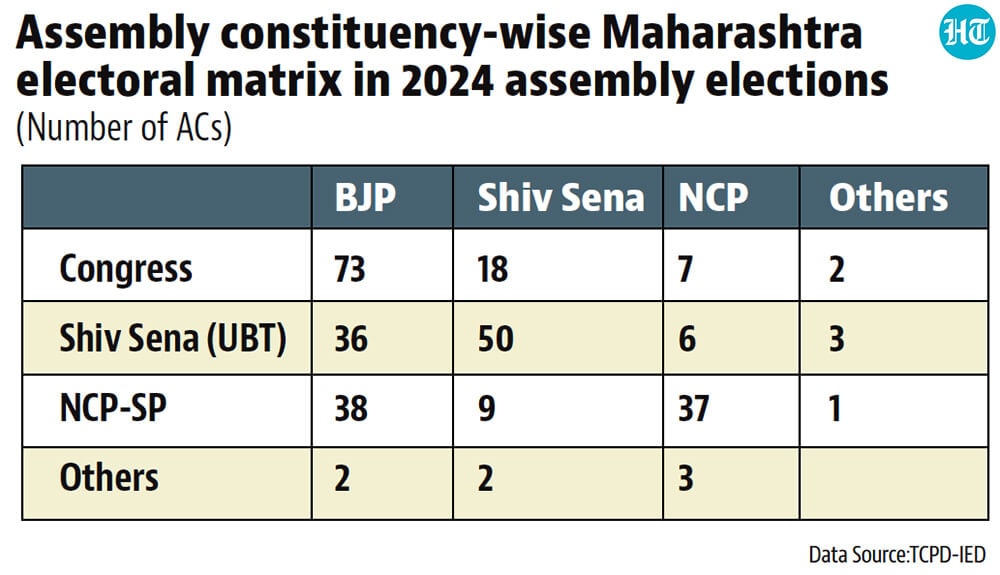
 One in every four contests is Congress vs BJP, but the Sena vs Sena and NCP vs NCP battles will play out in a larger number of ACsOne of the most useful ways to look at the Maharashtra contest this time is to make a matrix of AC-wise contests between the two alliances -- the Congress-led Maharashtra Vikas Agadi (MVA) and the BJP-led Mahayuti. The party contesting the maximum number of ACs in these elections is the BJP (149), followed by the Congress (100). In terms of contests, about 25% of the ACs (73) will see a direct fight between the Congress and the BJP. The second largest number of contests (50 ACs) is between the Shiv Sena and the Shiv Sena (Uddhav Balasaheb Thackeray) faction. Another 37 ACs will see a contest between the NCP and the NCP (Sharadchandra Pawar) . This means that the battle between the newly created factions of the Shiv Sena and the NCP will be even more important in these elections.
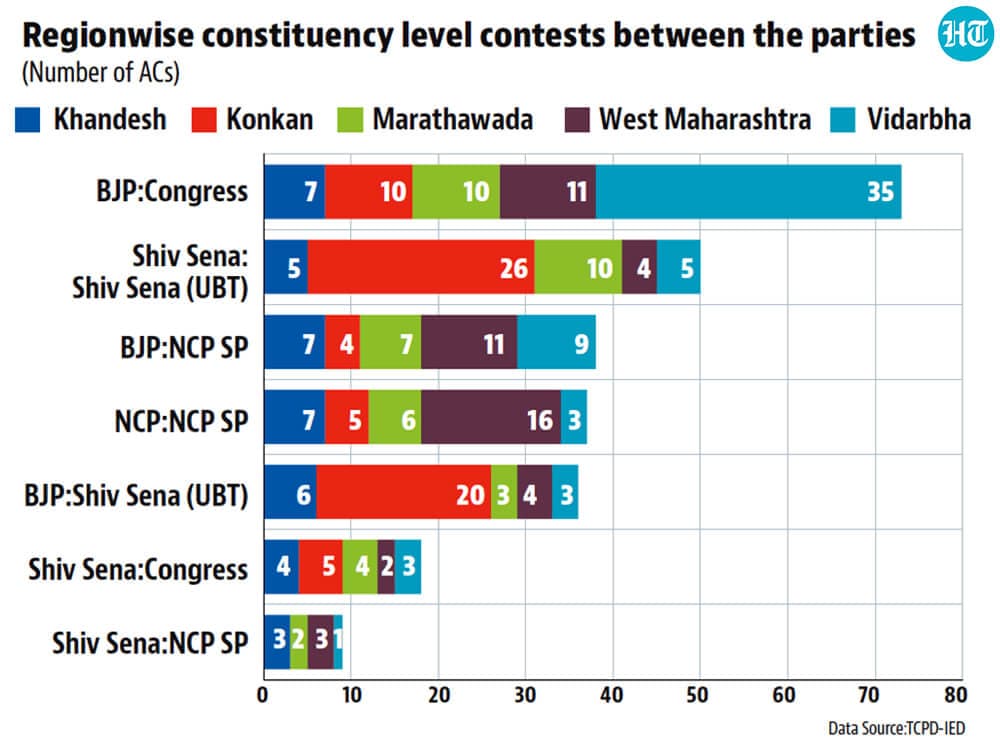
- There is also a regional aspect to the party-wise contests in MaharashtraMaharashtra can broadly be divided into five subregions -- Khandesh, Konkan, Marathawada, West Maharashtra, and Vidarbha. The Khandesh subregion comprises of the districts in northern Maharashtra such as Dhule, Nandurbar, Jalgaon, and parts of Nashik and Ahmednagar districts. Konkan and Vidarbha are the biggest subregions with 75 and 62 ACs respectively. Khandesh, Marathawada and Western Maharashtra have 47, 46, and 58 ACs respectively. Almost half of the Congress vs BJP contests are the in the Vidarbha region. Similarly, more than half of the Sena vs Sena contests are in the Konkan and Marathwada regions; and around half of the NCP vs NCP contests are in Western Maharashtra.
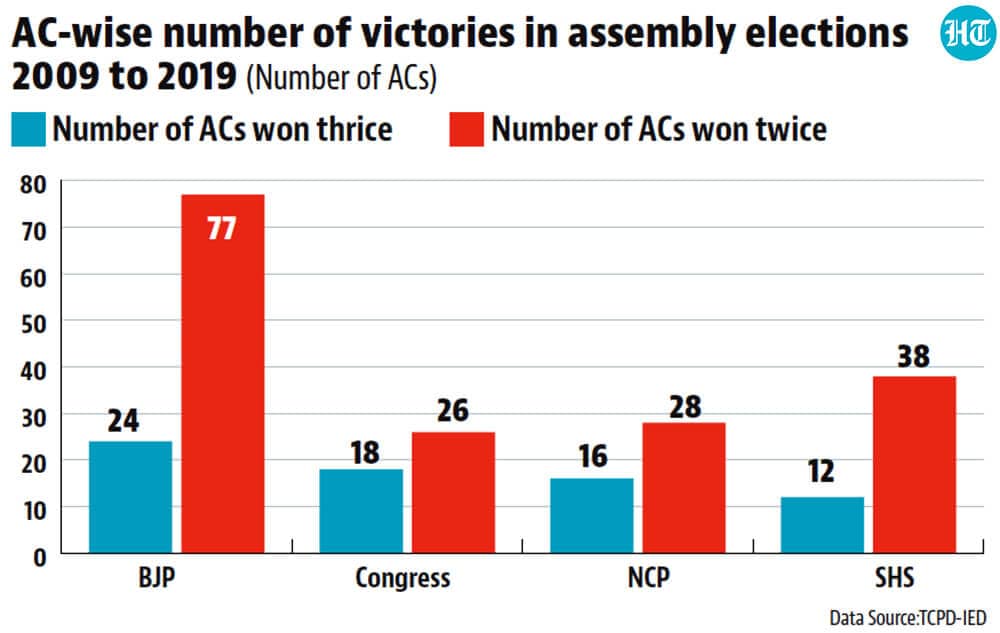
- There are very few AC-wise strongholds in MaharashtraHow many of Maharashtra’s 288 ACs are bastions for one political party? HT looked at the ACs that were won by one party in the three assembly elections from 2009 onwards. This number is 24 for the BJP, 18 for the Congress, and 16 and 12 for what used to be the united Shiv Sena and the NCP respectively. This means that the total number of ACs where the same party has been elected in the 2009, 2014 and 2019 elections is just 70 in an assembly of 288. To be sure, this number could have been higher if the four major parties in the state had not contested on their own in the 2014 elections. If we exclude the 2014 assembly elections, there are 28, 29, 17, and 28 ACs ( a total of 102) that the Congress, BJP, united NCP and united Shiv Sena won in 2009 and 2019.
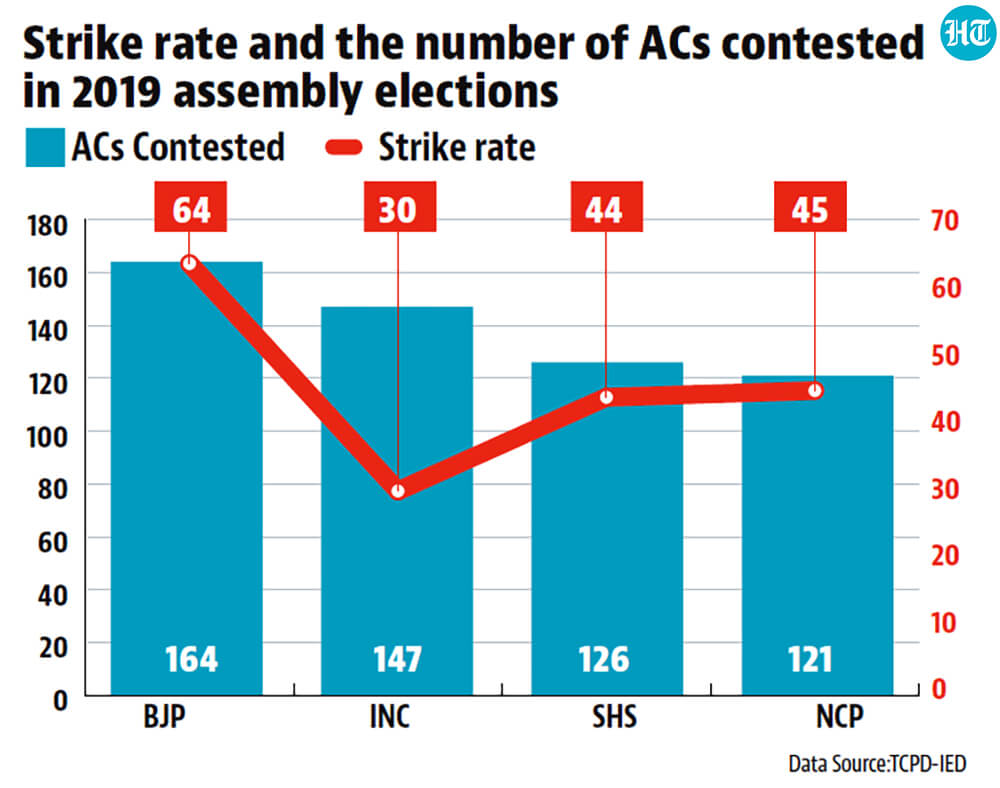
- 2019 laid the ground for the political fragmentation of 2024The numbers given above explain in detail how the final outcome in Maharashtra will depend on several factors. While the factional battles and new tailwinds and headwinds as a result of shift in political loyalties will play an important role, one-fourth of the state’s ACs will see a contest between the two national parties. It is useful to end with a recap of what happened in the 2019 elections in the state. The BJP ended up with the best strike rate (seats won as a share of seats contested) and the highest tally among the four major parties in the state. And yet, it failed to come close to the halfway mark of 144. This encouraged the Shiv Sena to demand the chief minister’s post in the alliance. What eventually happened was a post-poll alliance between the Shiv Sena, NCP and the Congress. Among the four major parties, the Congress had the lowest strike rate and seat count. In hindsight, the BJP’s entire strategy of breaking the Shiv Sena and the NCP is to prevent a similar collusion from happening after these elections. Whether this will work or not will become clear on November 23.