E-Paper



Number Theory: An electoral history of Jammu and Kashmir decoded in 3 charts
.

 Prefer HTon Google


The Union territory (UT) of Jammu and Kashmir is set to hold its first assembly elections in three phases on September 18, September 25 and October 1. The UT of Jammu and Kashmir as it exists today, used to be a full-fledged state along with what is now the UT of Ladakh. The erstwhile state of Jammu and Kashmir was downgraded into two UTs after the union government abrogated Article 370 in 2019.
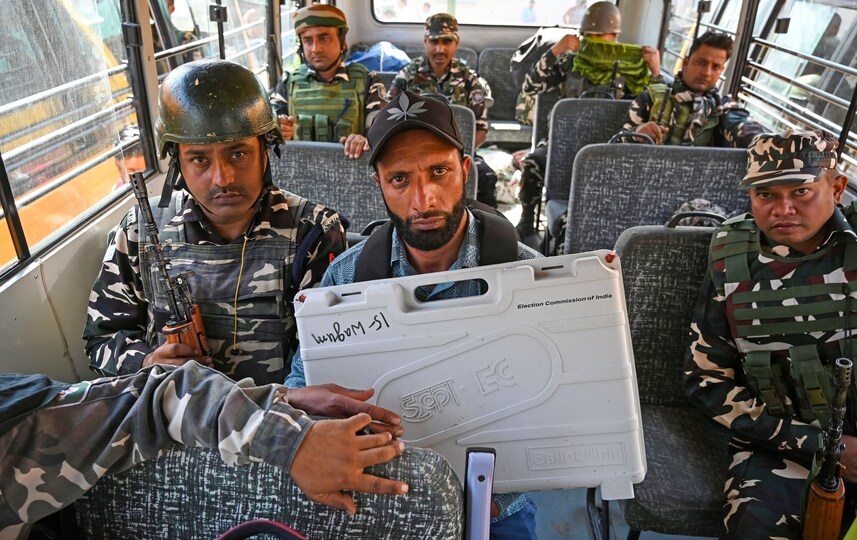
While Jammu and Kashmir did not have elections between 1987 and 1996 because of militancy in the state, the period since 2014, when the last assembly elections were held in the state, is the longest the state (now UT) has gone without an election. The 2024 assembly elections are also happening after a delimitation exercise which has made assembly constituency (AC) boundaries non-comparable from past elections. While the delimitation factor makes comparison of AC-based results impossible, it is useful to look at a long-term history of electoral competition and participation in Jammu and Kashmir.
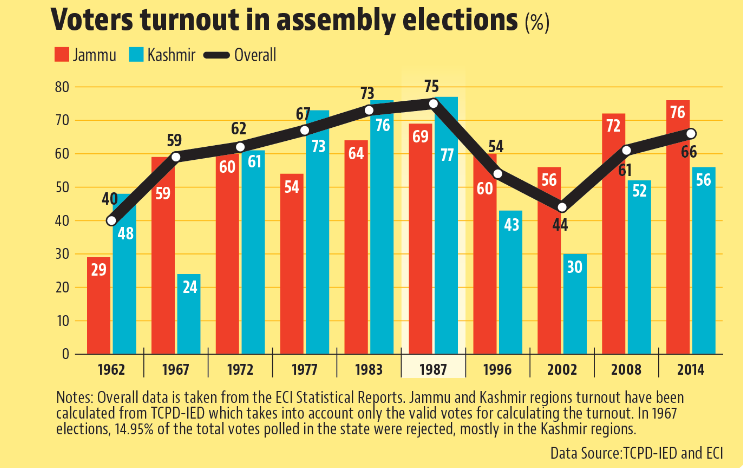
 Voter turnout in the Kashmir region has never returned to pre-militancy levelsBecause Jammu and Kashmir has had a chequered political history, first on account of rifts between central and state governments and then because of the secessionist militant violence, voter turnout in elections has always been taken a key metric of popular endorsement of Indian democracy. An HT analysis past elections from Ashoka University’s Trivedi Center for Political Data (TCPD) shows that voter turnout in the period after the onset of militancy in the state fell sharply even after the restoration of elections in 1996. This trend reversed itself from 2008, and the 2014 election voter turnout was the highest since 1987 in the state. To be sure, a region-wise break-up of voter-turnout data shows that turnout in the Kashmir region (which is where the militancy began) has never reached pre-militancy levels. In the 2024 Lok Sabha elections, voter turnout in the UT of Jammu and Kashmir was 58.46%.
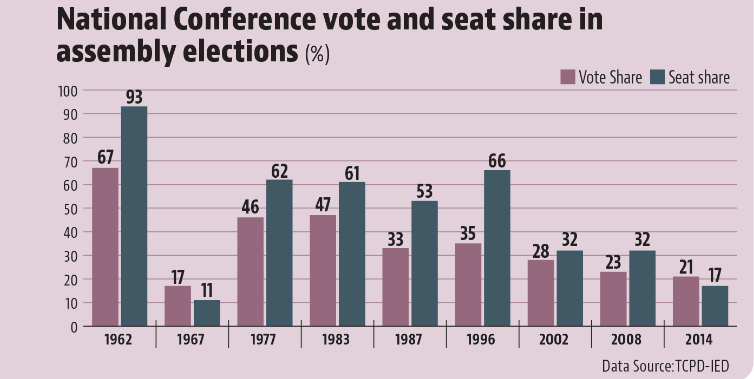
- National Conference losing its dominance over J&K’s politics is the most discernible long-term trendSheikh Abdullah, who founded the National Conference (NC), is the most important political figure in the history of Jammu and Kashmir’s politics. While Abdullah and his party had multiple instances of cooperation and disagreement with the union government, his party’s popularity in the state has been falling when seen from a long-term perspective. National Conference’s vote share fell from more than two-third in 1962 to just about one-fifth in the 2014 elections. A region-wise break-up of the NC’s performance shows that its erosion of support has been more consequential in the Kashmir region in the post-militancy period, as the NC has not been able to win a majority of seats in the Kashmir region in any election since 1996.
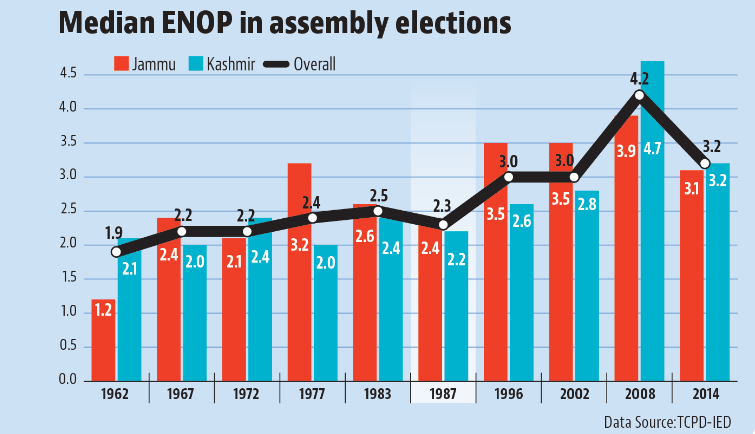
- Ja&K’s politics became more fragmented in the post-militancy periodThis seems to be the case whether one looks at it technically or politically. The median value of the Effective Number of Participants (ENOP) in the state has always been under three in the elections between 1962 and 1987. This number has been above three in every election since 1996 and actually crossed four in the 2008 elections. ENOP is the reciprocal of the sum of squares of the vote share of all candidates in a constituency, and a higher value indicates greater political fragmentation in the elections. For example, if there are four candidates in a constituency and they receive 26%, 25%, 25%, and 24% of the votes, the ENOP value will be 3.99. If these vote share numbers change to 50%, 45%, 3%, and 2%, ENOP will fall to 2.2. When seen in terms of political partywise break-up of the results, the 2008 and 2014 elections saw the BJP win 11 and 25 ACs in the state, all of which were in the Jammu region. In 2014, the BJP was closely tied with the People’s Democratic Party (PDP) in a hung assembly. In the 2014 elections, BJP had an overall vote share of 22.98%. It had a vote share of 40.2% in the Jammu region and just 2.24% in the Kashmir region of the erstwhile state. NC had a vote share of 14.4% and 29.2% in the Jammu and Kashmir sub-regions respectively in the 2014 elections while the same numbers for PDP were 11% and 37.4% respectively. Both NC and PDP had a seat share of 8.11% in the Jammu regions while the same numbers for Kashmir regions were 26.1% and 54.4%.