E-Paper



Number Theory: Can AAP-Congress alliance hurt the BJP in Delhi?
When the AAP fought its first Lok Sabha elections in 2014, Delhi saw its most multipolar Lok Sabha contest since 1991.
Published on: May 24, 2024, 08:57:49 IST

 Prefer HTon Google
Share via


Copy link

The Aam Aadmi Party (AAP), the Bharatiya Janata Party (BJP) and the Congress – the three main parties in Delhi – have so far fought elections without any pre-election understanding with each other. This has resulted in landslide victories for the BJP in 2014 and 2019 Lok Sabha elections and for the AAP in 2015 and 2020 state elections. Will the AAP and the Congress forming a pre-poll alliance change this equation in the 2024 Lok Sabha elections? Here are four charts that try to answer this question.
Can AAP-Congress alliance hurt the BJP in Delhi?
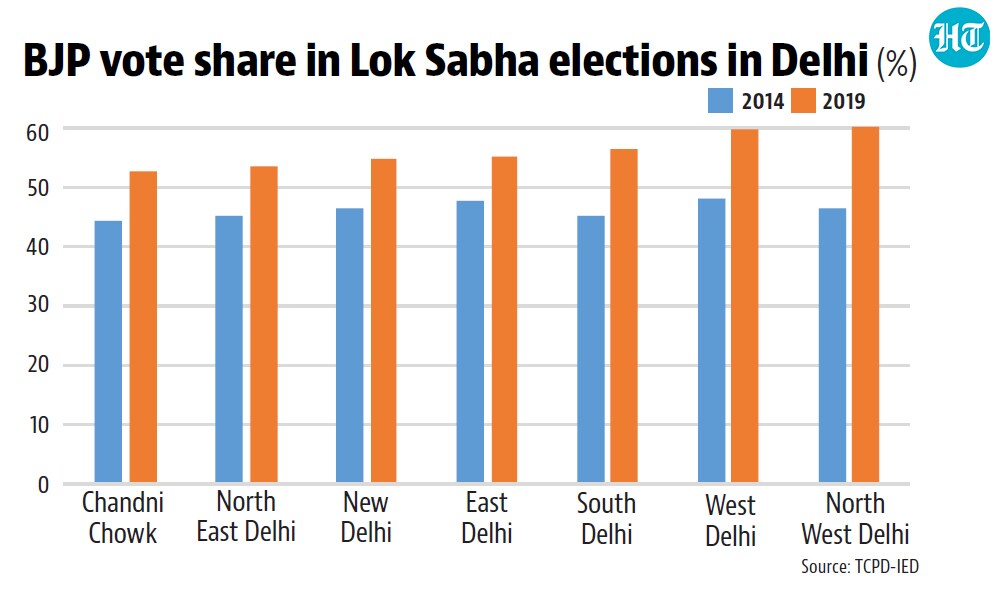
 Although BJP swept both 2014 and 2019 Lok Sabha elections in Delhi, its 2019 victory was much biggerBJP’s 100% strike rate in Delhi’s seven parliamentary constituencies (PCs) in the past two Lok Sabha elections does not mean that it won both these elections with a similar level of support. It increased its vote share from 46.4% in 2014 to 56.6% in 2019. A more important trend from the perspective of the AAP-Congress alliance is that the BJP increased its vote share in all PCs to more than 50%. This means that the BJP would win all seven Delhi PCs in 2019 even if all non-BJP parties came together. This was not the case in 2014, when the combined AAP-Congress vote share was ahead of the BJP in all PCs except West Delhi. These statistics suggest that the arithmetic of anti-BJP parties coming together alone cannot defeat the BJP in Delhi.
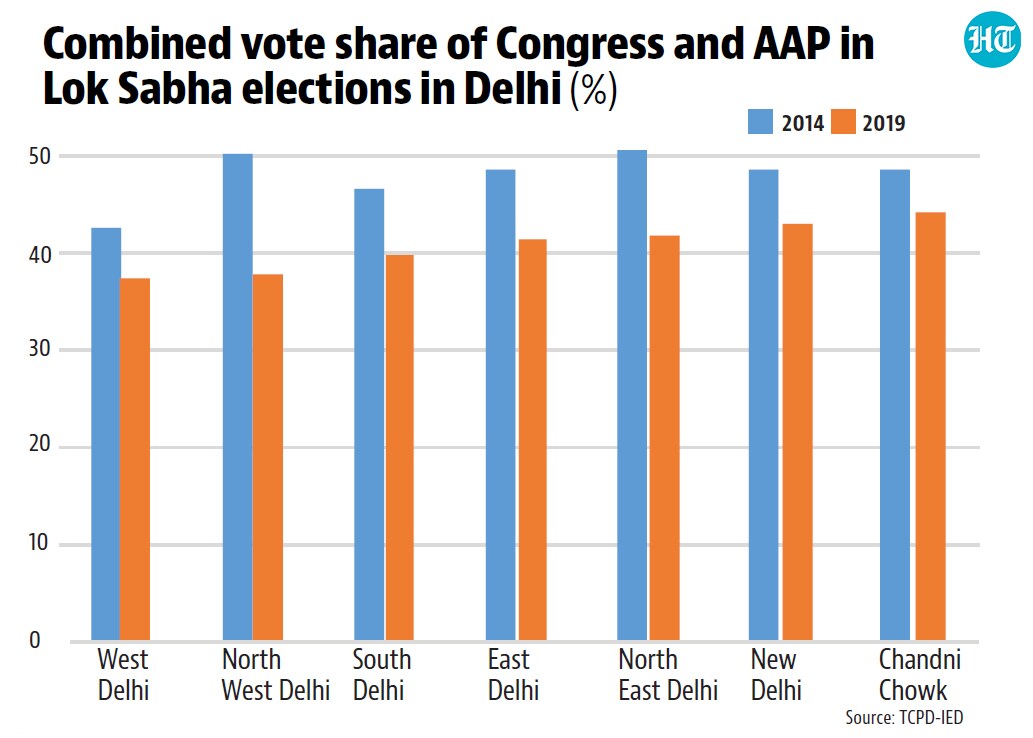
- Did the Congress and AAP retain their combined support between 2014 and 2019?How did the BJP increase its vote share between 2014 and 2019? Theoretically it was possible for the BJP to increase its vote share without the Congress and the AAP losing vote share. This is because even parties other than the three main ones held a significant 5.5% vote share in 2014. However, it is unlikely that the BJP increased its vote share by just winning over such voters. The PC-level gains made by the BJP are far more than the loss of vote share of non-BJP/AAP/Congress parties. Moreover, the combined vote share of the Congress and the AAP decreased in each PC between 2014 and 2019 – between 4.3 percentage points (Chandni Chowk) and 12.3 percentage points (North West Delhi). This suggests another challenge for the AAP-Congress in Delhi. The alliance needs to win back voters that possibly deserted it for the BJP between 2014 and 2019.
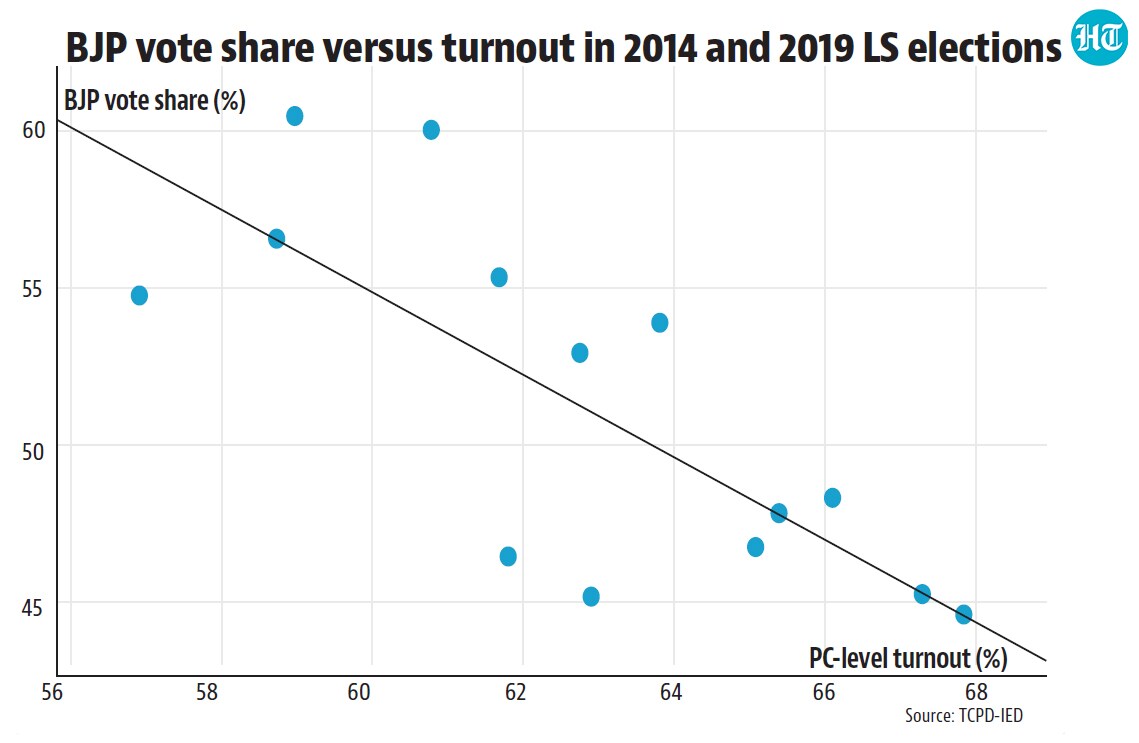
- Is there a relationship between turnout figures and the BJP’s performance?Though the numbers shown above suggest that the AAP and Congress taken together lost some of their supporters to the BJP between 2014 and 2019, this conclusion assumes that turnout changes between 2014 and 2019 were agnostic of party allegiances. That may not necessarily be the case in Delhi. The PC-level turnout in Delhi since 2013 – whether analysed for Lok Sabha elections, state elections, or the two taken together – has a moderate and inverse correlation with the BJP’s vote share. 2013 is when the AAP fought its first elections in Delhi. This suggests that at least part of the BJP’s vote share gains in Delhi could be the result of its ability to get its voters to turn up at the polling booth and the failure of the anti-BJP parties to do so.
- The most certain outcome of the AAP-Congress alliance is the contest becoming bipolar againWhen the AAP fought its first Lok Sabha elections in 2014, Delhi saw its most multipolar Lok Sabha contest since 1991. The median Effective Number of Parties (ENOP) across Delhi’s seven PCs was 2.86 in that election, the highest since 1991. ENOP is the reciprocal of sum of squares of vote share of every candidate in a constituency. An example can make this clear. If a constituency has only three candidates and their vote shares change from 25%, 35% and 40% to 10%, 35% and 55%, the ENOP value will fall from 2.9 to 2.3. Therefore, when BJP consolidated its vote share further in 2019 and the non-BJP/AAP/Congress vote share decreased, ENOP decreased compared to 2019. To be sure, the 2.5 median ENOP in 2019 was still the highest since 1996. With two of the three main parties of 2014 and 2019 coming together in 2024, perhaps the most certain outcome of this election is that the contest will be more bipolar than in 2014 and 2019.