E-Paper



Number Theory: Caste calculus of the 2024 Haryana polls
Because Haryana does not have data on caste-wise population shares, it is not possible to account for their representation or lack of it.

 Prefer HTon Google


Haryana will elect a new assembly in a single-phase election on October 5. The last date for withdrawal of nominations was September 16 which means that candidate lists are now final. The 2024 elections in Haryana are seen as a direct contest between the ruling Bhartiya Janata Party (BJP) and the opposition Congress. The two parties won five Lok Sabha constituencies each in the 2024 general elections held earlier this year. And both the BJP and the Congress have fielded candidates in 89 assembly constituencies (AC) out of the 90. While the Congress has left the Bhiwani AC for its alliance partner Communist Party of India (Marxist) or CPI(M), the BJP withdrew its candidate from Sirsa in favour of Gopal Kanda, an independent candidate.
What does the caste calculus of the 2024 Haryana assembly contest look like? HT has done a candidate-caste matching of all 180 candidates from the BJP, Congress and their allies. Here is what the data shows.
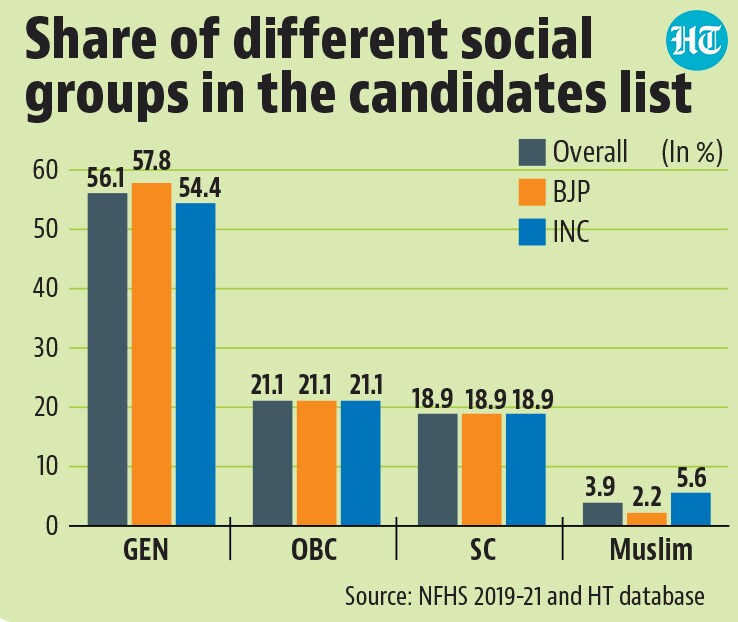
 Upper caste Hindus have a disproportionately large share among candidatesWhat is the broad social classification of 180 candidates from BJP and Congress and allies? 101 (56.1%) of them are Hindus who do not belong to Other Backward Classes (OBCs), Scheduled Castes (SC) and Scheduled Tribes (ST). 38 (21.1%) are Hindu OBCs, 34 (18.9%) are SCs and seven (3.9%) are Muslims. This analysis has not drilled down to a caste-wise breakup of Muslim candidates. How does this representation among candidates of two major parties compare to the overall composition of the population in Haryana? Indexing with data from the 2019-21 National Family and Health Survey (NFHS) shows that the relative share of non-SC-ST-OBC Hindus among BJP and Congress candidates is around 1.5, while this number is 0.9, 0.7,0.4 and 0.9 for Hindu OBCs, SCs and Muslims. The BJP has a slightly higher relative share of non-SC-ST-OBC candidates than the Congress. The two are at par in terms of relative share of SC (they have been fielded on 17 SC reserve ACs) and OBC candidates while the Congress is slightly ahead in terms of representation of Muslims. Relative share has been calculated by dividing the share of a social group in candidates with its share in the overall population. A relative share greater than one signifies over-representation while a share less than one would show underrepresentation.
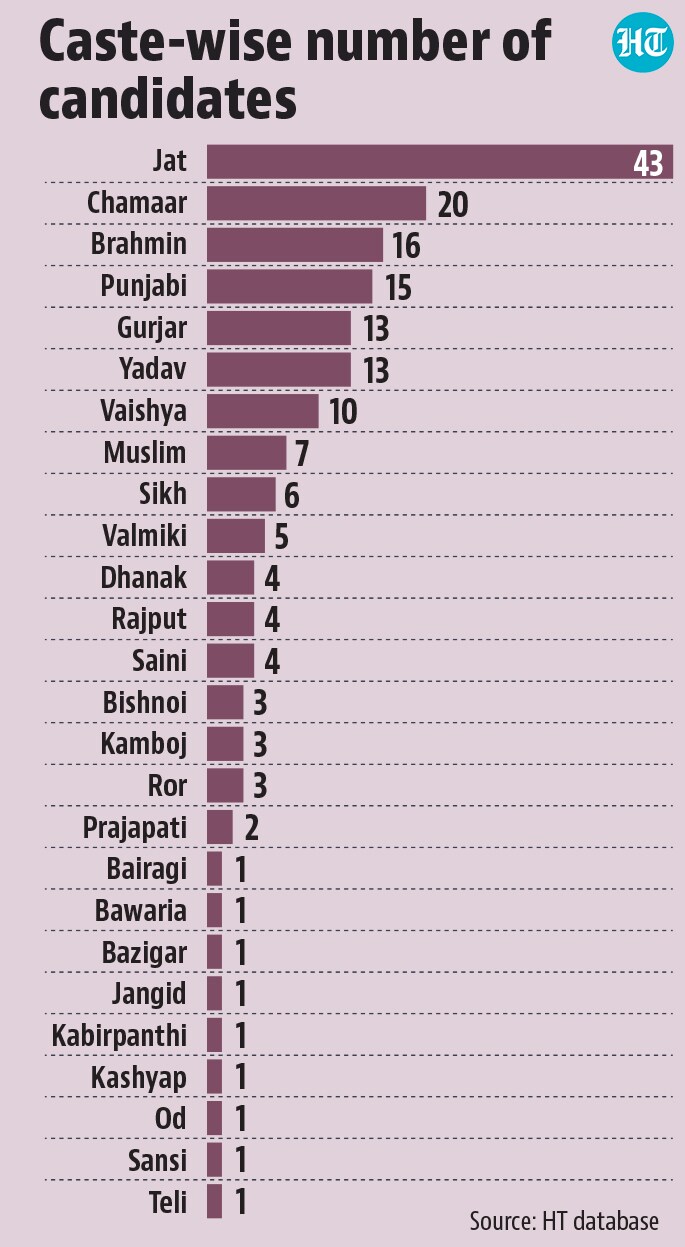
- Jats are the most dominant caste group in candidatesBroad social groups aside, what is the caste composition of candidates? Jats are the single largest group with 43 out of the 180 candidates which gives them a 24% share. The other caste groups by decreasing order of representation are Chamar (20), Brahmin (16), Punjabi-Hindus or Arora-Khatri (15), Gujrar (13), Yadav (13) and Vaishyas (10). No other caste groups have candidates in double digits in the candidates list. Just seven of the castes as mentioned above account for around 72.2% share of the total of 180 candidates fielded by the Congress and the BJP. A total of twenty-six castes are represented in the list of 180 candidates from BJP and Congress and alliances. Because Haryana does not have data on caste-wise population shares, it is not possible to account for their representation or lack of it at this level.
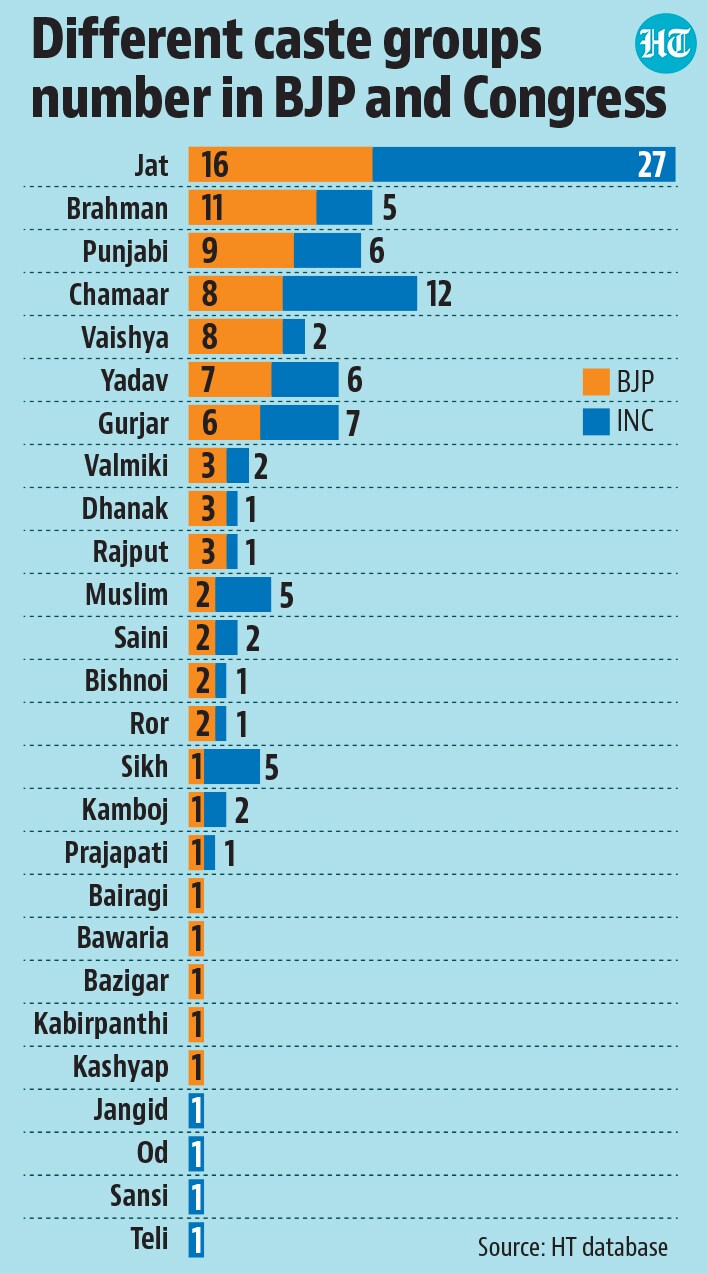
- Distribution of castes in BJP and Congress candidates listBoth the Congress and the BJP have given the maximum number of tickets to Jat candidates although the number is significantly higher for the Congress (27) than the BJP (16). The second most represented caste in the Congress’s list is Chamar (12) followed by Gurjar (7), Yadav (6), Punjabi Hindus(6) and Brahmin, Sikh and Muslims (5 each). Apart from Jats, the BJP has given most tickets to Brahmins (11), Punjabi Hindus (9), Chamar (8), Vaishyas (8), Yadav (7), Gurjar (6) and three each to Rajput, Valmiki and Dhanak, the last two being SC groups. What is interesting is the fact that the Congress has seen an increase in the number of Jat candidates between 2019 and 2024 (25 to 27) while the BJP has reduced this from 19 to 16.
- What is the caste equation at the level of assembly constituencies?Have BJP and Congress fielded candidates from the same or different caste groups at the constituency level? An AC-wise analysis shows that Jats are pitted against each other in 13 ACs, and Brahmins are pitted against Jats in 6 ACs. Yadavs are pitted against each other in 6 ACs while Chamar are contesting against each other in another 5 ACs. In three ACs each, Gurjars are contesting against each other, Vaishyas are contesting against Jats, and Valmikis are pitted against Chamars.
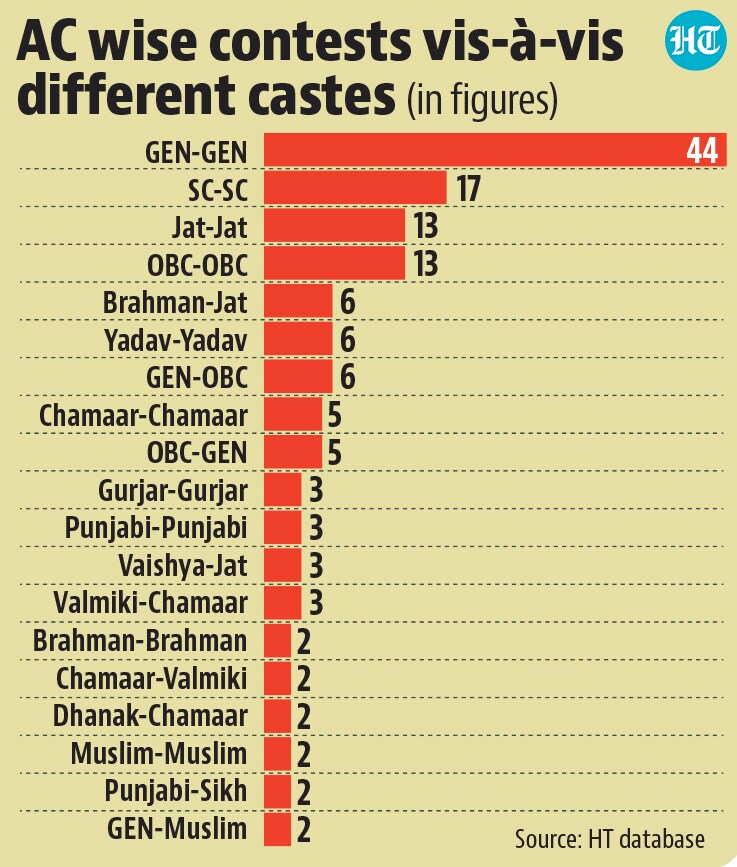
Anecdotal narratives about the Haryana contest suggest that the Congress is relying on the Jat voter base to a large extent. A caste-wise breakup of candidate data does suggest that the Congress has fielded more Jats than the BJP but it does have a lot of candidates from other castes too. Will this strategy along with a projected Jat chief minister help the Congress recapture Haryana or work to BJP's advantage once again? We'll know on October 8.