E-Paper



Number Theory: German snap polls — A crisis or opportunity?
.
Published on: Dec 18, 2024, 08:32:05 IST

 Prefer HTon Google
Share via


Copy link

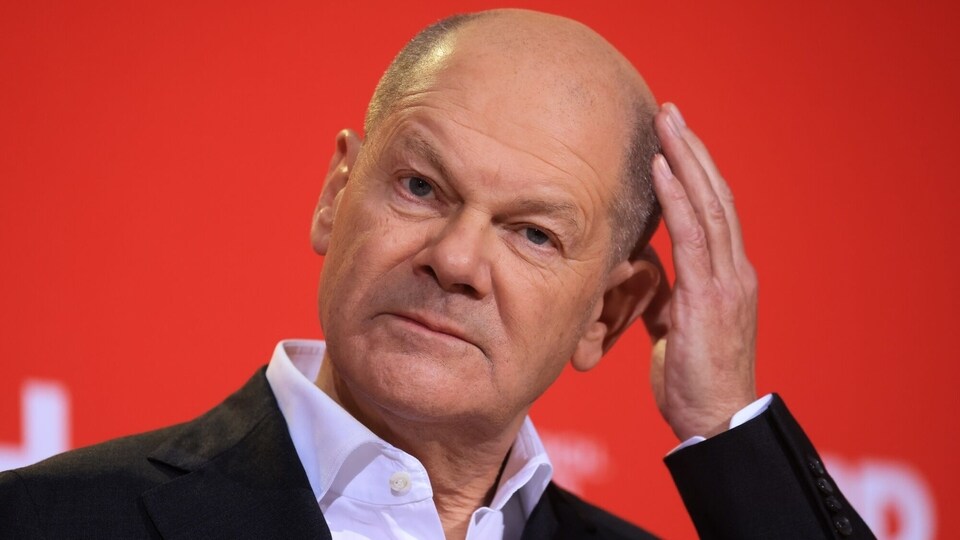
Europe’s largest and the world’s third largest economy Germany is now set for snap polls after Chancellor Olaf Scholz lost a trust vote in the Bundestag 207 votes to 394 votes. The polls, which will be held in February next year come at a critical time for Germany which is facing significant geo-economic challenges. Here are four charts which summarise the state of play in Germany.
German snap polls — A crisis or opportunity?
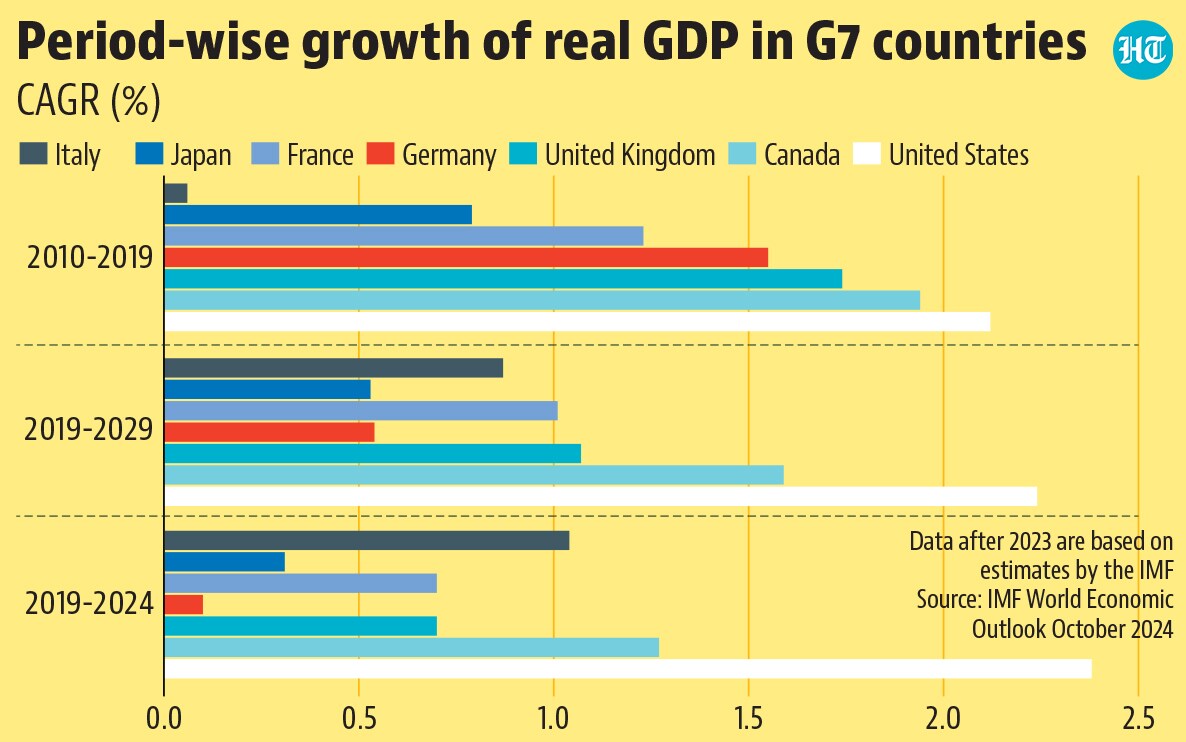
 The German economy is stagnant and trailing its G7 peersAccording to IMF’s October 2024 World Economic Outlook data, Germany’s GDP in 2024 is likely to be 3615.72 billion (3.615 trillion) Euros at constant prices. In absolute terms, this is lower than what this number was in 2022. Germany is the only country among the top ten economies in the world whose GDP in 2024 will be lower than what it was in 2022. Even if one were to compare Germany with other G7 economies –the US, Japan, Canada, France, the UK and Italy – it has gone from being one of the better performers in the 2010s to the worst performer in the 2020s.
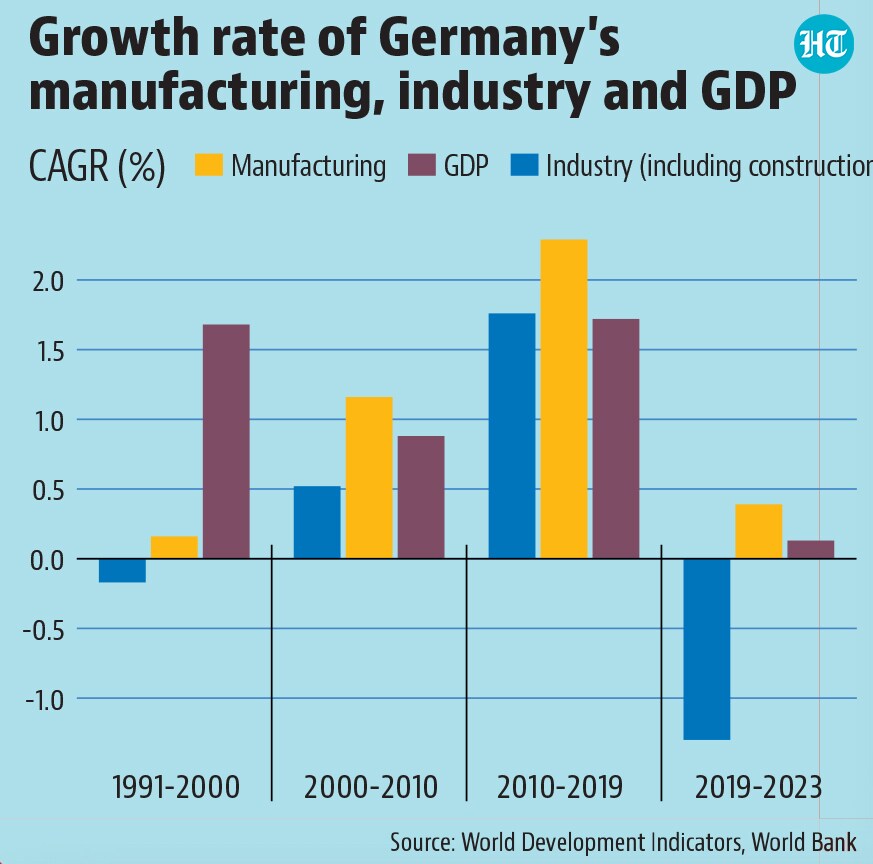
- The state of German industry is a critical factor behind the slowdown...Germany’s monthly industrial production index has been way behind its pre-pandemic levels in every month of 2024 for which data is available. A long-term look at the data from the World Bank reveals a more worrying picture. German industry (including construction) contracted by 1.3% on a compound annual growth rate (CAGR) basis between 2019 and 2023. This is the worst ever performance if one were to compare it to the 1990s, 2000s and 2010s. CAGR in manufacturing has collapsed from 2.3% in 2010-2019 to just 0.4% in 2019-23. Manufacturing and industry had a share of one-fifth and one-fourth in German GDP in 2023.
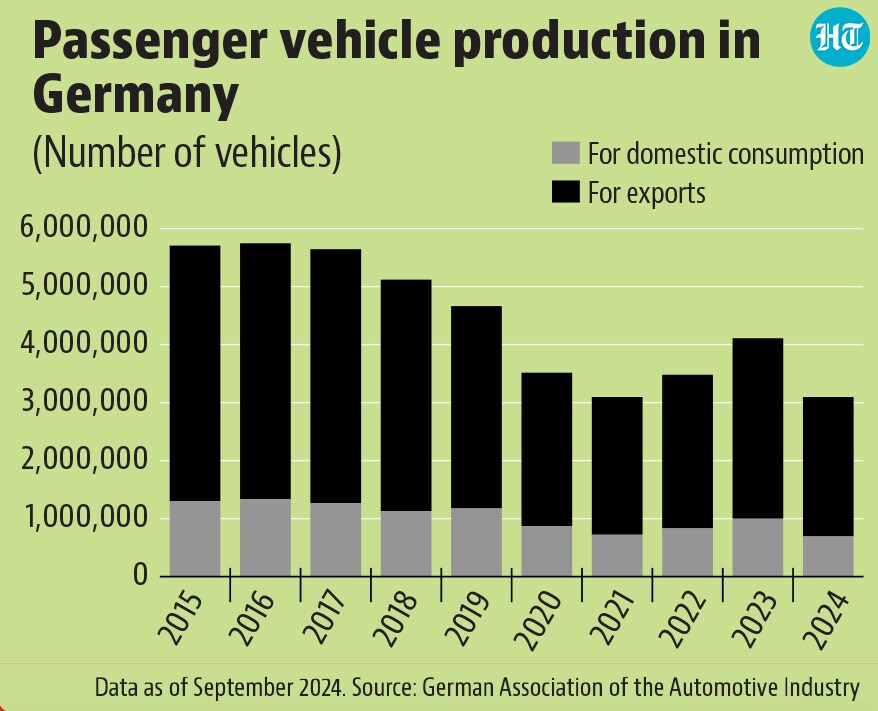
- ...and German manufacturing’s problems might not be cyclicalFor example, one of the most important pillars of Germany’s industrial prowess, automobiles – they had a share of almost one-fourth of industrial revenue in 2023 – might be staring at a permanent loss of markets because of growing Chinese dominance in electric vehicles. China became the world’s largest car exporter in 2023 and is much more cost efficient than its European competitors. It is not without reason that Volkswagen, Germany’s and one of the world’s largest car makers has announced job cuts and factors closures for the first time in its 87 year history. To be sure, car exports by German makers have seen a marginal increase of 2.3% in 2024 as of September, compared to the same period in the previous year. However, overall production of cars have declined further due to a fall in domestic consumption.
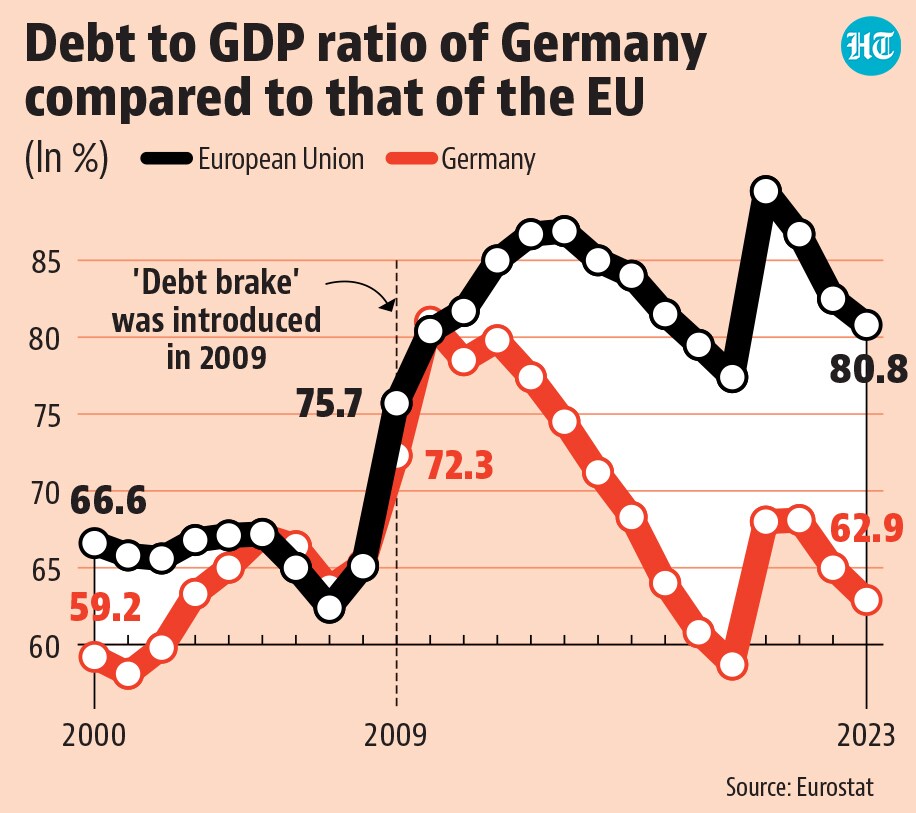
- The upcoming German polls may see a big debate on national debt…A disagreement over raising government debt was the key trigger behind Chancellor Scholz firing his finance minister Christian Lindner in November, which ultimately led to the fall of his government. Lindner’s Free Democratic Party has been against a break from Germany’s ultra-conservative outlook on the debt ceiling in the aftermath of the 2008 global financial crisis. A decision on debt is key to unlocking state investment in rejuvenating the state of public infrastructure in the country, which studies show is key to reviving German economy. “About a fifth of industrial value creation in Germany is under threat,” said a report by the Federation of German Industries (BDI), Boston Consulting Group and the German Economic Institute (IW) published in September. According to the report, order to be internationally be competitive in the future, Germany needs additional private and public investments worth 1.4 trillion Euro by 2030, with at least one-third of it being government investments.
- ...and the Russia-Ukraine warThe other major source of disagreement in Germany is its stance on the ongoing Russia-Ukraine war. Germany’s decision to decouple itself from Russian energy supplies has led to a significant rise in energy costs for both households and industry and undermined its living standards as well as competitiveness. It is no wonder that the recent success of right-wing parties such as the ‘Alternative for Germany’ has come on the back of a pro-Russia or abdicationist stance vis-à-vis the war. Germany’s future, in both the short and medium term, will depend on how the electorate views these two key issues. The snap polls suggest that the so-called traffic light collation government was itself unable to decide on them.