E-Paper



Number Theory: Growth in tandem with social justice holds key for poll-bound Jharkhand
This is the 2nd of a two-part series on economic backwardness of STs in Jharkhand. The 1st part looked at the increase in their economic backwardness over time.
Published on: Oct 22, 2024, 09:03:08 IST

 Prefer HTon Google
Share via


Copy link

The first part of this series explained how the Scheduled Tribe (ST) population in Jharkhand has fallen behind economically, when compared to other communities in the state as well as the community itself outside Jharkhand. The second and last part of this series will try and locate the reasons for this in Jharkhand’s economy and flag factors which can help reduce this inequality.
Growth in tandem with social justice holds key for poll-bound Jharkhand
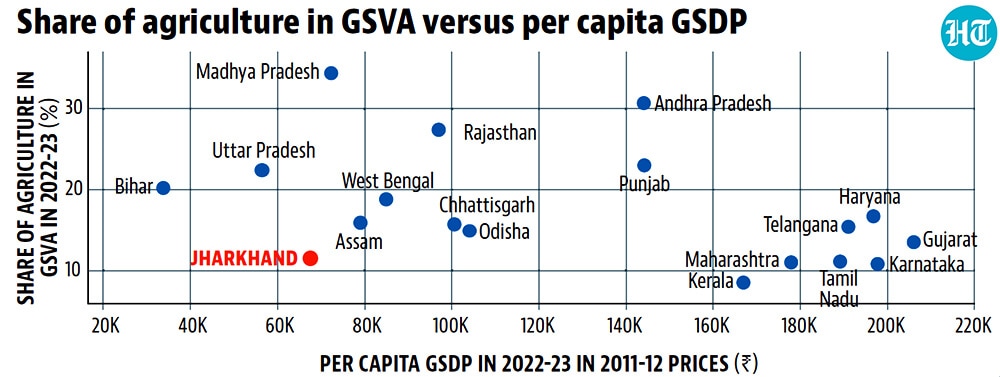
 Jharkhand is an outlier in terms of share of agriculture in its economy, per capita GSDP...This is an important factor to keep in mind while trying to understand Jharkhand’s poverty. Non-agricultural activities have a share of 88.5% in Jharkhand’s GVSA in 2022-23, the latest period for which we have data for all major states (those with 10 or more Lok Sabha seats) in the Centre for Monitoring Indian Economy (CMIE) database. Among India’s major states, Jharkhand has the fifth lowest share of agriculture in its Gross State Value Added (GSVA). However, unlike the states ahead of it on this count, Jharkhand’s per capita GSDP is significantly lower and much closer to states such as Bihar and Uttar Pradesh which have a much higher share of agriculture in their GSVA.
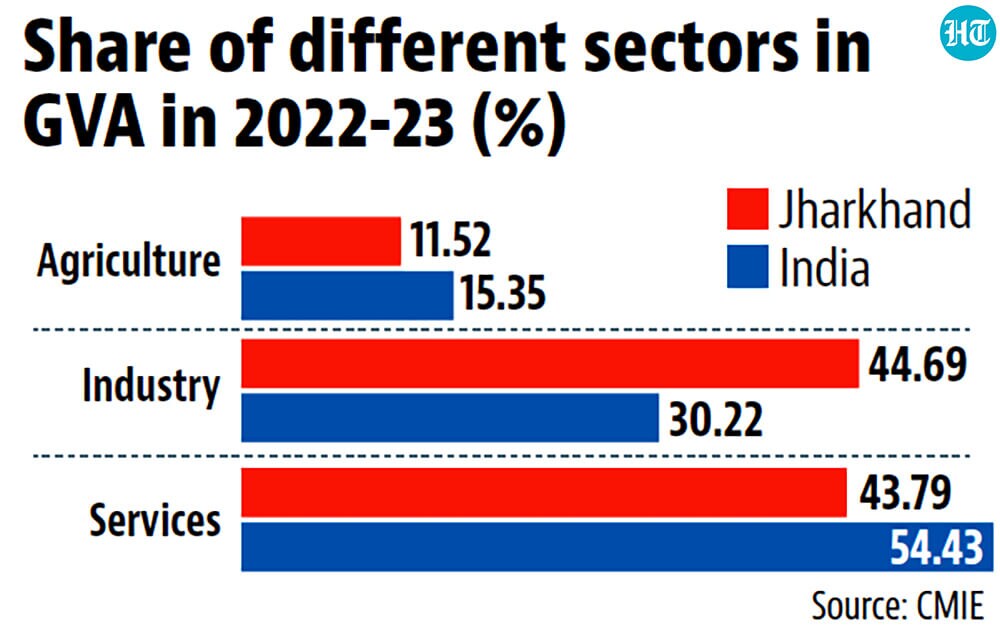
- ...and the reason is a disadvantaged service sectorWhat explains Jharkhand being an outlier in terms of having a low share of agriculture along with low per capita income among Indian states? While Jharkhand is a laggard in terms of per capita income in agriculture (more on this later), a bigger reason for its poor performance in per capita GSDP is a disadvantage in services. A comparison of per capita GSVA in agriculture, industry and services for Jharkhand and India shows this clearly -- Jharkhand does badly in both agriculture and services despite doing relatively better in industry.
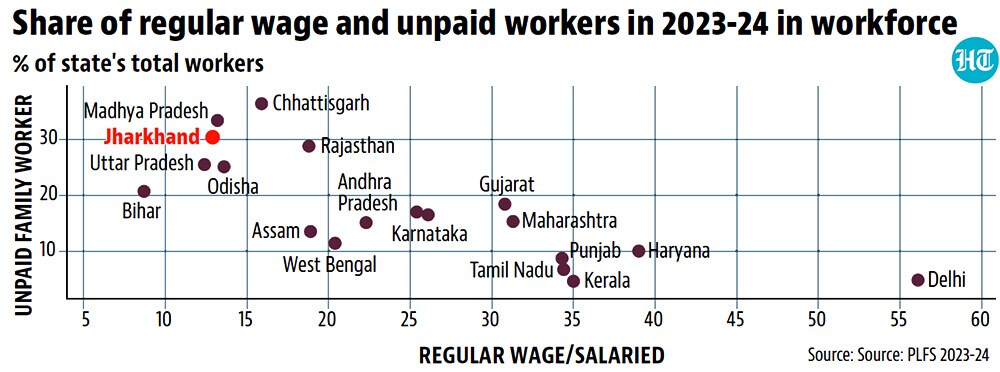
- This has also led to Jharkhand doing really badly in terms of salaried jobs...,Periodic Labour Force Survey (PLFS) data for 2023-24 shows this clearly. While Jharkhand does not do badly in terms of headline labour market indicators such as labour force participation rate (LFPR) and unemployment rate -- the latter in fact is much lower in Jharkhand than the national average -- it does really badly in terms of share of salaried workers in the workforce who are the most well paid among the lot. On the other hand, it is the state with the third highest share of unpaid workers in the workforce after Chhattisgarh and Madhya Pradesh (both of which have a higher proportion of salaried workers).
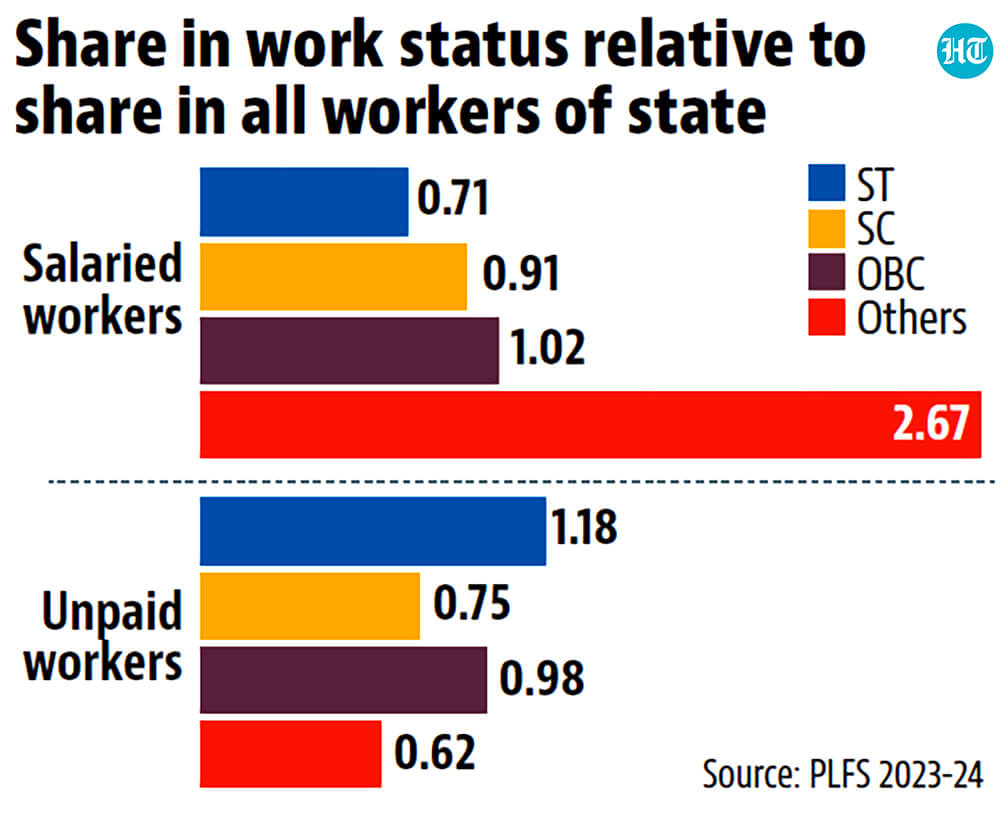
- ...which only adds to the already existing disadvantage for STs in JharkhandA relative share analysis of the social groups in salaried workers and unpaid workers in PLFS data shows this clearly. Relative share is defined as the share of a particular social group in a kind of work (such as salaried or unpaid) divided by their share in all workers. STs are the most under-represented in salaried work which pays the most and the most over-represented in unpaid work. While the magnitude of this asymmetric representation in the workforce decreases when looking at rural and urban areas separately, the nature of inequality is the same in both villages and cities. Given the fact that Jharkhand has fewer salaried jobs than most states, this only adds to the economic predicament of the STs.
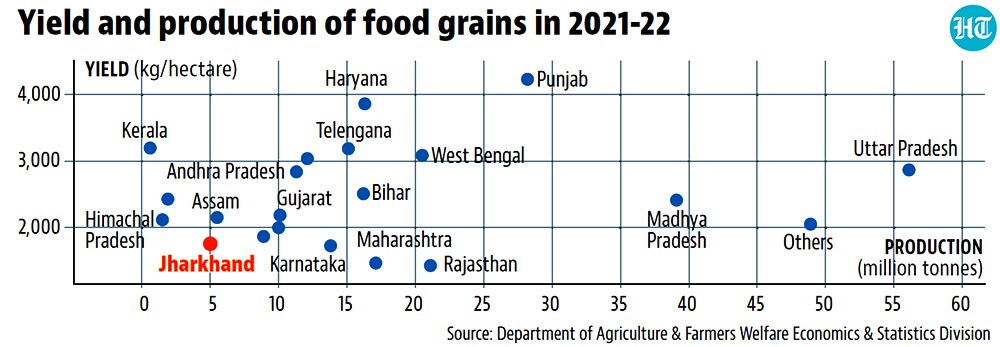
- A broad rural focus could help boost mass incomes in JharkhandBecause most of Jharkhand’s area is hilly the land is not very fertile for growing crops. This can be seen in official statistics as well. According to data published by the ministry of agriculture, Jharkhand had the fourth lowest yield for food grains among major states. The three states that have lower yield – Rajasthan, Maharashtra, and Karnataka -- make up for it by cultivating more area, and produce three to five times Jharkhand’s food grain output. Given the fact that land quality is not something which can be changed and Jharkhand is among the most rural states in the country, what is the best way forward for boosting mass incomes in the state? A sustainable push in sectors such as forestry, etc. – Jharkhand does much better than other sectors here – which also employ a large share of the ST population could be the best strategy to achieve this goal.