E-Paper



Number Theory: Is BJP's poll footprint evolving?
.

 Prefer HTon Google


In 2014, the Bharatiya Janata Party (BJP) became the first political party to win a Lok Sabha majority in the country since 1984. It replicated this feat in the 2019 elections, clearly establishing itself as the dominant political force in the country. This national dominance notwithstanding, the BJP’s performance in state elections after 2014 has often been subpar compared to its Lok Sabha showings. The gap in the BJP’s performance in national and state elections has often been described as a national premium for the party, which is also seen as linked with a preference for Narendra Modi as Prime Minister. The 2024 Lok Sabha elections questioned this narrative when the BJP was unable to reach the halfway mark. Additionally, its performance, in terms of seats, in some state elections which have been held after the 2024 Lok Sabha has been better than its Lok Sabha showing in terms of seats. Does this mean that the national vote share premium is shifting? Here is what the data shows.
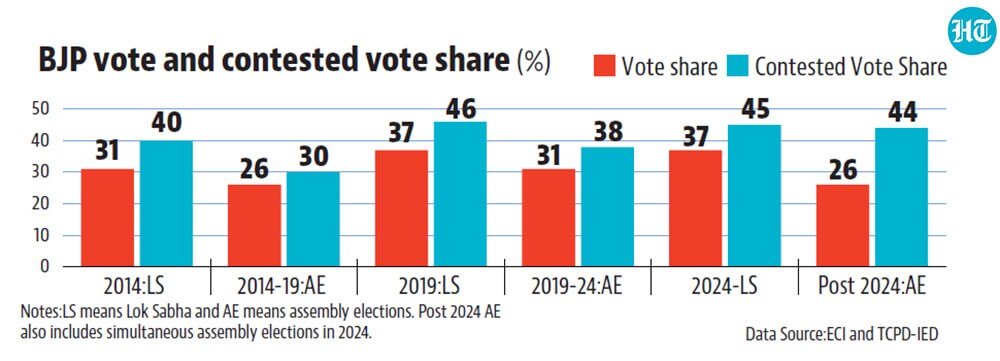
 Explaining BJP’s national vote share premium after 2014BJP had a vote share of 31% in the 2014 Lok Sabha elections. Its contested vote share in the 2014 polls was 39.6%. If one were to look at the BJP’s vote share and contested vote share in all assembly elections held along with – for example the 2014 assembly elections in Odisha will be included in the post-2014 Lok Sabha assembly elections cycle – or after the 2014 Lok Sabha elections, the number turns out to be 25.6% and 30.3%. The story repeated itself in the 2019 Lok Sabha election and the subsequent assembly election cycle. BJP’s 2019 Lok Sabha vote share and contested vote share was 37.3% and 46.1%. These numbers were 31% and 37.6% for the subsequent assembly elections. This analysis has used vote shares rather than seat shares as a metric because the latter can be influenced by the vagaries of the first-past-the-post contest without any change in a party’s popular support, which is what vote shares measure. Since a party’s vote share can also vary because of alliances, or lack of them, the analysis has also given contested vote share numbers which only look at performance in constituencies where a party actually contested.
- To be sure, the BJP’s national premium varied significantly across statesIn the post-2014 assembly election cycle, the BJP lost vote share in 23 out of 30 assembly elections. However, the magnitude of this loss varied from 21 to 1.54 percentage points. Similarly, during the 2019-24 Lok Sabha cycle, the BJP lost vote share in 26 assembly elections out of the 29 which were held. Jammu & Kashmir was downgraded from a state to a Union territory in 2019 and did not have assembly elections in this cycle. Once again, the range of this loss varied from 26.1 to 0.12 percentage points. The comparison of BJP’s vote share difference between national and state elections has excluded Nagaland because the BJP did not put up Lok Sabha candidates in Nagaland in both 2014 and 2019.
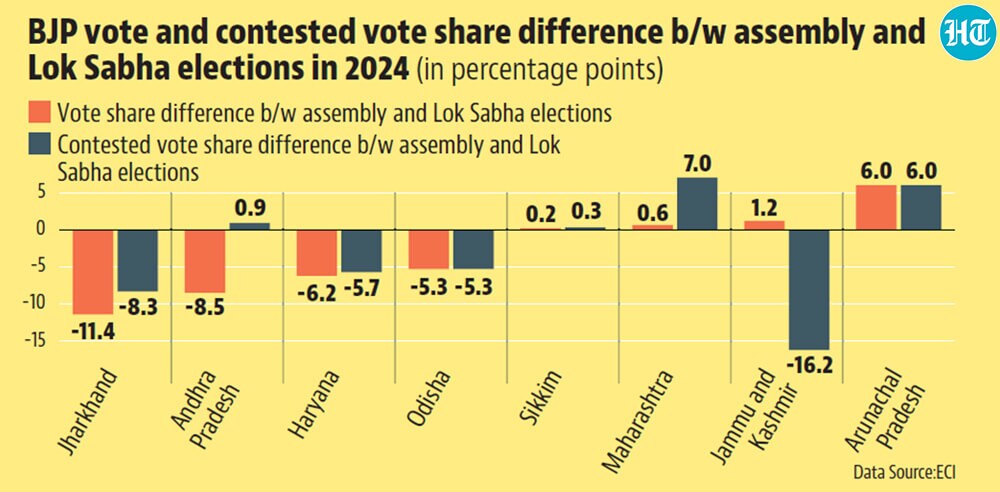
- What do the state assembly elections in 2024 indicate?Eight assembly elections have taken place in the post-2024 Lok Sabha election cycle so far. Andhra Pradesh, Arunachal Pradesh, Odisha and Sikkim went to polls along with the Lok Sabha elections, and Haryana, Jammu & Kashmir, Jharkhand and Maharashtra went to polls after the Lok Sabha elections. The BJP has lost vote share compared to its Lok Sabha performance in four out of these eight states, namely Jharkhand, Andhra Pradesh, Haryana and Odisha. This number remains the same even if one were to compare the contested vote share of the BJP. Among the states where the BJP has increased its vote share compared to the 2024 Lok Sabha elections, the gains are almost insignificant in Maharashtra and Sikkim. To be sure, this comparison masks the fact that the BJP increased its seat share in these assembly elections not just in comparison to the 2024 Lok Sabha but also the previous assembly elections. This also raises an interesting question. Is the BJP stabilising in terms of a lower national vote share than its 2014 and 2019 performances in stronghold states, but consolidating its vote share at a level where it will continue to be India’s most politically formidable force? We will know the answer between now and 2029.