
 E-Paper



Number Theory: Party and caste trends in dy CM appointments
.
Published on: Feb 28, 2025, 23:27:50 IST

 Prefer HTon Google
Share via


Copy link

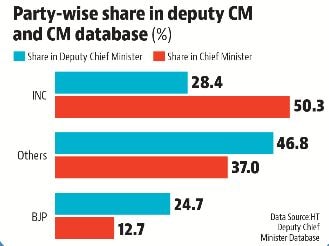
Highest share of deputy chief ministers have been from non-Congress non-BJP parties
 Highest share of deputy chief ministers have been from non-Congress non-BJP partiesOut of the 190 deputy chief ministers in the database, 89 are from non-Congress non-BJP parties. The Congress and BJP (this includes the Bharatiya Jan Sangh which was the predecessor of the BJP) have had 54 and 47 deputy chief ministers so far. How do these numbers compare with the party-wise breakup of chief ministers in India? The Congress has had 50.3% of India’s total chief ministers so far which is almost double its share in the number of deputy chief ministers. For the BJP, the situation is the other way round with its share in number of deputy chief ministers being double its share in number of all chief ministers in the country.
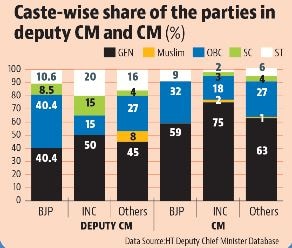
- Unlike chief ministers, majority of deputy chief ministers are not from the so-called upper castesThis is perhaps the most important takeaway from the database. Of the 190 deputy chief ministers in the database, 54.7% are from social groups which belong to the category of Other Backward Classes, Scheduled Castes, Scheduled Tribe or Muslims. This is a very different trend from what is seen in the chief minister’s database where 68.7% of the 485 chief ministers are from non-SC-ST-OBC-Muslim communities. To be sure, HT’s chief minister database had only analysed chief ministers from 21 big states including the union territory of Delhi.
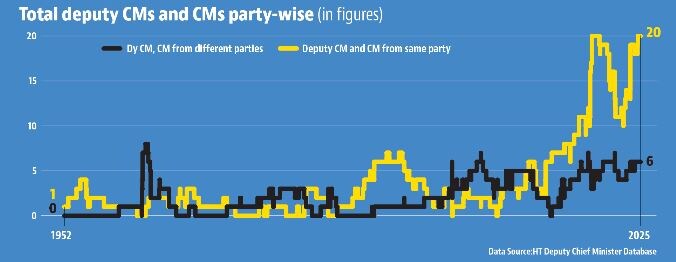
- 60.2 % of the deputy chief ministers in the database are from the same party as the chief ministerIs the coming into being of deputy chief ministers a reflection of multi-party alliance governments? Not necessarily. India’s first deputy chief minister, Anugrah Narayan Singh from Bihar, was from the Congress party, which also had the chief minister’s post. Among the 26 deputy chief ministers today, 20 are from the same party as the chief minister. The share of deputy chief ministers from the same party as the chief minister in the entire data set is 60.2%. This shows that deputy chief ministers are often appointed with considerations of power sharing within the party in power than to placate alliance partners.
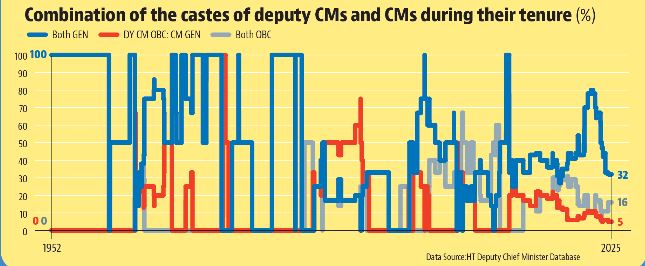
- 87% of the deputy chief ministers are from a different caste than the chief ministerOut of 137 deputy chief ministers (only for the 21 states for which Chief Minister caste data is available), 119 came from a caste different from the Chief Minister’s caste. The remaining 18 deputy ministers had the same caste as the Chief Minister, six came from Maharashtra (all Maratha), four from Punjab (all Jatt Sikh), two from Andhra Pradesh, and one each from Bihar, Gujarat, Karnataka, Kerala, Madhya Pradesh, and Rajasthan. At the level of caste category, 55 upper caste deputy chief ministers worked with the same category CMs, 25 deputy chief ministers from the Other Backward Classes (OBCs) also worked with the CM from the same category, 9 Scheduled Caste deputy chief ministers worked with the CM from the upper caste, and 15 deputy CMs from OBCs served under an upper caste CM

Unlock a world of Benefits with HT! From insightful newsletters to real-time news alerts and a personalized news feed – it's all here, just a click away! -Login Now!


