E-Paper



Number Theory: The method behind government's vacillations on rice export
.
Published on: Oct 7, 2024, 08:28:56 IST

 Prefer HTon Google
Share via


Copy link

The government of India lifted its ban on non-basmati white rice exports on September 28, 2024, more than a year after it was imposed on July 20, 2023. To be sure, even before an outright ban was imposed, there were other restrictions on rice exports from India. India’s rice export restrictions created a lot of angst in the international rice market with many stakeholders appealing that the restrictions be removed. The IMF too appealed on these lines in July 2023 a few days after the ban was enforced, encouraging India to remove the ban.
What is the larger story behind India’s frequent rice export restrictions, the global anguish they cause and their impact on domestic markets? Here are four charts which explain this in detail.
The method behind government's vacillations on rice export
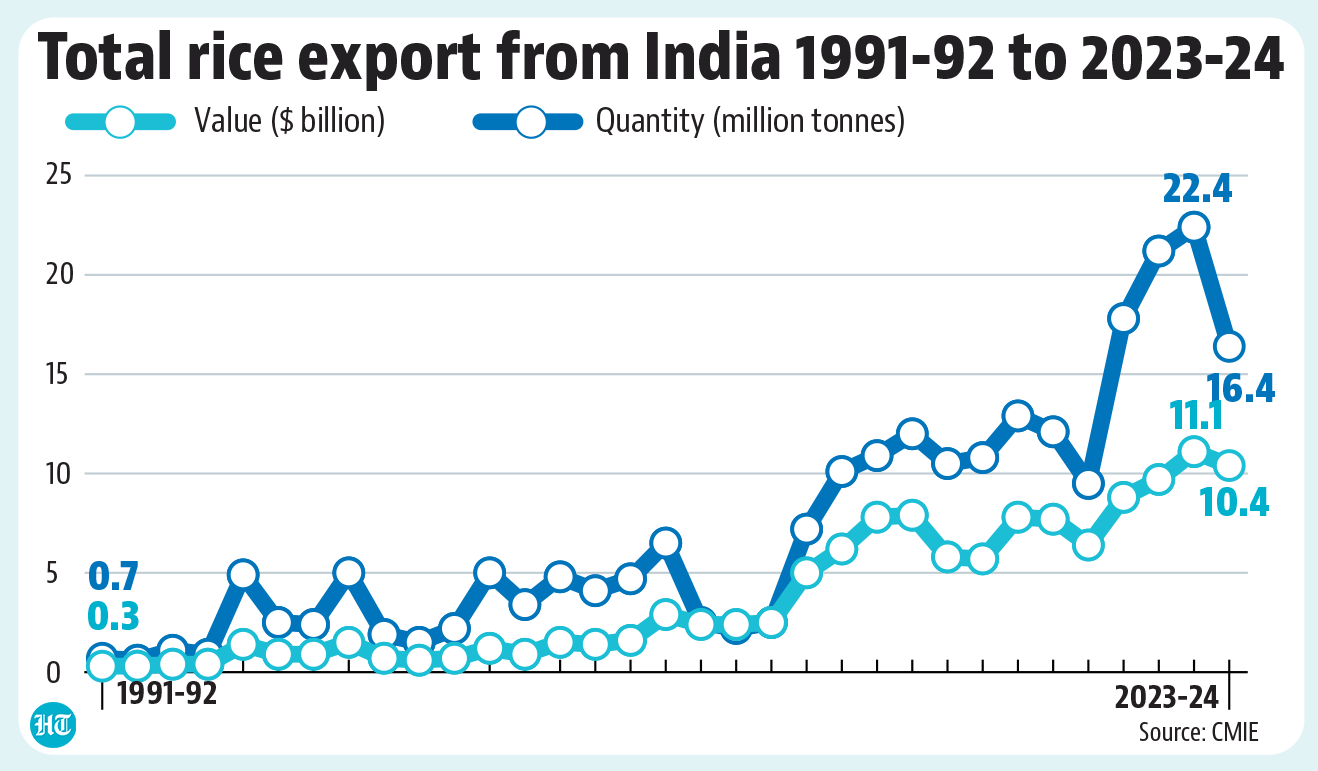
 India’s rice exports have risen consistently in the last decadeData from the Centre for Monitoring Indian Economy (CMIE) shows this clearly. India never exported more than 10 million tonnes of rice between 1991-92 and 2011-12. But between 2012-13 and 2023-24, India’s rice exports were less than 10 million tonnes in only one year (2019-20). As is to be expected, there has also been an increase in export earnings in value terms. What is even more interesting is the fact that India’s non-basmati rice exports were far from insignificant even after the ban which was imposed in July 2023. CMIE data shows that India exported 1.96 million tonnes of non-basmati rice between August and October 2023 which is less than half of the 4.4 million tonnes it exported in the corresponding period a year ago, but still a very large quantity.
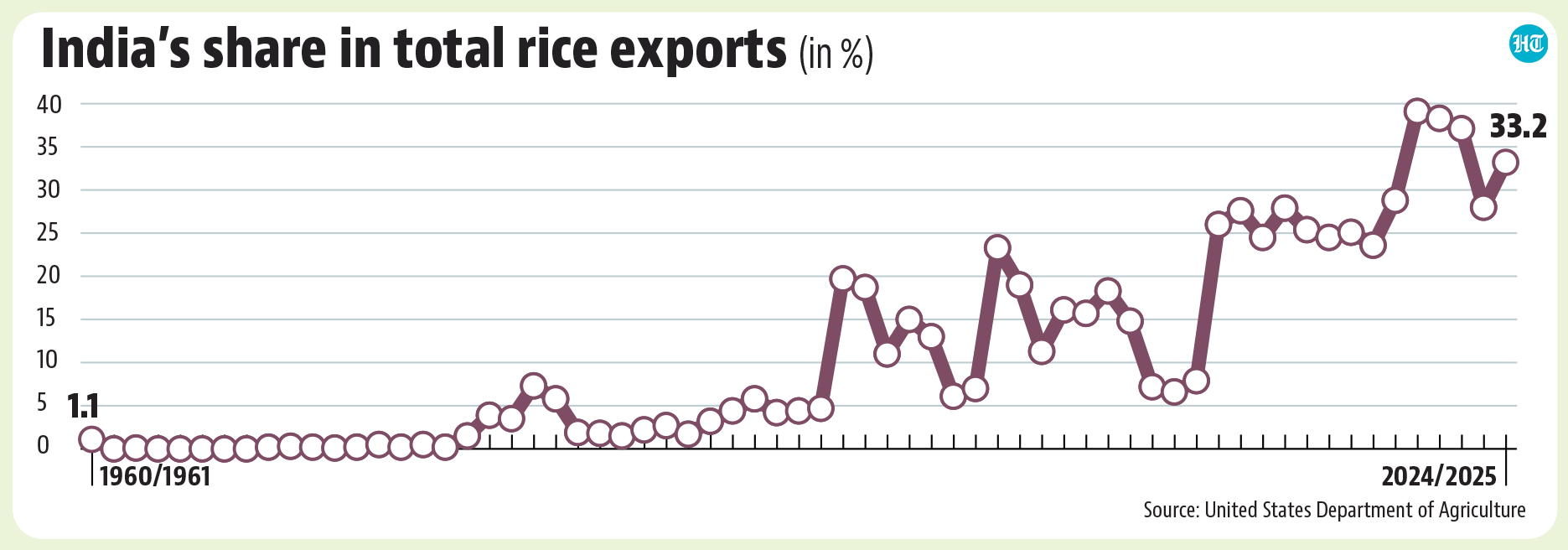
- And so has its importance in total rice exports in the worldData from United States Department of Agriculture (USDA) shows that India’s share in total rice exports in quantity terms barely exceeded five percent until 1993-94. This number has not fallen below 25% since 2011-12 except a minor shortfall in 2018-19. India is the largest rice exporter according to USDA’s latest data.
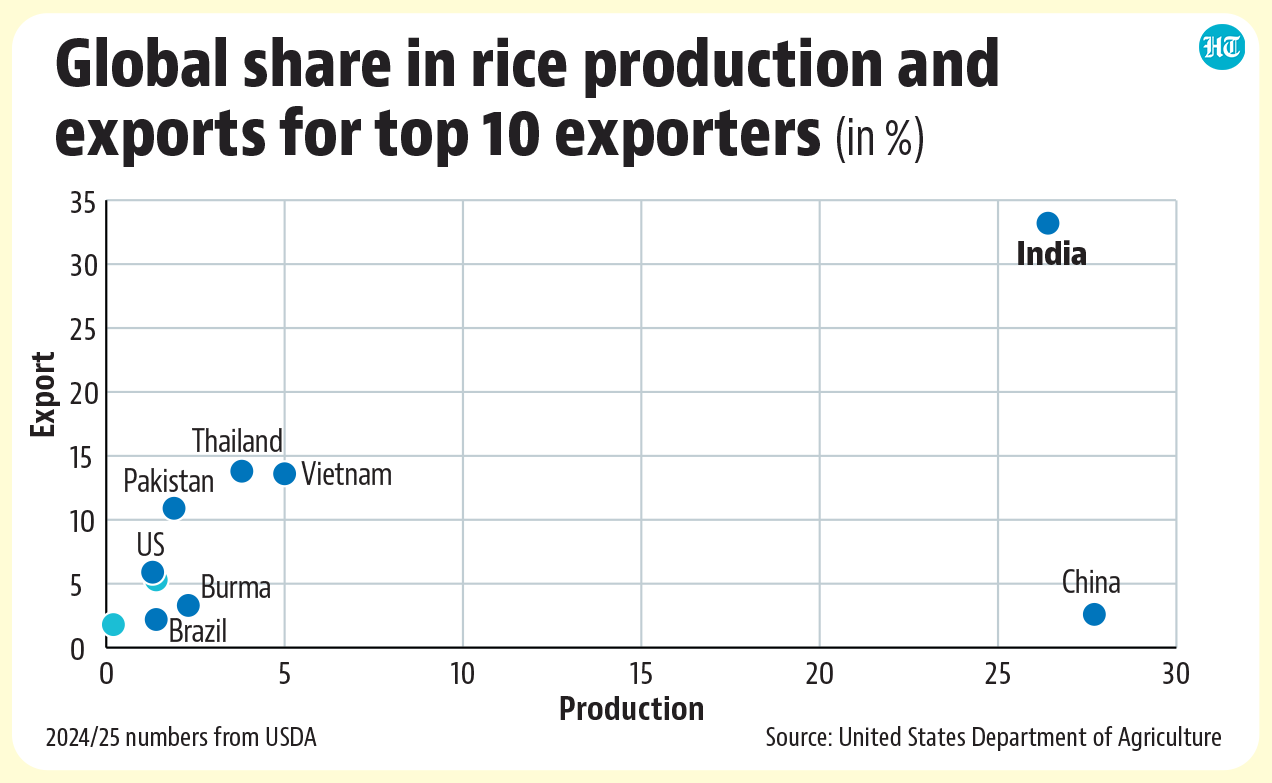
- But India’s production-export dynamics for rice are very different the only country that comes closeThis is the most important statistic when it comes to understanding the frequent policy interventions vis-a-vis rice exports in India. According to USDA’s latest data, India is the second largest rice producer in the world with a global share of 26.4%. The country which is the leading producer of rice in the world is China with a production share of 27.7%. India and China differ drastically when it comes their share in global rice exports, the numbers being 33.2% and 2.6% respectively. These numbers need to be seen in the context of India and China being the largest and second largest countries in the world in terms of population which would entail very large requirements for domestic consumption. Unlike India, where rice is complemented by wheat as a staple cereal, China largely consumes only rice as its staple cereal.
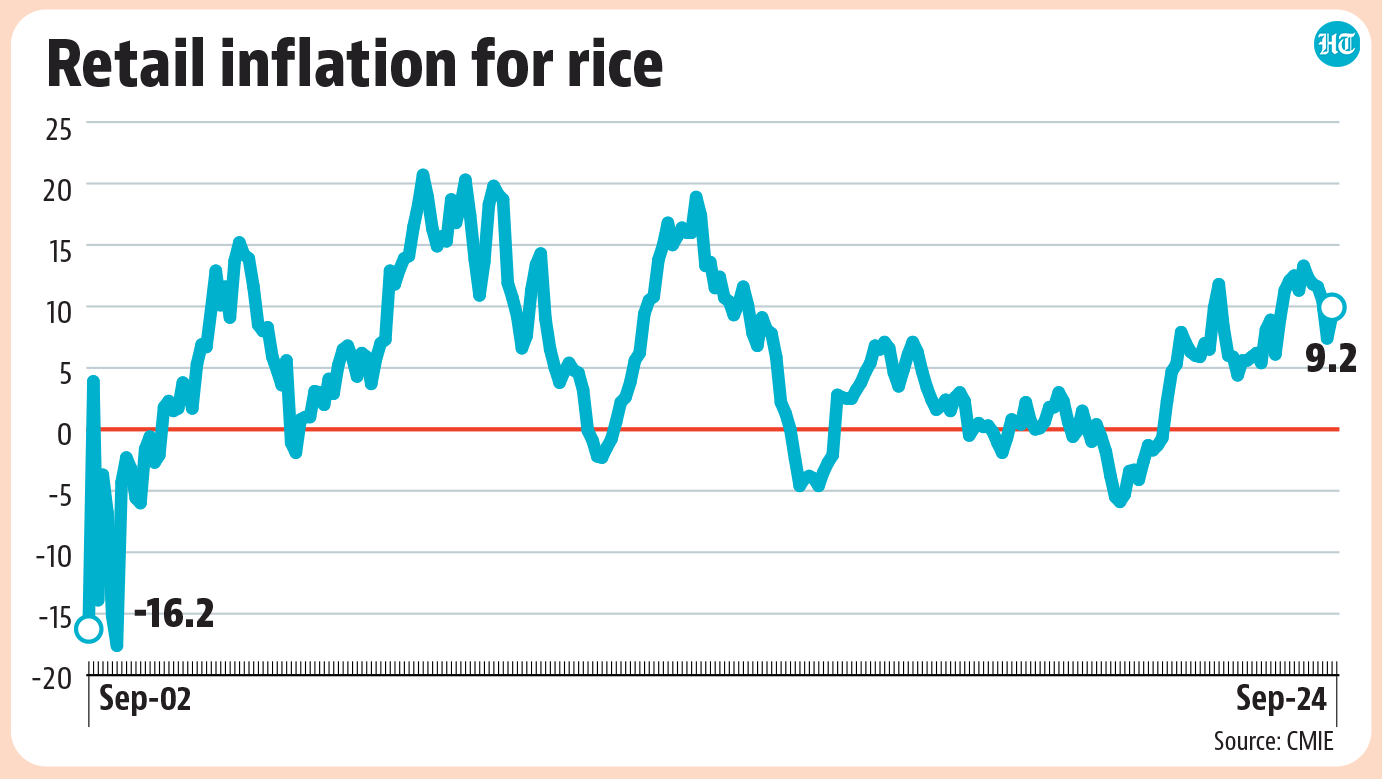
- The latest phase of rice export restrictions was also one of high rice inflationThe government imposed a ban on non-basmati rice exports in July 2023. Around that time, monsoon was expected to be deficient and adversely affect the rice crop in the country. Retail inflation for rice, as seen in retail price data from the CMIE kept increasing even after the export ban and grew in double digits between November 2023 and July 2024, something which has not happened in the country since 2014-15. It is only in the last two months that rice inflation has come down to single digit levels. To be sure, domestic rice prices could increase after the move even as international prices have fallen with assurances of a larger supply from India.
- At the root of this balancing act is the political economy of rural incomesWhile policy interventions to control inflation help consumers, especially the poor, they also generate headwinds for farm incomes because of a squeeze on farm gate prices. The balance of policy, as an October 4 research note by Nomura economists Aurodeep Nandi and Sonal Varma points out depends on the political cycle. “So far, the RBI has relied on supply-side interventions by the government to control food inflation. These have typically taken the form of export restrictions, reduced import duties, open market sales, imposition of stock limits and curbs on speculation, and measured increases in minimum support prices. The policies have helped consumers, but food producers have suffered at the margin. However, with elections due in farm-intensive states like Haryana and Maharashtra, there is also political pressure to tip back the scales in favour of farmers,” the note says.