E-Paper



Number Theory: What does Japan's poll results say about its polity and economy?
The charts below explore what the election results mean for Japan's polity and its economy
Published on: Oct 31, 2024, 12:43:35 IST

 Prefer HTon Google
Share via


Copy link

Japan’s government faces instability after voters in a snap election rebuked Prime Minister Shigeru Ishiba’s conservative coalition led by Liberal Democratic Party (LDP), just weeks into his term which began on October 1. The elections have left no party with a clear majority in the lower House of the Parliament and pushed the country to political uncertainty. The political uncertainty has come at a time when Japan is facing multiple challenges. The charts below explore what the election results mean for Japan's polity and its economy.

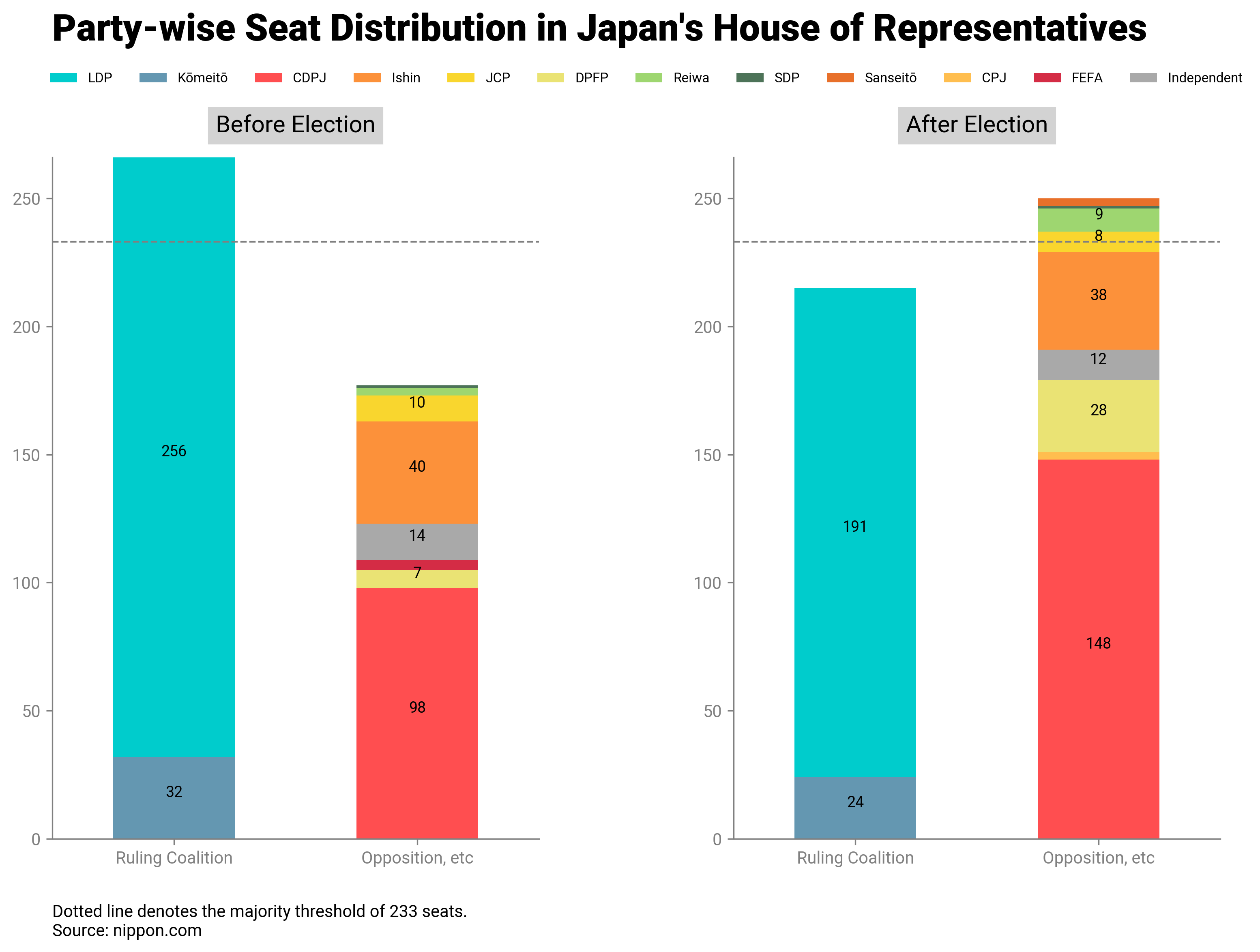
 How did Japan's new PM lose his majority?The ruling LDP and coalition partner Kōmeitō dropped from 279 to 215 seats amid a political funding scandal that has been simmering for a year and rising cost of living. Ishiba’s troubles began with his cabinet appointments. Though he pledged fresh leadership, Ishiba’s cabinet choices leaned on old-school loyalty, appointing few younger or female ministers, resulting in his approval ratings hitting 30%—an unprecedented low for a new prime minister. Public dissatisfaction, fuelled by Ishiba's handling of the LDP donations scandal which rocked Japanese politics last year, mirrored that faced by his predecessor, Fumio Kishida. And his abrupt decision to call a snap election, reversing his previous statements, provided a rallying point for the opposition to accuse him of being no better than his tainted peers. He also lacked a clear policy platform as he backtracked on proposals like an “Asian NATO,” which anyway had little voter appeal. The main opposition, the Constitutional Democratic Party of Japan (CDPJ), gained ground with 148 seats, though still far short of a 233-seat majority. However, non-ruling parties now outnumber the ruling coalition in the lower House. Chart 1: Party-wise seat tally in parliament before and after elections
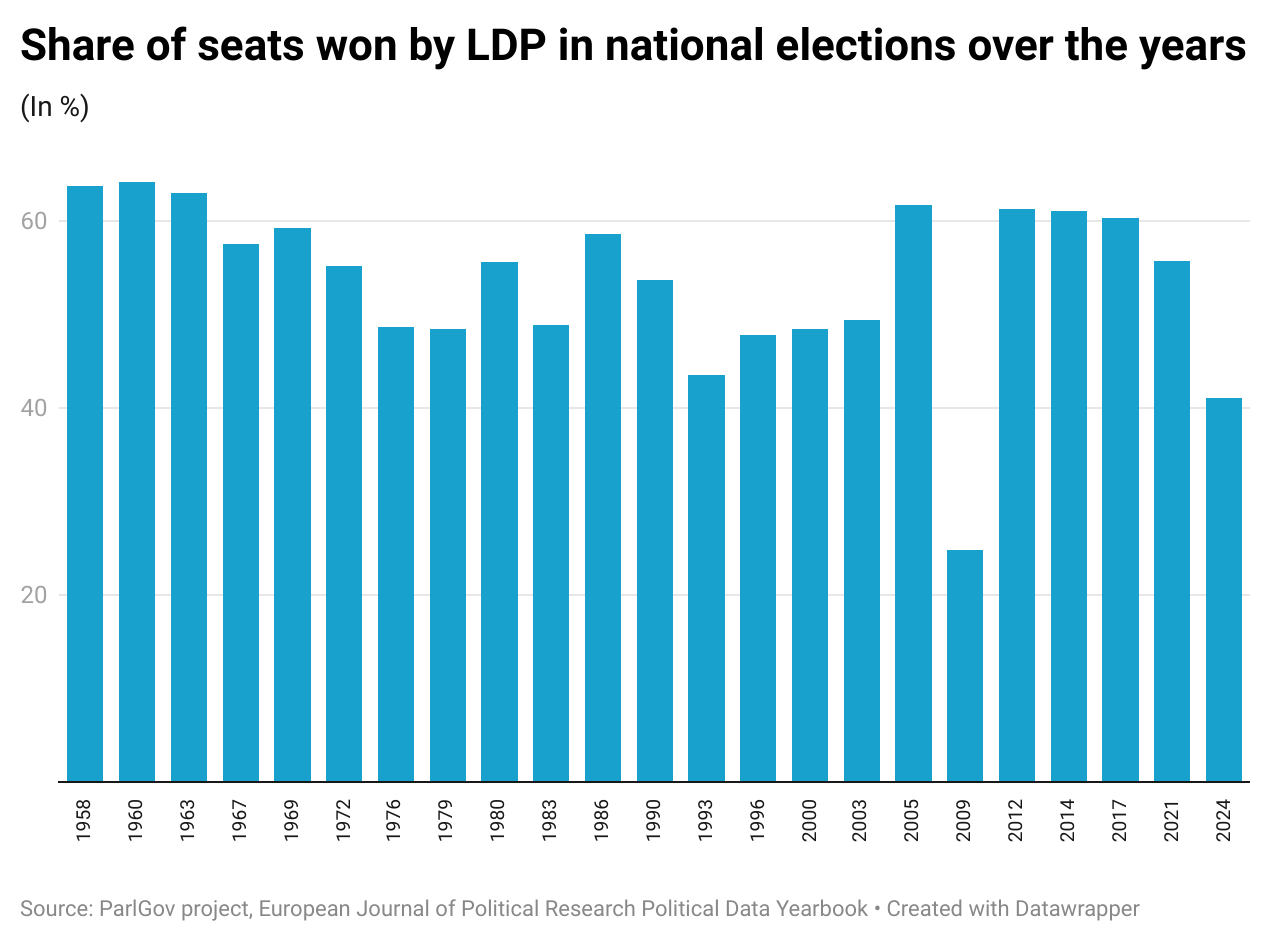
- This is LDP's second-worst result since its inceptionSince its founding in 1955, the LDP has held a near-constant grip on power over Japan, interrupted only briefly in 1993 and 2009. LDP's current seat share at 41.1% is the second-lowest in its history, the first being the 24.8% seat share it got in 2009, when it lost power to the Democratic Party of Japan, which is also the predecessor of CDPJ. The current scenario for the LDP is, however, more similar to that of the 1993 election, where it lost its majority yet retained the largest number of seats in parliament. This was followed by seven opposition parties uniting to form a coalition, ousting the LDP from power for the first time since 1955. This coalition, however, collapsed within a year, allowing the LDP to swiftly regain control. Presently, leaders of smaller opposition groups, like the DPFP, have stated they won’t join the ruling coalition but may collaborate on certain policy issues. This arrangement could, however, create significant challenges for the government’s legislative and policymaking efforts. Chart 2: LDP's seat share over the years
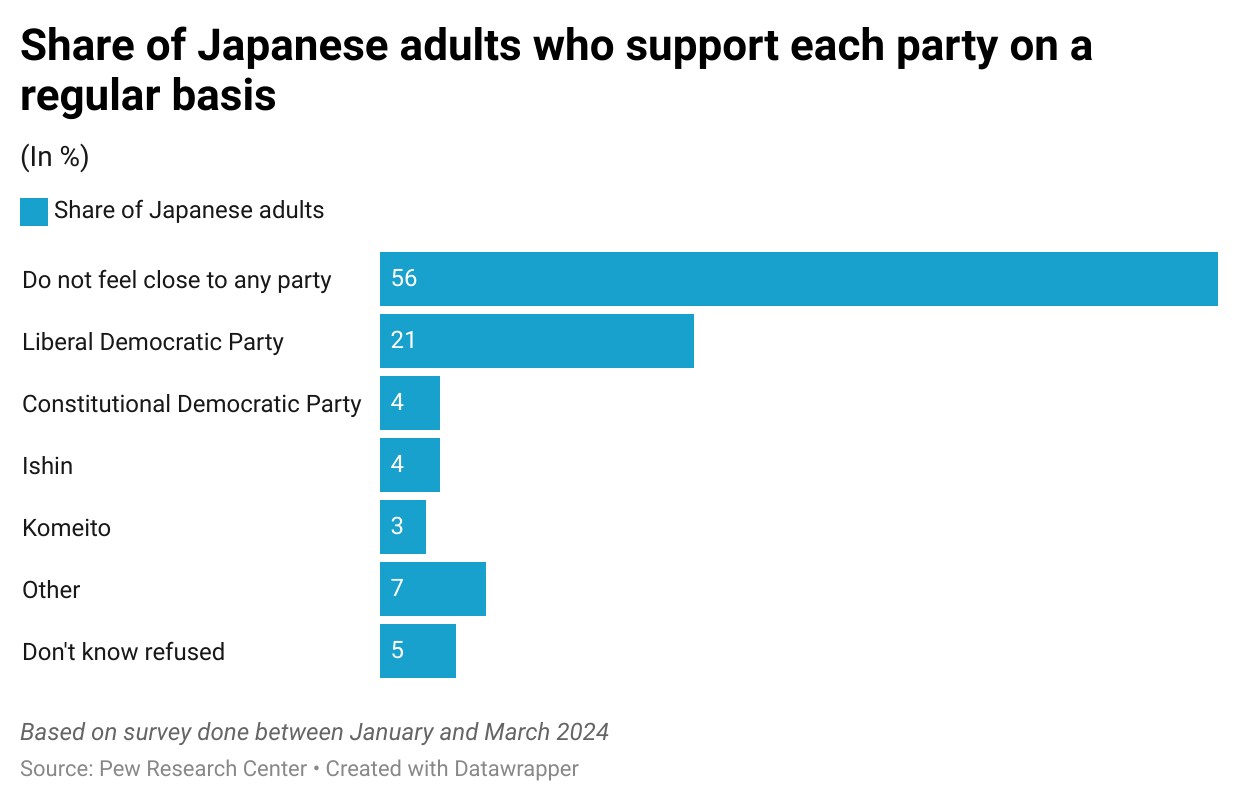
- The results reflect the rising dissatisfaction among the Japanese populaceThe LDP's weakening position might suggest an opening for other parties to drive change. However, most voters still do not view any of Japan's opposition parties as a credible alternative. A survey by Pew Research Center between January and March 2024 shows that as much as 67% of the adults in the country are not satisfied with their democracy, up from 54% in 2019. Meanwhile, 56% of Japanese adults don't feel close to any party. Low voter enthusiasm could also be linked to low turnout rates in Japan, which has one of the lowest voter turnouts among OECD countries despite automatic registration. In Sunday’s general election, turnout for single-seat constituencies was 53.85%—the third lowest since World War II. Chart 3: Share of Japanese adults who support each party on a regular basis
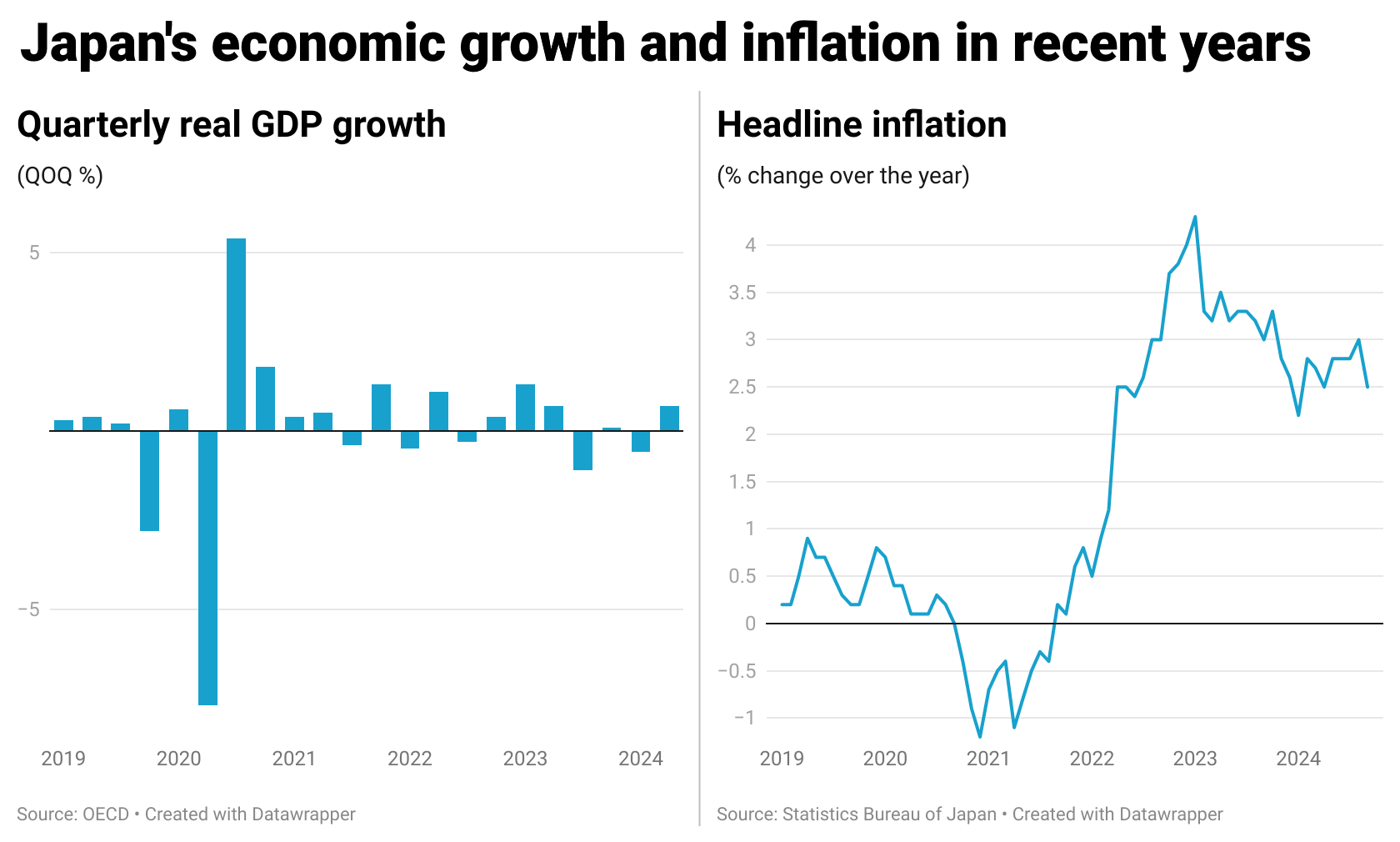
- Japan needs to make tough choices for its economyThe Japanese economy, alternating between weak growth and recession, grew only marginally in the most recent quarter. This summer, the yen reached a nearly four-decade low, raising import costs and pushing up inflation. At the same time, Japan’s ageing population strains social welfare budgets—about one-third of the budget is spent on the social welfare needs of Japan’s ageing population—while military spending rises to address security threats from China and North Korea. The defence ministry has requested 8.54 trillion yen (US$57 billion) for fiscal year 2025, marking a 10.6% increase from last year's budget proposal. The Bank of Japan (BOJ) recently ended negative interest rates and raised short-term rates to 0.25% in July, aiming to reach its 2% inflation target. But political divisions could complicate further rate hikes. DPFP leader Yuichiro Tamaki have criticised the BOJ for raising rates too soon, while Ishin proposes expanding the bank's mandate to include economic growth and employment. On Monday, the day after the results were declared, the yen plunged to 153.88 against the dollar, its weakest since late July. A weak yen could force the BOJ to raise rates again, especially if external events, like a stronger dollar, worsen currency depreciation and drive up inflation. Chart 4: Real GDP growth rates and inflation in Japan