
 E-Paper



Politics in India’s Muslim dominated ACs – 2 | Number Theory
The concluding part of this story will look at party-wise representation in these ACs and the fragmentation or lack of it when it comes to electoral competition
Updated on: Nov 26, 2025, 08:46:48 IST

 Prefer HTon Google
Share via


Copy link

The first part of this series looked at assembly constituencies (ACs) in India by the share of Muslim population in the district they are located in. It laid down their overall number and state-wise distribution for different thresholds of share of Muslim population. The concluding part of this story will look at party-wise representation in these ACs and the fragmentation or lack of it when it comes to electoral competition.
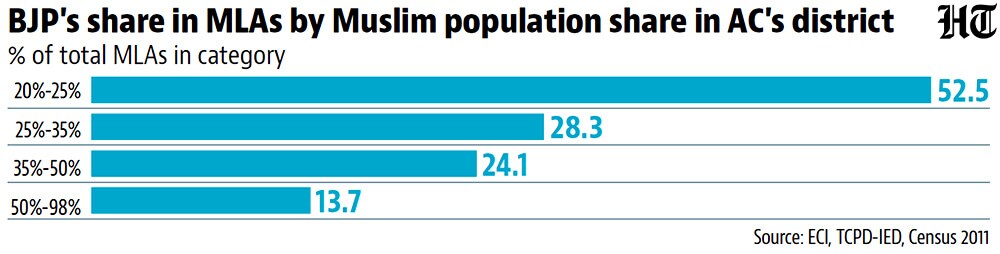
 BJP has the largest share of MLAs in ACs which are located in districts with more than 20% Muslim population shareThe BJP has the largest number of MLAs among all parties in India currently. This also continues to hold true among the 707 ACs where the share of Muslims is more than 20%. However, it falls to the second rank beyond the 25%. After the 50% threshold it falls to the fourth rank. This could partly be a result of the BJP not being a strong enough force in states where these ACs are located or it facing political headwinds because of Muslims not voting for it. See Chart 1: BJP share in MLAs by share of Muslims in that district
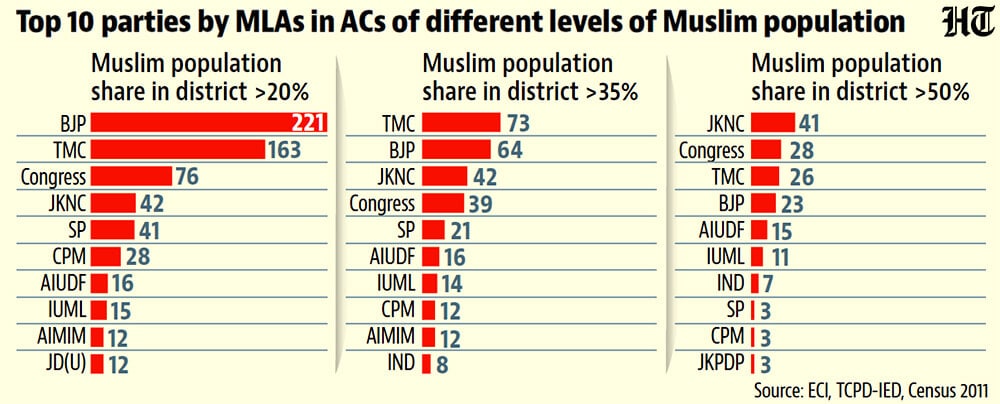
- Among non-BJP parties the TMC accounts for the biggest share of MLAs from higher-than-average Muslim population share ACsAll India Trinamool Congress (TMC) had the second largest number of MLAs from ACs which were located in districts with more than 20% share of Muslims. It becomes the single largest party with MLAs in districts with a Muslim population share of 35% or more. However, if one is comparing party-wise ACs in districts where Muslims have a more than 50% share in population, it is the National Conference which is ranked first thanks to its presence in Jammu and Kashmir, India’s only Muslim majority large UT.
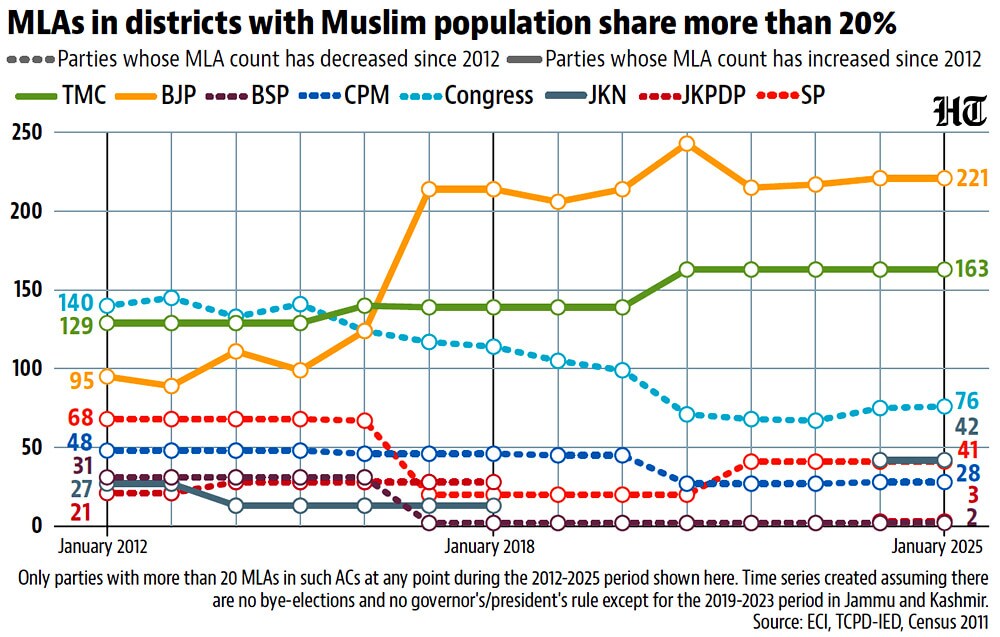
- Seen overtime, BJP and TMC have made gains in ACs with higher share of Muslims while Congress has sufferedHow has political representation changed in ACs with a higher share of Muslims in India? Unfortunately, this comparison can only be made from 2012 onwards because AC boundaries were redrawn in the 2008 delimitation exercise in India and the first cycle of elections were completed only in 2012. A time-series comparison shows that the BJP has made the largest gains in these ACs (95 to 221) between 2012 and 2025. TMC is the only other party which has made big gains in these ACs while the Congress has suffered the biggest loss. Among the other major losers are Bahujan Samaj Party (BSP), Samajwadi party (SP), and the Communist Party of India (Marxist) or CPI (M). The pattern is largely the same even when one is comparing political representation in ACs in districts with a Muslim population share of 35% or even 50%.
- Politics has become more polarised in ACs with higher-than-average Muslim population, but that holds at a general level in India as wellDo ACs with a higher-than-average share of Muslim population show greater political fragmentation in India? One way to measure this is to look at median value of Effective Number of Participants (ENOP) in these ACs. ENOP is the reciprocal of the sum of the squares of vote shares polled by different candidates in an AC. This number increases with increasing fragmentation of vote shares. For example, if three parties get 40%, 35%, and 25% vote share in an AC, the ENOP is 2.9. If these vote shares change to 80%, 15%, and 5%, the ENOP is 1. Latest median ENOP values for ACs with different thresholds of Muslim population show very little difference right now. While ENOP has fallen in all kinds of ACs when classified by share of Muslim population in the district between 2012 and 2025, the ACs with higher share of Muslim population show a larger fall in median ENOP in proportionate terms. This suggests that the degree of political polarisation has perhaps been greater in ACs where there is a larger share of Muslim voters in India. The consequent counter-polarisation may also explain why the BJP has the largest number of MLAs in the 707 ACs where the share of Muslims is more than 20%



Unlock a world of Benefits with HT! From insightful newsletters to real-time news alerts and a personalized news feed – it's all here, just a click away! -Login Now!


