
 E-Paper



Problematics | Chicken and egg — and duck too
Two children mix up chicken and duck eggs in this customised version of a puzzle that traces its origins to Euler and Stendhal.

 Prefer HTon Google


Here at Problematics we usually aim for puzzles that are not the kind you would find in a textbook, but there are exceptions. Some puzzles that can be solved with textbook methods are still interesting because of the way they are packaged or because of their pedigree, with illustrious minds having dwelt on them at some point in history.
A prime example of puzzles that are delightful because of both packaging and pedigree are the problems in Bhaskara’s Lilavati. While those are widely known, I recently found one that I hadn’t come across earlier. It is said to have appeared in a book by the great Euler, and described by the French writer Stendhal before making its way into the writings of the late Russian mathematician Yakov Perelman.
To insulate the solution from an internet search, I have added my customary modifications to the version described by Perelman. I have changed the currency to Indian rupees, and tinkered with the prices to bring them within a range that is credible for the story into which I have packaged my adaptation. The story, of course, is entirely my own.
#Puzzle 145.1
A family of poultry farmers collects 100 eggs one morning. They are all chicken and duck eggs, the distribution being unequal. Handing the chicken eggs to their son and the duck eggs to their daughter, the farmer parents send them off to the market.
The price for each kind is fixed, with the duck eggs being costlier than chicken eggs, as is the case in most places. Each child sells his or her full share of eggs at the respective fixed rates. In the evening, when they compare their earnings, they are thrilled to find that both have made exactly the same amount.
I am no farmer, but the internet tells me that hens and ducks lay about one egg daily at the peak of their productive years. It is not surprising, therefore, that the same birds at our farm lay the same number of eggs the following morning. In other words, the family has 100 eggs again, and the unequal distribution of chicken and duck eggs is the same as on the previous day.
Mother segregates the produce into a number of baskets, the chicken eggs on one side, the duck eggs on another. Father passes the orders: “Pick up your respective shares and come back with the same earnings as you did yesterday.”
The kids get mixed up, of course (how else would there be a puzzle?) The son picks up the duck eggs by mistake, and the daughter takes the rest. Neither of them notices that his or her count is not the same as on the previous day. At the market, the boy sells the duck eggs at the price for chicken eggs, and his sister sells the chicken eggs at the price for duck eggs.
When they compare their earnings in the evening, the boy is alarmed. “I got only ₹280 today. I don’t know how I can explain this to Father,” he says.
The girl is equally puzzled about her collection, but pleasantly so. “I don’t know how, but my earnings rose to ₹630 today,” she tells her brother.
How many chicken eggs and how many duck eggs did they sell on each day? Will Father be angry or happy with the second day’s earnings?
#Puzzle 145.2
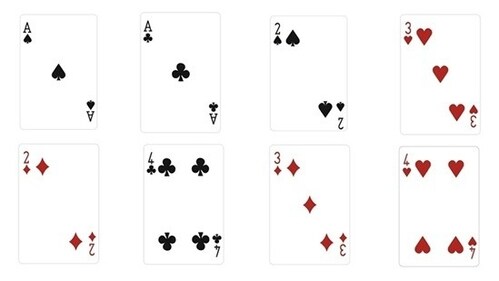
You are given eight playing cards: two As, two 2s, two 3s and two 4s. Arrange them in a single row from left to right so that there is exactly one card between the two As, exactly two cards between the two 2s, exactly three cards between the two 3s, and exactly four cards between the two 4s.
MAILBOX: LAST WEEK’S SOLVERS
Hi Kabir,
Assuming that the store owner initially bought cat food for 31 cats for N days, or 31N cans. As each cat consumes 1 can/day, the total consumption reduces by 1 can every day. Again, all cans were consumed in one day less than twice the number of days originally planned, or (2N – 1) days. Thus the total number of cans is the sum of an arithmetic progression of (2N – 1) terms starting 31, and with a common difference of –1. The sum of the AP is:
[(2N – 1)/2][2*31 + (2N – 1 – 1) (–1)] = 65N – 32 – 2N²
Equating the above to 31N and simplifying, we get the equation 2N² – 34N + 32 = 0. The roots of this equation are N = 16 and 1. As 1 day is not viable, N must be 16. So the total number of cans bought initially = 31*16 = 496. And as it took (2N –1) = 31 days to finish the whole stock of food, only 1 cat was left unsold.
— Anil Khanna, Ghaziabad
***
Hi Kabir,
Suppose the cat food was initially ordered for N days. Then, the number of cans ordered = 31N. Also, suppose K is the number of cats remaining unsold when the food stock got exhausted. On any day, the number of cans consumed is the equal to total number of unsold cats. Thus the total cans consumed
= 31 + 30 + 29… + (K + 2) + (K + 1) + K = (31 + K)(31 – K + 1)/2
i.e. 31N = (31 + K)(31 – K + 1)/2
For the right-hand side to be a multiple of 31, K has to be 1. This means 31N = 32*31/2, or N = 16. The number of cans = 31 x 16 = 496. The food lasted for 31 days. If we add one more day, we get 32 days which is twice the original period of 16 days.
— Professor Anshul Kumar, Delhi
From Professor Kumar’s approach, it emerges that the puzzle can be solved even without the information about the cans being exhausted in (2N – 1) days. Many readers, however, have used this bit in solving the puzzle.
Puzzle #144.2
Hi Kabir,
The puzzle about the party trick is fairly simple — you randomly tap on any two animal names for the first and second taps and then tap in the order of length of the animal names — i.e. COW (third tap), LION, HORSE, MONKEY, OSTRICH, ELEPHANT, BUTTERFLY AND RHINOCEROS. Obviously, this trick will get old very soon because your tapping pattern will become predictable to a keen observer.
— Abhinav Mital, Singapore
Solved both puzzles: Anil Khanna (Ghaziabad), Professor Anshul Kumar (Delhi), Abhinav Mital (Singapore), Kanwarjit Singh (Chief Commissioner of Income-tax, retd), Dr Sunita Gupta (Delhi), Yadvendra Somra (Sonipat), Shishir Gupta (Indore), Ajay Ashok (Delhi), YK Munjal (Delhi), Sampath Kumar V (Coimbatore)
Solved #Puzzle 144.1: Vinod Mahajan (Delhi)


