
 E-Paper



Problematics | Word-hunting Mastermind
This week, try using rules of an existing board game to work out a hidden word, then move to a mathematical puzzle to determine the shares of pirates in a loot.

 Prefer HTon Google


The code-breaking game Mastermind, introduced by Vic-Toy in the early 1970s, continues to be sold worldwide, but I am not sure how much interest it evokes from a generation brought up on the Internet and smartphones. That said, there is enough logical deduction involved in the game to be of interest to people of any generation who enjoy solving puzzles.
Mastermind is based on pegs of six different colours. One player hides a certain number of pegs (usually four) and the other has to guess them by calling out various colour combinations, with the first player letting the second know how many colours in the guess are correct and how many are wrong. An illustrative example helps in such descriptions: say the first player hides a peg each of the colours red, blue, yellow and white, in that order. The second player calls out blue, green, yellow and red, in that order. The first player then informs the second that the combination scored one X and two Os. One X means one correct colour in the correct position (yellow in third position). Two Os means two correct colours but in wrong positions (blue and red, which appear in the hidden combination but in a different order).
All this offers infinite possibilities for puzzlers. I have tried to incorporate these principles in a word game below.
#Puzzle 174.1
The first player has a total of 12 letters — two each of A, C, L, O, S, T. They can use any four of them to create a word hidden from you. This be two pairs of duplicate letters (e.g. TOOT) or one duplicate pair with two other unique letters (e.g. COOL) or 4 entirely different letters (e.g. LOST). To determine the first player's word, you can check with any 4 of the same 12 letters A, A, C, C, L, L, O, O, S, S, T, T.
You are allowed the liberty of testing with words as well as anagrams of 4-letter words that can be formed with the allowed letters. For example, you have ALSO at your disposal but you may feel that more useful information can be derived from the arrangement LOSA, and you are allowed to use that even though it's not a dictionary word.
You test with 5 such words and the following are your opponent's responses:
LOSA: OO (2 matching letters, both in wrong positions)
ASCT: OO again
CTLO: XO (one letter in the correct position, another matching letter in a wrong position)
TLOS: XO again
OACT: XO again.
What is the hidden word?
#Puzzle 174.2
Bluebeard, Blackbeard and Redbeard share 1,000 pieces of loot unequally. Bluebeard which he could steal half of Blackbeard's share and half of Redbeard's share, which would raise his share to 3 times its present value. Blackbeard has similar dreams: if he could steal half of Bluebeard's share and half of Redbeard's, his share would grow by 50%.
How much is the current share of each?
#Puzzle 173.1
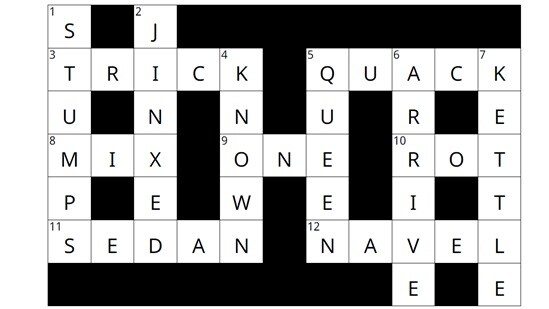
The following steps were taken to solve the crossword from the numerical clues: (1) Factorise the given numbers; (1) identify those factors that correspond to valid words; (3) find the combinations of these words fitting in the puzzle. Since the number of combinations is large, it was helpful to decipher the shorter words first and use their crossing letters as additional clues for the longer words. The result is shown in the illustration.
— Professor Anshul Kumar, New Delhi
#Puzzle 173.2
Dear Kabir,
Triangular numbers are nothing but the sums of consecutive integers given by n(n+1)/2. Here, we need n(n+1)/2 to be a whole square, and it is also a product of two consecutive integers divided by 2. In consecutive numbers, one is odd and one is even. For n (n+1)/2 to be a square, the odd number between the two should a square, and half the even number should also be a square. We do iterations with all odd whole square after 9, i.e. 25, 49 and see that the square number 49 meets the condition. This happens in 49 x 50/2. So the next triangular number meeting the condition is 49 x 50/2 = 1225 (which 35²).
— Yadvendra Somra, Sonipat
Solved both puzzles: Professor Anshul Kumar (Delhi), Dr Sunita Gupta (Delhi), Sabornee Jana (Mumbai), Shishir Gupta (Indore), Vinod Mahajan (Delhi), Ajay Ashok (Delhi), Kanwarjit Singh (Chief Commissioner of Income-tax, retired)
Solved #Puzzle 173.2: 73.2: Yadvendra Somra (Sonipat), Shri Ram Aggarwal (Delhi), YK Munjal (Delhi)


