
 E-Paper



SIR may hit gains made in bridging voting gender gap | Number Theory
.
Updated on: Jul 7, 2025, 08:24:18 IST

 Prefer HTon Google
Share via


Copy link

The Election Commission of India’s (ECI) Special Intensive Revision (SIR) of electoral rolls – it is to begin with Bihar which will go to polls later this year – has created a political storm on fears of possible exclusion of millions of voters. This controversy aside, if one of the stated objectives of the SIR is indeed achieved, India could go back to the days of a gender gap in its voter turnout. Here are four charts which explain how.
SIR may hit gains made in bridging voting gender gap
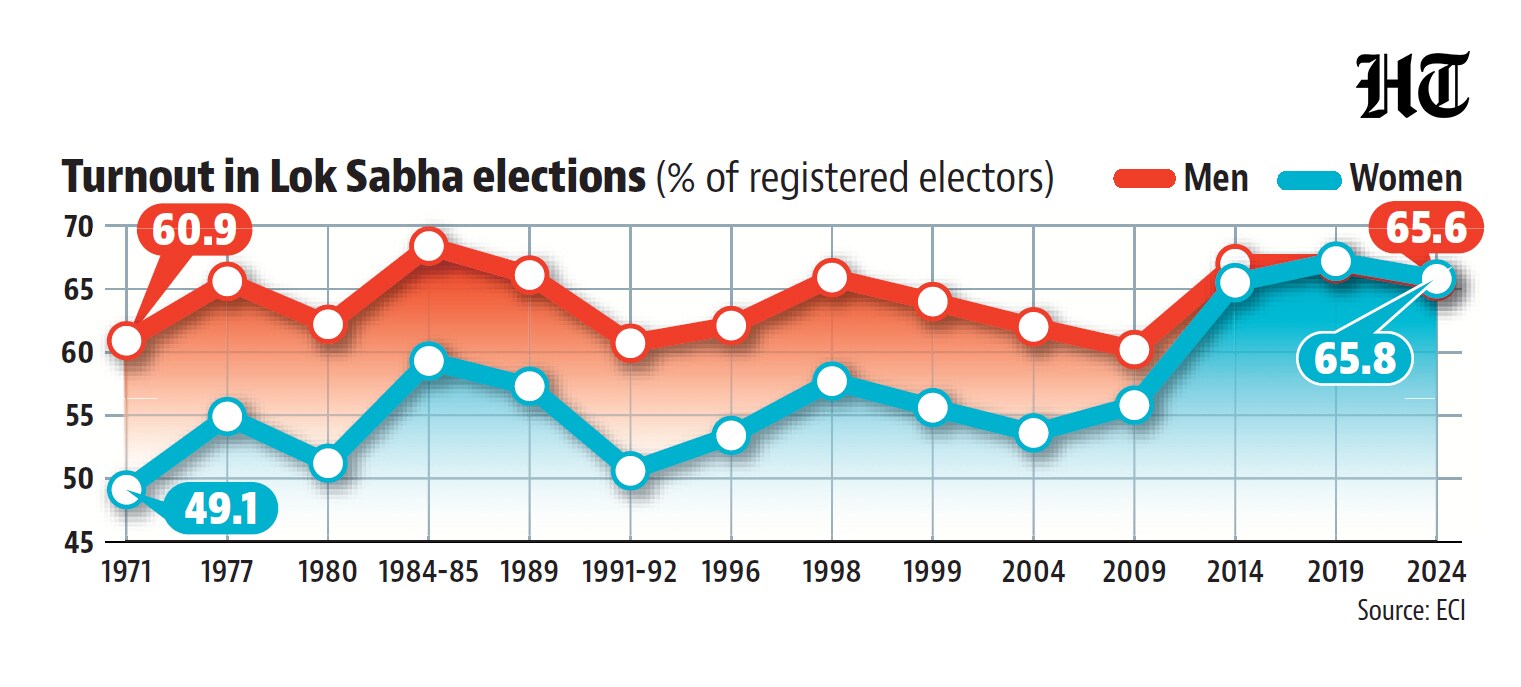
 Gender gap in India’s voter turnout has fallen drastically in the last decadeECI data shows that male voter turnout was 8-10 percentage points greater than that of women in general elections in India for almost two decades between 1984 to 2004. This number used to be slightly higher pre-1984. It halved in the 2009 elections, fell to 1.5 percentage point in 2014, and women outvoted men in the 2019 and 2024 general elections.
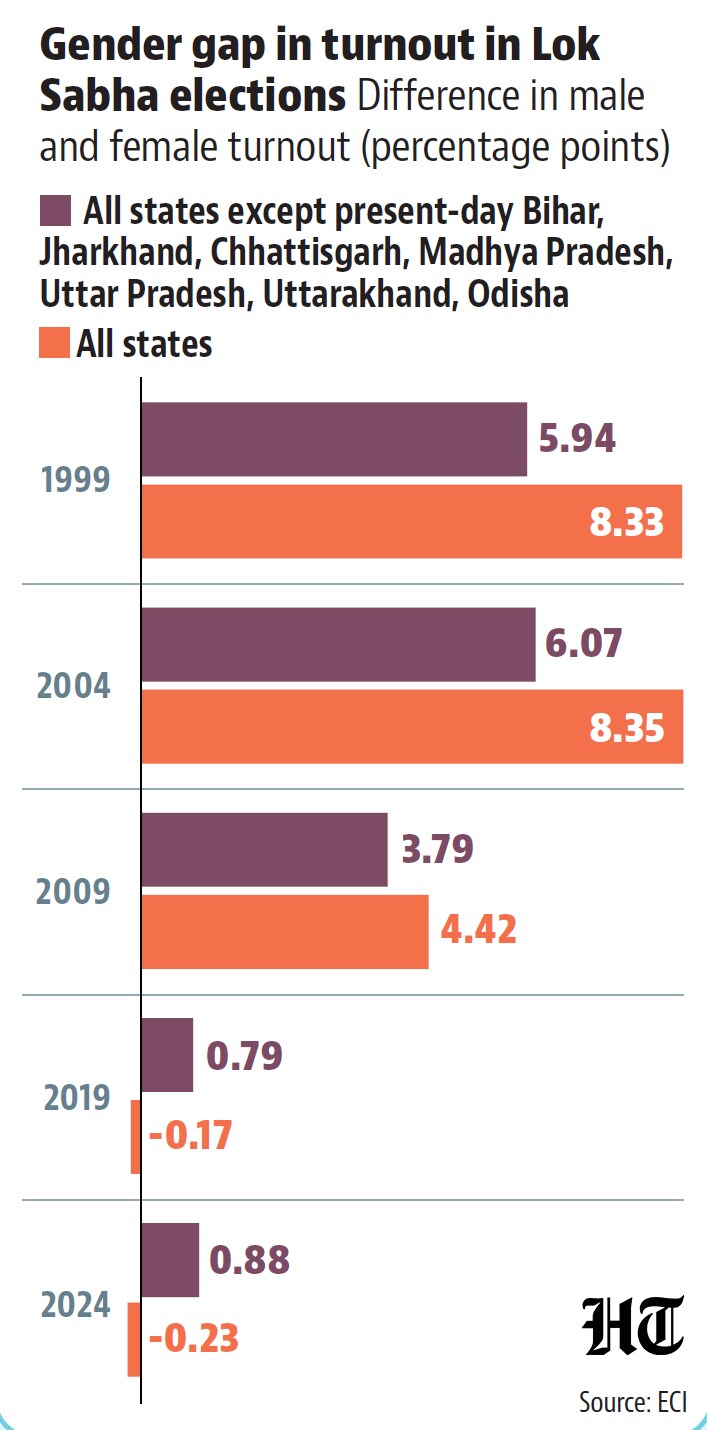
- Only a handful of states can undo the gainsThe reduced gender gap in voting has been noticed and praised in India and outside and justifiably so. But what really explains this trend? Sure, ECI has taken a lot of effort to raise awareness about voting, and women have been increasingly coming out in the public sphere in India in the past couple of decades. While these factors could have played a role, the primary driver might have been economic (more on this later). For now, it is important to flag that the recent changes in India’s gender-wise voter turnout gap have been driven by a handful of states. If one were to take out undivided Bihar, Madhya Pradesh, Uttar Pradesh and Odisha from the national voter turnout calculations, men would have a greater voter turnout than women in India in both 2019 and 2024 elections. Another way to look at this data is to argue that only eight out of India’s 18 major states (the new states/UTs created in 2000, 2014, and 2019 counted together with their parent states) had a higher women voter turnout than men in 2024.
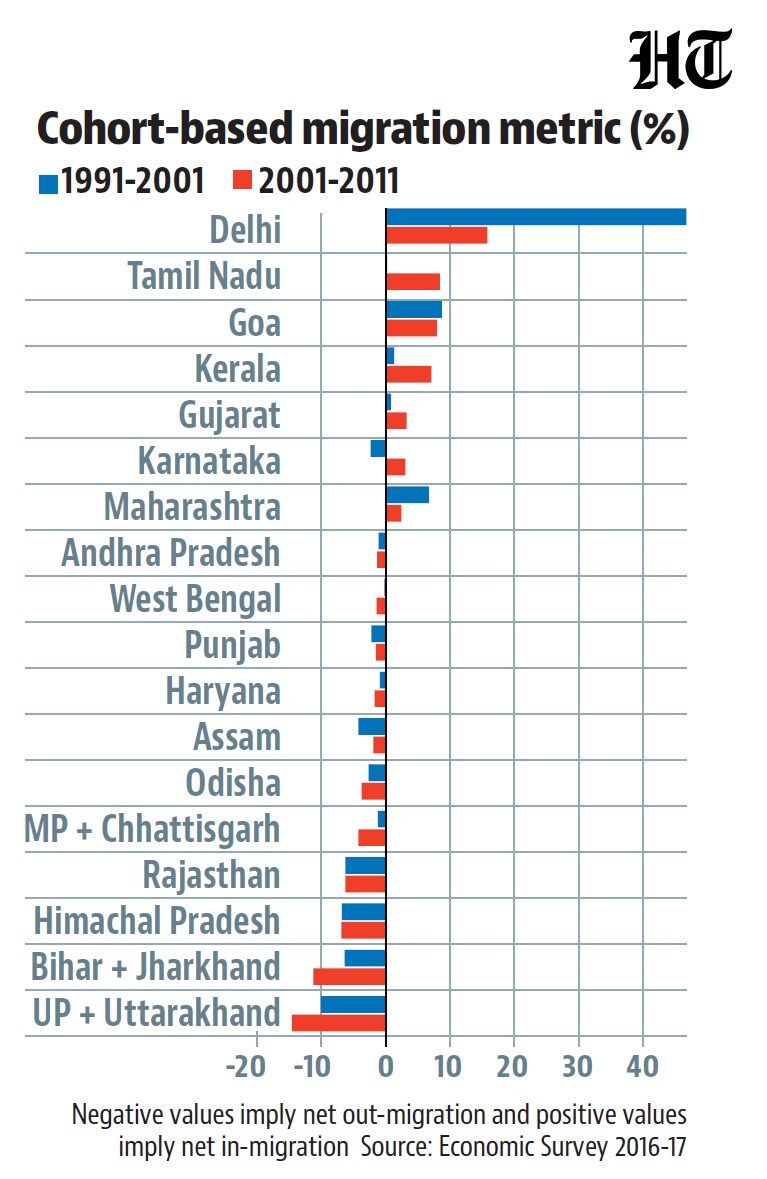
- And these are the ones with highest outmigrationMigration for employment is one of India’s biggest economic realities. Official data on migration, unfortunately, is extremely dated – the last census was conducted in 2011 – and by the government’s own account, not even correct. The 2016-17 Economic Survey, the flagship publication of the ministry of finance, for example, used age-wise census data and railways data to argue that the official number of migrants in the census was likely a gross under-estimate and that the actual numbers were likely around twice as large. To be sure, even the official migration numbers in the census show that the annual growth in the number of migrant workers increased from 2.4% between 1991 and 2001 to 4.5% between 2001 and 2011. While the rate of migration increased more for female workers, they were a small proportion of economic migrants in all three years, the respective numbers being 15.4%, 12.1%, and 17.6%. The Survey used something called a cohort-based migration metric (CMM) to estimate the migration of 20-29-year-olds and found that Odisha and undivided Bihar, Madhya Pradesh and Uttar Pradesh were the leaders in outmigration in India, the same states whose contribution has flipped Lok Sabha turnouts in favour of women. What explains women outvoting men in most high out migration states? The simplest explanation can be male migrant workers being registered as voters but not voting because they work outside and are physically not present when voting happens. To be sure, male voter turnout has increased even in these states except Bihar but one can argue that the increase would be even greater if migrant workers were voting.
- What has all this got to do with SIR?ECI has listed weeding out immigrants as one of the stated objectives of the SIR exercise. “For example, if you ordinarily reside in Delhi but own a house in Patna, your vote should be registered in Delhi, not in Patna,” Chief Election Commissioner Gyanesh Kumar told media. The legality of such a statement notwithstanding, a strict enforcement of this principle will entail migrant workers being removed from electoral rolls in their home states even though they could potentially be added in places where they work. However, ECI and everybody else ought to ask a more deep-rooted, perhaps, even a philosophical question. If millions of migrant workers work as proverbial footloose labour outside their homes, is it really wrong if they want to maintain their votes in their homes rather than places of work where they have very few social-political links and perhaps even agency?



Unlock a world of Benefits with HT! From insightful newsletters to real-time news alerts and a personalized news feed – it's all here, just a click away! -Login Now!


