The rationalised Goods and Services Tax (GST) rates came into effect on 22 September. After the upward revision in income tax slabs – effectively a tax cut – announced in the 2025-26 Union Budget, the latest GST rejig is yet another policy burden to reduce the tax burden on the economy. The government’s own calculations put the estimated tax forgone because of these two decisions at around ₹1.5 lakh crore ( ₹1 lakh crore form the income tax
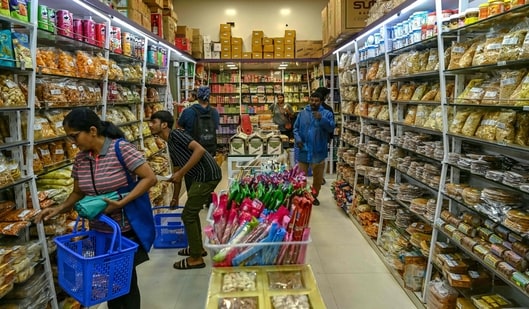
The GST rationalisation is clearly an attempt to boost spending in the economy and generate tailwinds for not just growth but even revenue creation. (AFP)
The dissipation of pent-up demand after the pandemic
The dissipation of pent-up demand after the pandemic
Anybody who looks at annual growth numbers after the pandemic will think that the economy has been losing growth momentum almost continuously. Annual GDP growth was 9.7%, 7.6% and 9.2% in 2020-21, 2021-22 and 2023-24 and it fell to just 6.5% in 2024-25. These numbers need to be seen in the context of the post-pandemic recovery of the economy. If one were to compare the compound annual growth rate (CAGR) of the economy from the pre-pandemic year (2019-20) it has continuously increased in every year. To be sure, the pace of the post-pandemic CAGR increase did fall in 2024-25, which suggests that there was some sort of slowing in growth momentum in the last financial year. It is perhaps this momentum which the government is hoping to rekindle by giving a tax relief to consumers.
India’s consumer demand is far from homogenous
Just because cars will become cheap after the new GST rates does not mean everybody will start buying cars in India. Large number of Indians do not earn enough to spend on such goods. According to the latest government data on consumer spending – the 2023-24 Household Consumption Expenditure Survey (HCES) – at least half of Indian households in both rural and urban areas spent over 40% of their household budgets on just food. To be sure, the HCES data might not be the best indicator of consumer spending in India because it tends to undercount the spending by the rich. For example, of the 261,953 households surveyed in 2023-24, only 26 had a monthly spending of ₹2 lakh or more. . To be sure, the HCES does a good job of giving a fairly representative idea about the consumption pattern of a large part of the Indian population. What most Indians need to boost their spending is a sustained increase in their income levels rather than some windfall tax gains.
But the tax benefits could boost economic sentiment of the relatively rich and generate some tailwinds for growth
Consumer sentiment data as captured by RBI’s Consumer Confidence Surveys (CCS) shows a clear class-wise divergence in economic sentiment across class. Higher income groups are more bullish about the general economic situation than their lower-income counterparts. Given the fact that this cohort undertakes a large part of the spending in the Indian economy in any case, the disposable income tailwinds from income tax and now GST cuts could nudge them to spend more on goods and services especially in the festive season. We would get a better idea of such sentiment boost or lack of it when RBI generates the next round of its CCS in October. To be sure, the unit level data for the October round of the CCS will only be available with some lag.
The real challenge is a sustained revival in private investment
That India is the fastest growing major economy in the world and will become its third largest in the next few years is well known. This is something which is not contingent on the government’s recent tax relief announcements. What the Indian economy really needs is a sustained high growth phase (in the ballpark of 7.5%-8%) to attain the government’s goal of making India a developed economy by 2047. What this needs more than anything else is a sustained increase in investment spending in the economy. While the government raising its share of capex has helped, what is still missing in the act is a sustained rise in private investment which merits fresh investment. This will not happen unless the private sector sees a sustained growth in future demand. Capacity utilization levels as seen in RBI’s surveys have been largely flat at around 75%. This is essentially a demand side challenge for the economy.
Roshan Kishore is the Data and Political Economy Editor at Hindustan Times. He heads the newsroom's data journalism team, which produces Number Theory, a daily data-driven feature for the print edition and the HT app. Number Theory uses data analysis and story-telling based on it to add value to the newsroom’s daily coverage by putting stories in a larger context on a range of issues, including politics, macroeconomy, markets, global affairs and climate. Under his leadership HT’s data journalism work has established itself as a niche product in Indian journalism and pushed the boundaries of marrying academic rigour with news sense and speed. Along with writing and editing data stories, he has also been writing a weekly political economy column called Terms of Trade for HT Premium. A trained economist with an MPhil degree from Jawaharlal Nehru University, Kishore has also been a visiting fellow at the Centre for Advanced Studies of India (CASI) at the University of Pennsylvania. Along with his journalistic work, his writings have also appeared in journals such as the Economic and Political Weekly and working papers for CASI and UNESCAP.
Abhishek Jha is Assistant Editor-Data at Hindustan Times. He uses statistical programming to generate newsworthy insights from large datasets. He is part of the team that produces Number Theory, a daily data story feature of the paper’s print edition. Since March 2024, he has been writing Weather Bee, a weekly column for the Hindustan Times website. He is a chemical engineer by training, who specialises in stories related to weather, climate, and the environment. Jha has been at HT since 2018, where he offers data-driven perspective and analysis on politics, environment, weather, climate, economy and society. His work includes data coverage of elections in India and abroad, including the 2019 and 2024 Lok Sabha elections; the disasters and extreme weather resulting from changing climate, such as floods, droughts, heat waves, cold waves, and dwindling snow cap in the Himalayas; the factors that drive poor air quality in northern India; the changing patterns of land use; the Covid-19 pandemic and its impact on labour market conditions; the changing pattern of consumer spending seen in the new consumer spending surveys; and social norms seen in the surveys such as the National Family Health Survey.
Unlock a world of Benefits with HT! From insightful newsletters to real-time news alerts and a personalized news feed – it's all here, just a click away! -Login Now!
Unlock a world of Benefits with HT! From insightful newsletters to real-time news alerts and a personalized news feed – it's all here, just a click away! -Login Now!
Home/Editors Pick/State of the economy and economic sentiment | Number Theory
{{^htLoading}}
Advertisement
{{/htLoading}}
SHARE THIS ARTICLE ON
{{#usCountry}}{{/usCountry}}
Notifications
Get breaking alerts directly from the newsroom
Notifications are on!You'll be notified when news breaks