
 E-Paper



The fiscal implications of GST rationalisation | Number Theory
.
Updated on: Aug 20, 2025, 09:05:42 IST

 Prefer HTon Google
Share via


Copy link

Prime Minister Narendra Modi announced in his August 15 speech that the government would bring a proposal in the Goods and Services Tax (GST) Council to reform the indirect tax regime beginning with a reduction in the number of slabs. GST, if the proposal goes through the Council, is expected to become a 3-slab tax with two main rates of 5% and 18% and a special rate of 40% from the current four-slab system of 5%, 12%, 18% and 28%. Unless most commodities and services are moved to the 40% slab, which would increase the tax burden on consumers, this is likely to lead to a loss in GST revenues. What can we say about the fiscal implications of this rate rationalization? Here are three charts that try to answer this question.
The fiscal implications of GST rationalisation
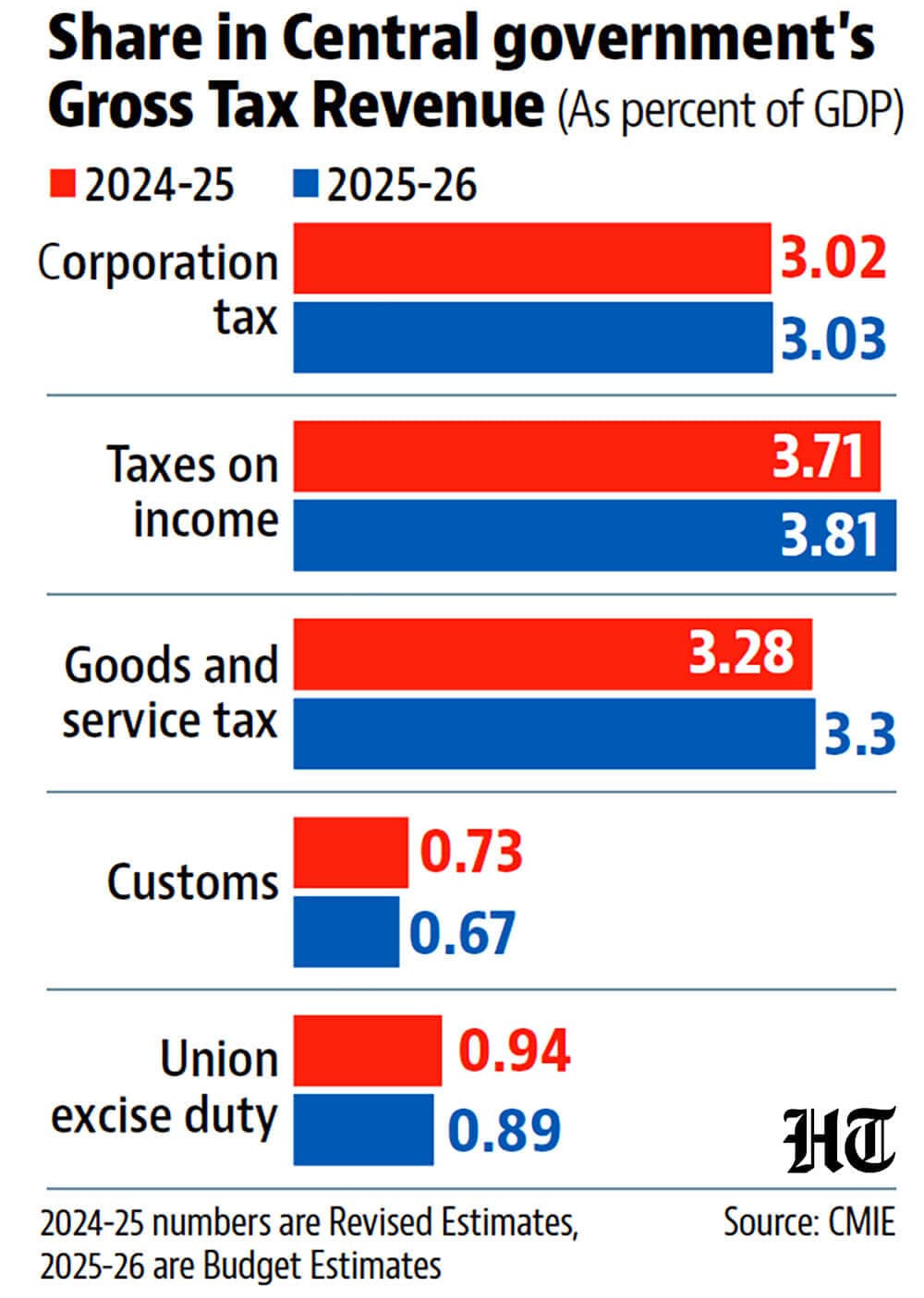
 How important is GST in total tax collections?If one were to look at GST collections as a whole – it accrues to both Centre and states – they have stabilised at around 6.7% of GDP in the past three years, slightly higher than in the first three-four years after the tax’s rollout. This makes GST a much more important tax than other central taxes such as income tax, corporation tax, excise duties or customs duties. To be sure, the GDP share of GST in central taxes is not very different from direct taxes such as income tax and corporation tax.
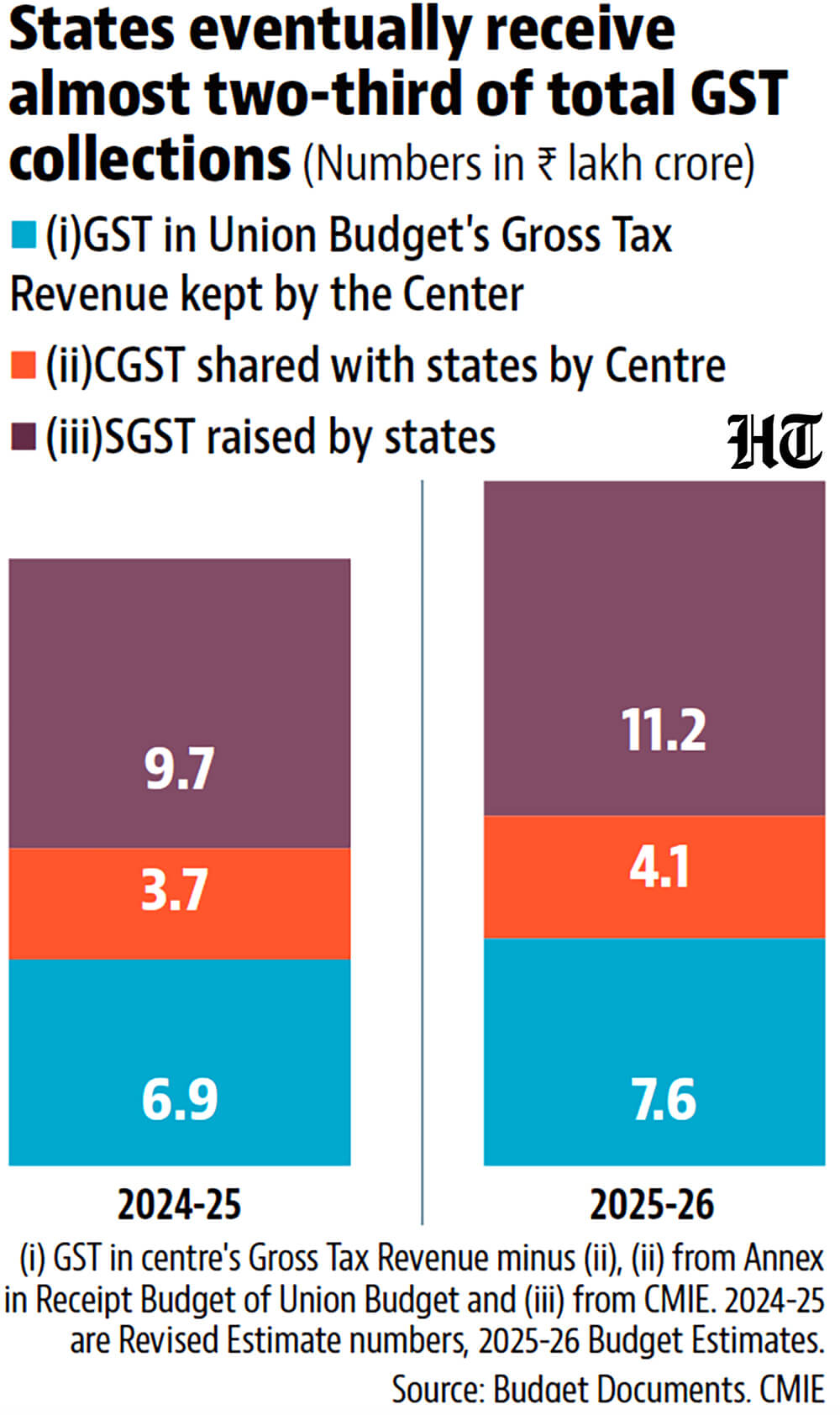
- How is GST shared between the Centre and states?States benefit from GST in two rounds. They receive the State GST (SGST) collections as part of their own tax revenue and then get part of the central GST collections as part of India’s fiscal federalism framework. This means that the central government only gets a small share of total GST collections, and therefore, also means that states will share a bigger burden of any fall in GST collections on account of rate rationalisation.
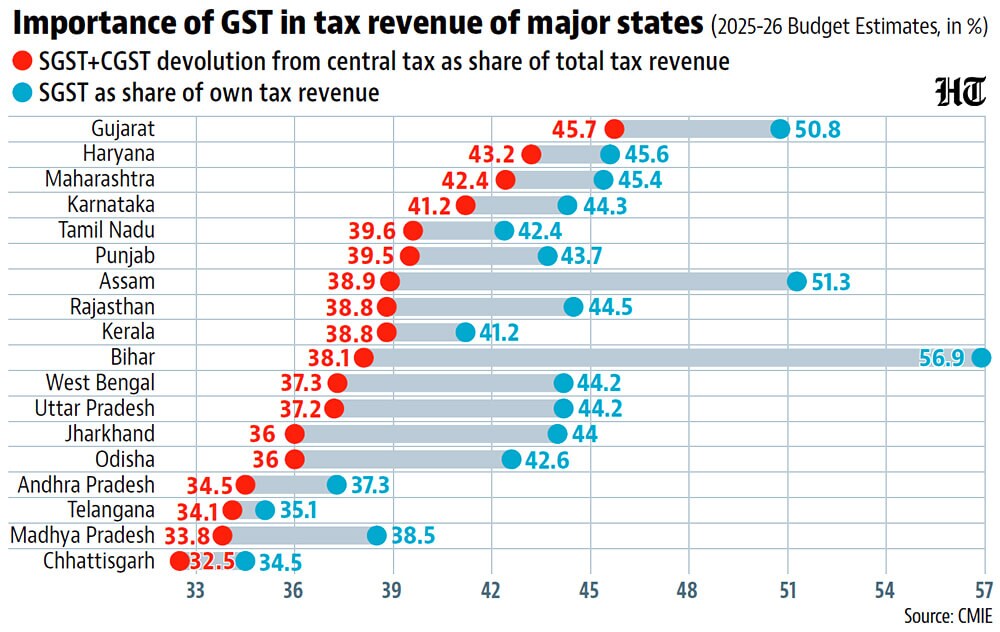
- How important is GST for different states?There are two ways to answer this question. SGST’s importance in state’s own tax revenues and SGST plus GST devolution from the Centre in a state’s total tax revenue. A comparison of these two numbers using the Centre for Monitoring India Economy’s (CMIE) database shows a large variation among states. For example, a state like Bihar got almost 57% of its own tax revenue from State GST ( it raises zero in excise duty collections because of its prohibition policy) while this number was just about 38.5% for Madhya Pradesh. If one were to compare state GST plus GST devolution received from the center as a share of total tax revenues of the states, the range varies from about 45.7% for Gujarat to just 33.8% for Madhya Pradesh. This means that states will have a differentiated impact on their revenue baskets on account of any reduction in GST collections because of the proposed rate rationalisation.
- What are experts saying?“Things begin to get complicated when we ask who will foot the bill of tax cuts…The Centre has other revenue sources to count on, but states do not have as many options. They may not agree to the revenue hit. Their complaint could be that they already follow the FRBM Act whereby they must keep the fiscal deficit below 3% of GDP. Now following the GST rules and cutting tax rates could be a difficult task, unless they cut other important expenditure like capex. If the central government then comes up with a compensation plan to handhold states for a few years, the funds would have to be made available. If these funds are generated by a GST tax hike in say, some luxury goods or suchlike, that would go against the efficiency principles of having lesser number of GST rates” HSBC Chief India economist Pranjul Bhandari said in a note. “Even within the Centre’s total tax revenue (including GST), around one-third is shared with states. So overall, two-thirds of the GST revenue loss would fall on states… Another source of uncertainty is the treatment of extra revenue collected under currently applicable GST compensation cess. As we discussed earlier, there could be some extra revenue collected under the GST compensation cess which might help offset these losses, however treatment of this extra revenue remains unclear”, Samiran Chakraborty Chief India Economist Citibank said in a note.


Unlock a world of Benefits with HT! From insightful newsletters to real-time news alerts and a personalized news feed – it's all here, just a click away! -Login Now!


