E-Paper



The roots of BJP’s current dominance in Assam | Number Theory
.

 Prefer HTon Google


Assam, which will vote on April 9, is the only state in this election cycle which is ruled by the Bharatiya Janata Party (BJP). It is also one of the few states where the BJP’s dominance has followed its 2014 national victory. The BJP has not lost a national or state election in the state since 2014 and is looking to form its third consecutive government in the coming elections. How exactly did the BJP establish itself as a dominant party from being a marginal force in the state? Why is it difficult for the Congress to dislodge the BJP? This two-part data journalism series on Assam will answer some of these questions. The first part will examine BJP’s recent dominance, and the second part discusses the challenges that face Gaurav Gogoi’s Congress compared to Tarun Gogoi’s Congress.
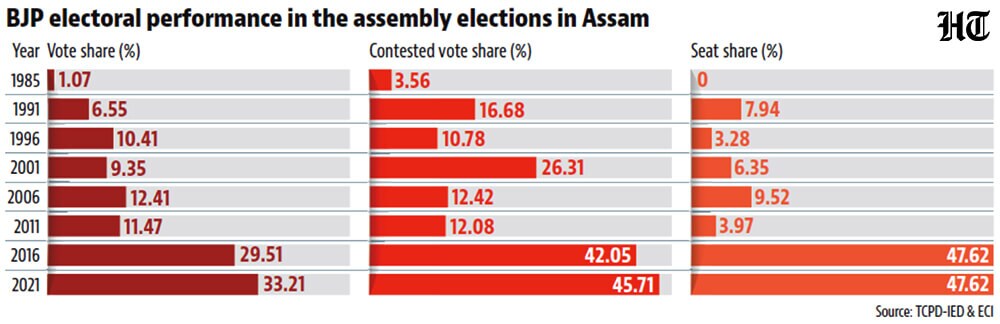
 BJP’s current political dominance in Assam is remarkable compared to its own pastIn the 2021 assembly elections, the BJP-led alliance won 75 out of the state’s 126 assembly constituencies (ACs). BJP alone, won 60 ACs in 2021. 2021 marked an improvement for both the BJP and its larger alliance compared to 2016 when they won 60 and 74 ACs respectively. The past two election victories are also a huge achievement for the BJP which started contesting assembly elections in Assam from 1985 and had never crossed a threshold of 13% vote share and 10% seat share before 2016. To be sure, the BJP did get 29% seat share in the 2009 Lok Sabha elections. Not only has the BJP turned the tables on Congress, its principal opponent in the country in Assam, it has also made the Asom Gana Parishad (AGP) its junior partner now. The BJP contested the 2001 assembly election in Assam with the AGP as its senior partner. The AGP had defeated the Congress twice in the state in the 1985 and 1996.
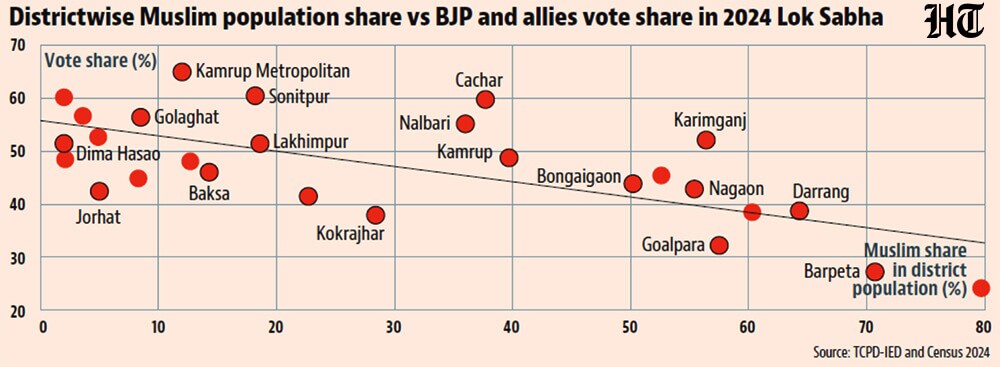
- BJP’s latest electoral victory has a very simple logic: State's demographic geographyThe BJP’s chief minister in Assam has often made the headlines with shrill remarks against the state’s Muslim population. Intuitively speaking, this sounds like a very bad strategy. Assam has the largest share of Muslim population among Indian states, and they accounted for 34.2% of the state’s population according to the 2011 census. However, Assam’s Muslim population distribution is extremely skewed, and 90% of it is concentrated in just 14 out of 27 districts as they existed in the 2011 census. An AC-wise breakup of the 2024 Lok Sabha results shows a strong correlation between the vote share of the BJP and its allies and the share of the Muslim population at the district level. To be sure, the incumbent BJP government in Assam, like most other peers, has also used cash transfers to consolidate its support before elections. Assam announced a cash transfer of ₹9000 each to 4 million women in the state on March 8, just ahead of the elections.
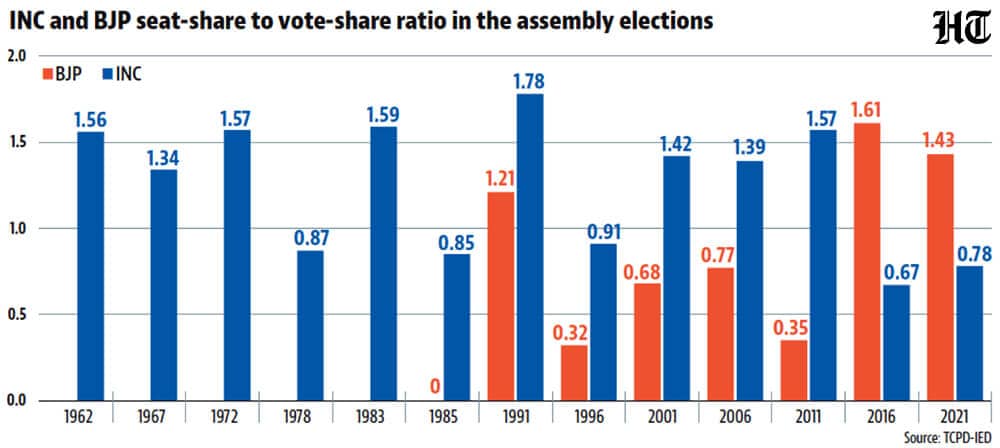
- To be sure, BJP’s first-past-the-post exploits are still smaller than what they were for the Congress at its peakIn the 2021 assembly elections, the BJP won 60 out of the state’s 126 ACs with a vote share of 33.6%. This means a seat-share to vote-share ratio – it is a useful metric to capture a party’s efficacy of lack of it in converting popular support into legislative strength in the first-past-the-post system – of 1.41 for the BJP. The Congress, in 2021 managed to win just 29 ACs with a vote share of 30%, which means a seat-share to vote-share ratio of just 0.77. While the BJP significantly outperformed the Congress on the seat-share to vote-share ratio comparison in both 2016 and 2021, the Congress had done even better on this count in the 2011 assembly elections which saw Tarun Gogoi becoming the chief minister of the state for the third consecutive time. The Congress, in 2011 won 78 ACs with a vote share of 39.4% leading to a seat-share to vote-share ratio of 1.57. For the Congress, this ratio has been even higher in the past.