
 E-Paper



The two-horse AI talent race | Number Theory
The race to build AI of that potential is being run with an extremely small pool of human researchers. It is primarily a 2-horse race between the US and China
Updated on: Sep 24, 2026, 06:41:04 IST

 Prefer HTon Google
Share via


Copy link

Artificial intelligence, when it reaches its full potential, might replace humans at work. But the race to build AI of that potential is being run with an extremely small pool of human researchers. It is primarily a two-horse race between the US and China. While the former is still drawing talent from across the world, the latter is primarily working with homegrown talent. India, unfortunate as it sounds, is just a preparatory school of producing AI talent. These findings are from research by Damien Ma and Binyi Yang at Carnegie China, which draws on information collected from papers accepted in NeurIPS, one of the most prestigious machine-learning conferences, to track the global elite among AI researchers.
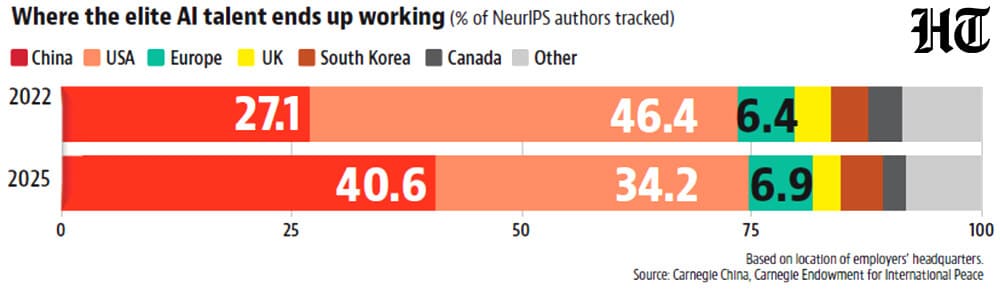
 US and China are the biggest leaders in employing the AI talent poolThe elite AI talent pool has increased significantly in the recent past. The number of unique authors at NeurIPS, for example, increased from 9,617 to 25,677 between 2022 and 2025, of which 3,153 and 10,280, respectively, are tracked by Ma and Yang for their analysis. In 2022, the US led China by a distance in the share of this cohort who ended up working in its country. Now China is ahead of the US with a six-percentage point lead. Three-fourth of the 2025 elite AI talent pool in the world is now working in China and the US. To be sure, Ma and Yang only track researchers in the year following the conference. In other words, the 2025 numbers mean that three-fourth of the authors with papers accepted in the year work in the US and China in 2026.
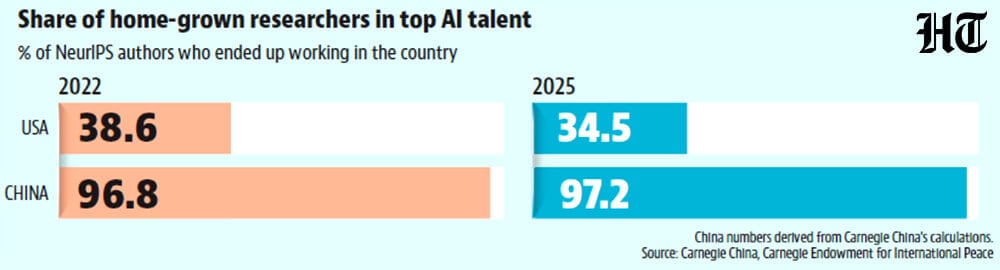
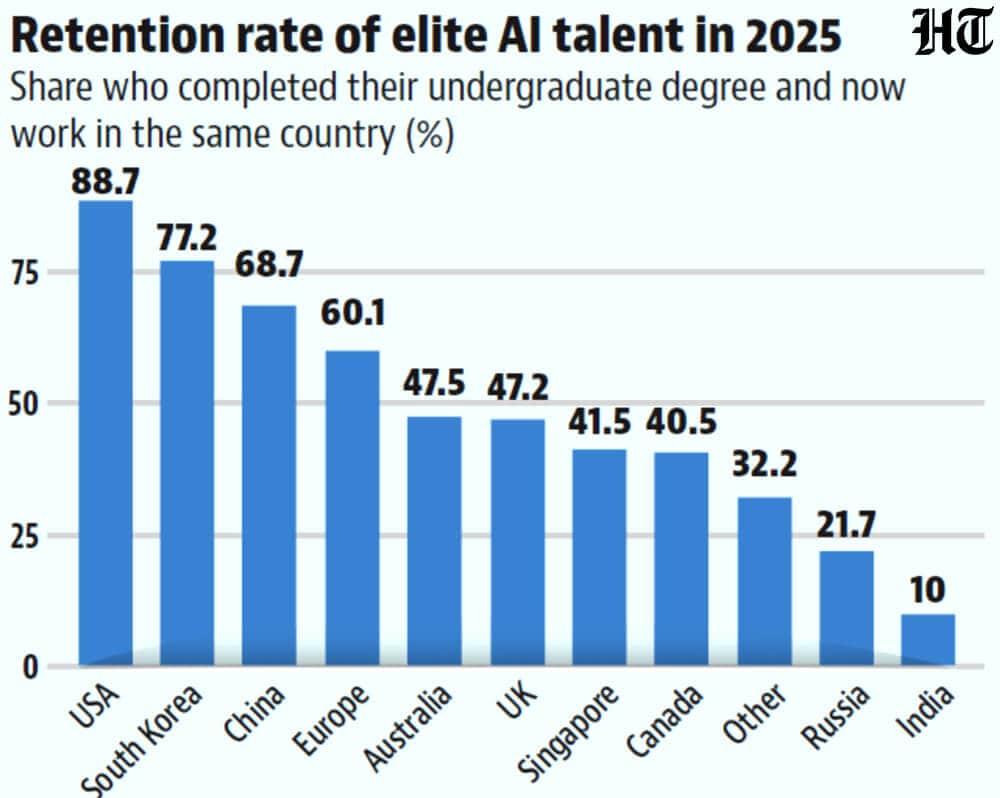
- China’s elite AI talent pool is overwhelmingly home-grown, unlike the USChina has achieved the feat described above by boosting its production and retention of the elite cohort. Between 2022 and 2025, China’s production of such talent increased from 1,460 to 5,903 and retention rate from 57% to 69%. In the same period, USA’s production increased from 623 to 1,369, while its retention rate was around 90% in both years. This means that only 34% of the roughly 3,500 researchers who ended up working in the US from the 2025 cohort were trained in the country while 97% of the 4,100 who ended up working in China were trained there. Data from Carnegie also underlines the role of Chinese universities in buttressing its lead in AI. In 2022, only two Chinese universities figured in the top 10 institutions where elite AI researchers worked. In 2025, this number had increased to five.
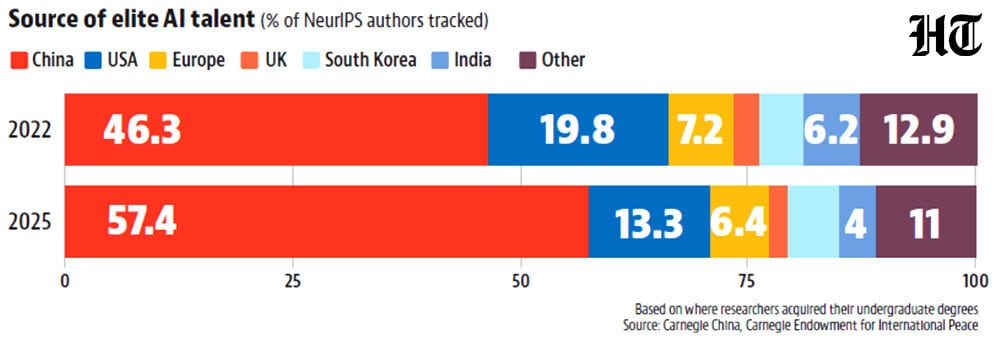
- India does relatively well in producing early talent for AIThe data tracks the source of AI talent as the place where the researchers completed their undergraduate degree. This shows that India had a 6.2% share in the global pool of elite AI talent in 2022. This decreased to 4% in 2025. To be sure, this does not mean that the number has fallen in absolute terms. However, countries such as South Korea have increased their global share to move ahead of India and China has increased its share to account for more than half of the researchers.
- However, India finds it hard to retain such elite talentTo be sure, producing AI talent is not enough for a country to drive economic value from the technology if it cannot retain the talent. This is yet another problem plaguing India. Among the 11 regions tracked by the dataset – nine countries, Europe, and rest of the world – India had the lowest retention rate for the 2025 talent. Just 10% of the 411 people who acquired their undergraduate degree in India in 2025 now continue to work in the country. At the same time, more AI talent left than arrived in the country in 2025, making it an unattractive place for AI talent.
- These numbers need to be read with two more caveats. One: author information was dependent on authors maintaining structured profiles covering education and current employment. Two: the sample also over-represents academia and under-represents industry talent. Ma and Yang say this affects the direction seen for Europe and not for the US and China, but are silent on India.


Unlock a world of Benefits with HT! From insightful newsletters to real-time news alerts and a personalized news feed – it's all here, just a click away! -Login Now!


