
 E-Paper



Understanding global military expenditure | Number Theory
How is military spending rising around the world? Where does India fit into this trend? The charts below explore these in detail
Updated on: Apr 29, 2025, 08:23:07 IST

 Prefer HTon Google
Share via


Copy link

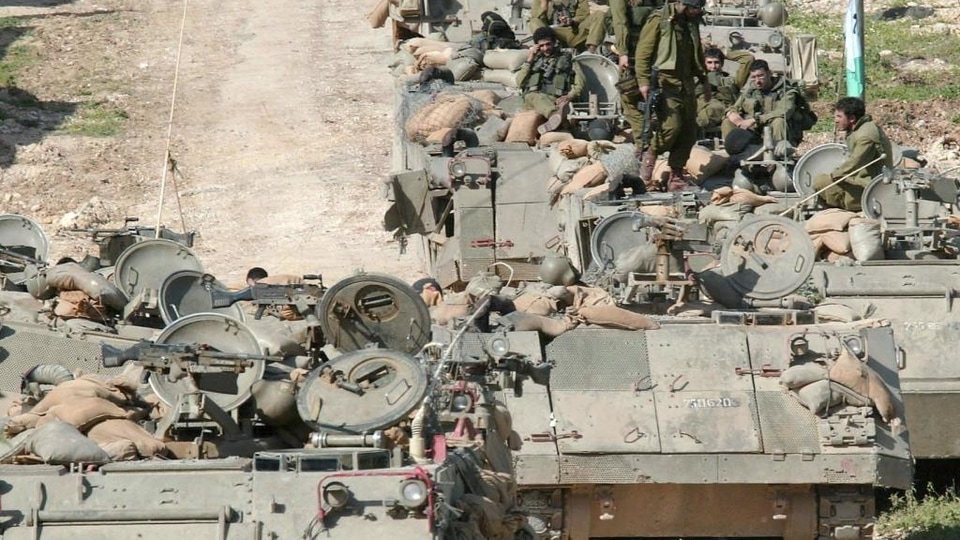
World military expenditure has touched a record high, rising sharply amid wars, geopolitical tensions, and a renewed global arms race. In 2024, global military spending grew 9.4% in real terms to reach $2.7 trillion, according to the “Trends in World Military Expenditure 2024” report released by the Stockholm International Peace Research Institute (SIPRI). This is the highest amount ever recorded, and the sharpest year-on-year increase since at least 1988.
How is military spending rising around the world? Where does India fit into this trend? The charts below explore these in detail.
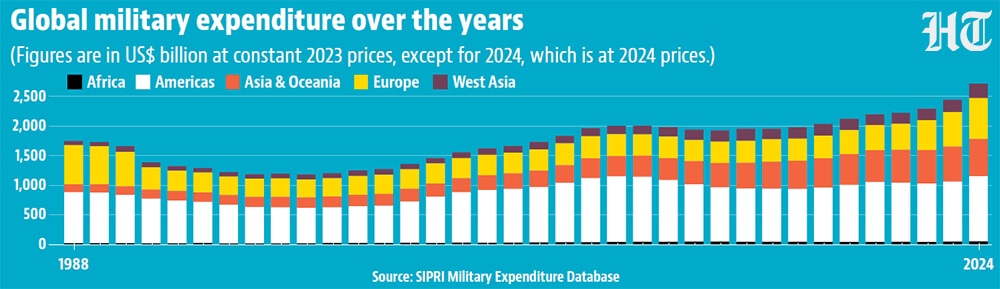
 A record surge in global military spendingGlobal military spending has risen by nearly 37% over the past decade. For the second year running, military expenditure increased in every region of the world in 2024. Europe saw the sharpest regional jump, with spending rising by 17% from the year before amid the ongoing war between Russia and Ukraine. West Asia’s military expenditure also grew by 15% as Israel’s conflicts with Gaza and Lebanon intensified. Data from SIPRI shows that a relatively small group of countries is responsible for the majority of the world’s military expenditure. The United States, China, Russia, Germany and India together accounted for 60% of all military spending last year. To be sure, they also account for 52.4% of global GDP. Notably, 2024 marked the tenth consecutive year in which global military spending has increased—signalling rising military spending is a trend rather than a one-off event. See chart 1
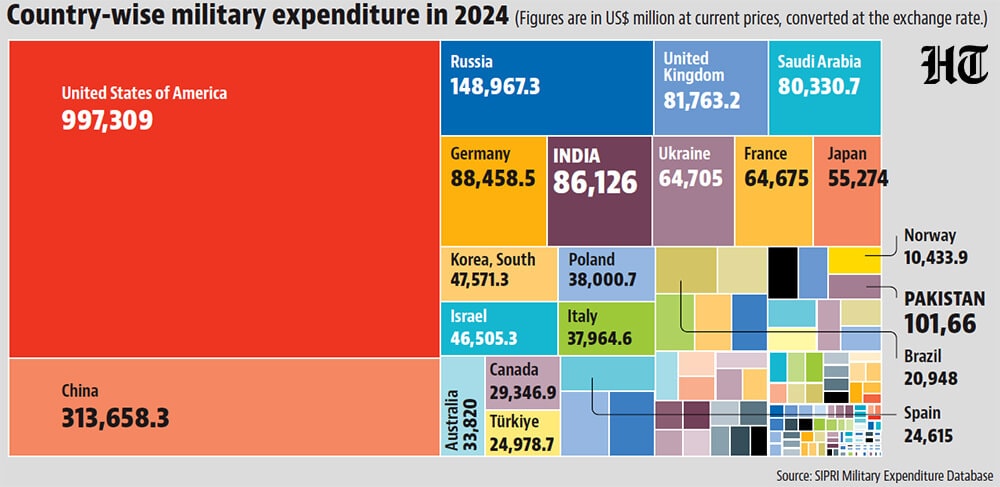
- Where does India stand?The United States remained the world’s largest spender, with its military expenditure reaching $997.3 billion, accounting for 37% of the global total. China was second, with an estimated military expenditure of $313.7 billion. Russia and Germany followed. Russia’s military spending rose by 38% in 2024 alone to reach $149 billion, while Germany’s jumped by 28% to reach $88.5 billion, as it continued to rebuild its armed forces after decades of under-investment. India was the fifth-largest military spender in the world in 2024, allocating $86.1 billion to defence. This was a modest 1.6% rise from 2023, and a substantial 42% increase over the past decade. Although India remains one of the world’s biggest arms importers, it has made progress reducing its reliance on imports, said the report. As much as 75% of its cap-ex on defence (equivalent to 22% of military spending) is now earmarked for domestic procurement. The country is now able to produce armoured vehicles, helicopters and submarines. “However, it remains reliant on imports for some more advanced systems, such as combat aircraft,” added the report. Pakistan, meanwhile, ranked 29th for military spending in 2024, with an estimated expenditure of $10.2 billion. See chart 2
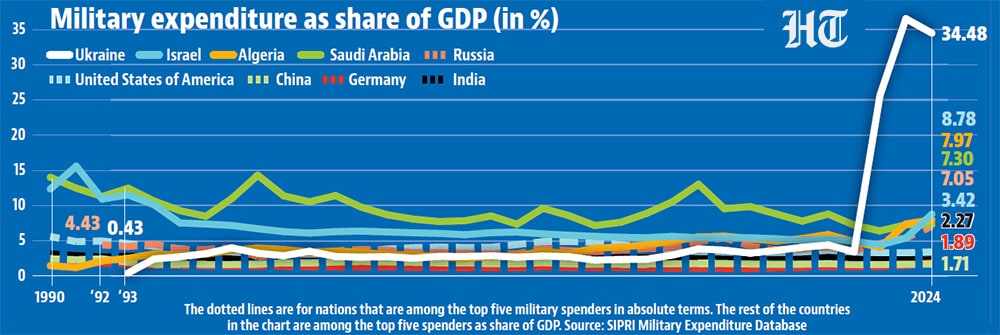
- Beyond strategic considerations, the surge in military budgets is creating significant economic pressures. Military spending accounted for 2.5% of global GDP in 2024, the highest share since 2009. The previous high could have been driven by global GDP falling because of the 2008 global financial crisis. On average, countries experiencing armed conflict (defined as those with over 1,000 conflict-related deaths in the year) spent 4.4% of their GDP on the military in 2024, compared with 1.9% in countries not affected by conflict. The highest military burdens, spending as share of GDP, were recorded in Ukraine (34%), Israel (8.8%) and Algeria (8.0%). The largest year-on-year increases were seen in Israel (+3.4 percentage points), Myanmar (+3.0) and Russia (+1.7). Meanwhile, India’s military expenditure as a share of GDP stood at 2.27% in 2024, a marginal decline from 2.36% the year before. To finance growing defence budgets, many countries have been forced to cut spending elsewhere or borrow more. The United Kingdom plans to reduce its overseas development assistance to fund military expansion, while Germany is relaxing its fiscal rules to accommodate larger defence outlays. “These approaches carry significant economic, political and social consequences,” the report noted. Increasing debt to boost military budgets may offer a short-term solution, but risks undermining macroeconomic stability by pushing up inflation and interest rates. “Redirecting social expenditure or international aid to free up resources may negatively affect socio-economic protection, impacting heavily on the most vulnerable groups or countries,” it warned. Depending on how they are implemented, tax rises to support defence spending may also raise concerns about fairness. “Broad-based increases in income tax or consumption taxes can have regressive effects, potentially worsening economic and societal inequality,” said the report. See chart 3


Unlock a world of Benefits with HT! From insightful newsletters to real-time news alerts and a personalized news feed – it's all here, just a click away! -Login Now!


