
 E-Paper



What would a BJP-SAD reset mean for Punjab? | Number Theory
Here are four charts that answer some questions pertaining to the possibility of a BJP-SAD détente
Updated on: Dec 8, 2025, 09:10:37 IST

 Prefer HTon Google
Share via


Copy link

Amarinder Singh, former Punjab chief minister from the Congress and now a Bharatiya Janata Party (BJP) leader, recently advocated an alliance between the BJP and the Shiromani Akali Dal (SAD) to boost the winnability of both parties in the state. While other BJP leaders have attributed the views as Singh’s personal opinion and said that the central leadership of the party will take a call on any such move, it is worth examining what such an alliance would entail as far as political arithmetic goes in Punjab. Here are four charts that answer some questions pertaining to the possibility of a BJP-SAD détente.
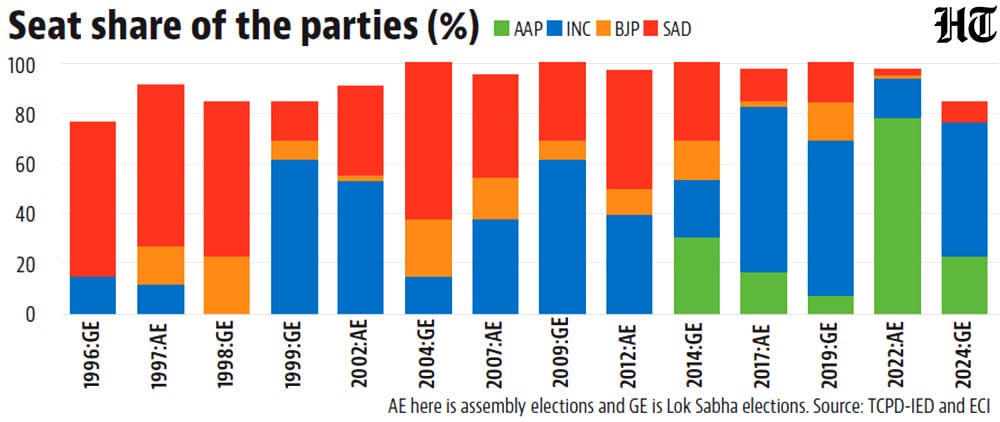
 Both the SAD and the BJP have suffered since parting ways in PunjabThe BJP and the SAD entered into an alliance in Punjab for the first time in the 1996 elections. This ended after the SAD withdrew from the National Democratic Alliance (NDA) in 2020 in protest against the (now-withdrawn) three farm laws, which triggered a large farmers’ protest in Punjab. The rupture cost a lot for both the SAD and the BJP. While the BJP-SAD alliance won the highest number of assembly constituencies (AC) or parliamentary constituencies (PC) in six of the 12 elections held between 1996 and 2019, the two parties put together won just 4.3% and 7.7% of the ACs and PCs in 2022 assembly and 2024 Lok Sabha elections, the worst performance for both these parties in a long time. To be sure, things had started going downhill for the SAD-BJP alliance even before they parted ways in 2020. The 2020 breakup also came in the backdrop of two back-to-back electoral losses: 2017 assembly and 2019 Lok Sabha elections. See Chart 1: Party-wise seat-share in assembly-Lok Sabha elections in Punjab
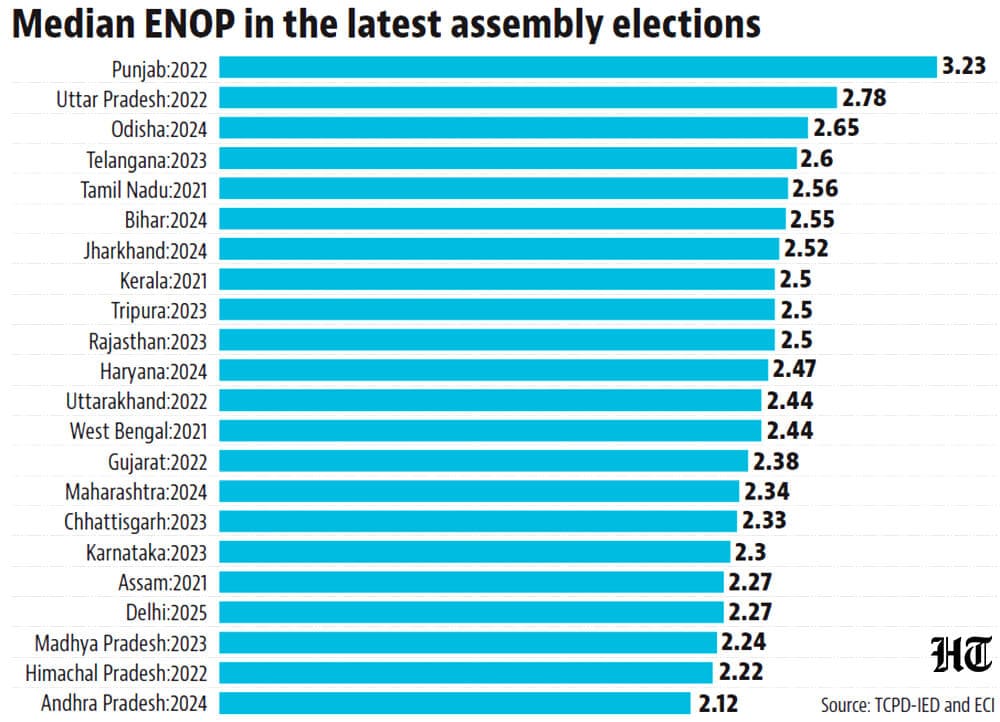
- Punjab’s political churn goes beyond the rupture between the BJP and the SADPunjab, today, is India’s only major state with a polity that is decidedly not bipolar. The median Effective Number of Participants (ENOP) for Punjab in the latest assembly elections is 3.23, the highest among all states and union territories with at least seven PCs or more. ENOP is the reciprocal of the sum of squares of the vote share of each candidate in a constituency and decreases with decreasing fragmentation. For example, if three parties poll 40%, 35%, and 25% votes, the ENOP in the AC is 2.9. If this distribution changes to 80%, 15%, and 5%, the ENOP is 1.5. Punjab’s median ENOP was just 2.4 in 2007. The rise in political fragmentation in Punjab is primarily a result of the Aam Admi Party’s (AAP) entry in the state’s politics in 2014, and increased further when the BJP and the SAD parted ways. See Chart 2: Median ENOP in latest assembly election of major states and UTs
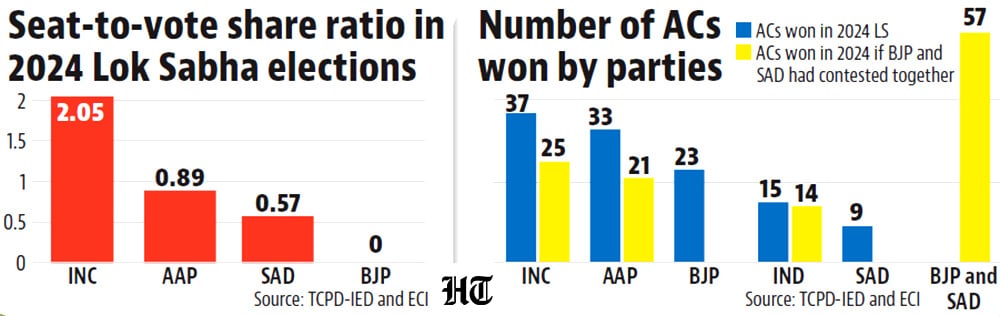
- At this level of political fragmentation, the Congress can gain disproportionately from anti-incumbency against the AAP in 2027The Congress won seven out of the 13 PCs in Punjab in the 2024 Lok Sabha elections with a vote share of just 26%. Not only was Congress’s seat share to vote share ratio the highest for major political parties in the 2024 Lok Sabha election, it was also the highest for any of the four major political parties in the state in all Lok Sabha elections since 2014. If one were to add BJP and SAD votes at the PC level in 2024, the picture would change drastically and the hypothetical alliance would end up with a vote share and seat share of 32% and 48.7% when results are disaggregated at the AC level. See Chart 3A: Seat share vote share ratio of Congress, AAP, SAD and BJP in 2024 See Chart 3B: Hypothetical SAD-BJP alliance performance at AC level
- Compelling as the mathematical case is for the resurrection of the alliance between the BJP and the SAD is, politics is not always driven by arithmetic. There was a lot of bad blood between the two parties during the farmers’ agitation and there is good reason to believe that some of that animosity among farmers vis-à-vis the BJP still persists in the state. However, politics is always the art of the possible and if the alliance were to indeed happen political contest in Punjab could take a new turn.


Unlock a world of Benefits with HT! From insightful newsletters to real-time news alerts and a personalized news feed – it's all here, just a click away! -Login Now!


