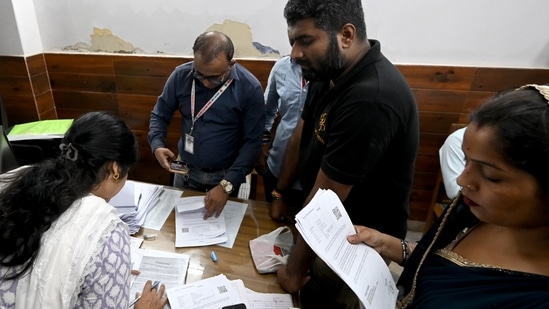
Claims of differences between the Chief Election Commissioner and the other two election commissioners over crucial procedural aspects of the ongoing Special Intensive Revision (SIR) of electoral rolls in the country have raised serious questions about institutional propriety and integrity in one of India’s most critical institutions (the Election Commission has dismissed these claims, insisting that the decisions were all unanimous, or majority ones). The opposition is also criticizing the government for the controversy, especially, in the backdrop for the
2019 and 2024 NES Rounds suggest a decline in faith in Election Commission and even EVMs
While the latest controversy around procedural irregularities in SIR raises important questions, the opposition has been making allegations about the integrity of the election process for a long time now. The allegations go beyond the state of electoral rolls and have often tried to cast aspersions on Electronic Voting Machines (EVMs) too. To be sure, the BJP also did the same when it lost the elections in 2009. Such a campaign has changed voter beliefs to some extent and a larger share now believes that the Election Commission of India (ECI) cannot be trusted completely, and neither can the EVMs. To be sure, it could very well be a confirmation bias – people who are already opposed to the BJP believing that it is winning elections in an unfair manner. ECI has repeatedly shown that EVMs are tamper-proof and they now have the provision of a VVPAT slip which shows the voter where the vote has been cast.
Declining faith in an institution such as the ECI was accompanied by a belief that the BJP does not really have a moral halo to its politics and it still had the largest support
Responses to more than one question in the 2024 NES clearly show this. A large number of respondents believed that arrests of opposition leaders were politically motivated, the Bharatiya Janata Party (BJP) had inducted corrupt leaders denting the image of Prime Minister Narendra Modi, and that the BJP itself was a corrupt party. What matters, however, is that the BJP still won the elections and had the maximum support even with the NES data. In fact, the NES got the national vote shares of the BJP and Congress pretty close to the actual vote shares – 37.2% and 23.6% in the survey compared to 37% and 21.5% actually.
Because what mattered while making voting decisions against the BJP were primarily bread and butter issues not institutional propriety or ideology
This is perhaps the most important takeaway from the 2024 NES data. It shows that 46.3% and 38.6% respondents reported that the BJP-led government should and should not get another chance. A detailed break-up of the reasons given for each of these groups shows that economic reasons such as price rise, unemployment etc. were the biggest sources of headwinds for the BJP. Ideological reasons or even governance related issues such as curtailment of civil liberties or even corruption were a much smaller driver of anti-incumbency in the NES data. Another piece of NES data, which appeared in an analysis published in The Hindu by Sanjeer Alam, underlines this theory. It shows that the probability of supporting the BJP was much larger among voters who believed that their financial conditions had improved rather than those who thought things had worsened financially.
The alleged improprieties in the ECI are indeed a matter for concern. But if previous polling data is any indicator, the economic environment which has suffered thanks to external disruptions etc. might be a bigger concern for the BJP’s political prospects right now. This is exactly why the GDP debate generated so much traction despite there being nothing wrong with the data per se.
{{^htLoading}}{{/htLoading}}{{#usCountry}}{{/usCountry}}