Who is an MGNREGS worker in India? | Number Theory
Whether or not the new bill is passed in this form remains to be seen, but it is a moment worthy of asking a basic question: who is the MGNREGS worker in India?
The Mahatma Gandhi National Rural Employment Guarantee Scheme (MGNREGS), when it came into effect in 2006, was India’s biggest , a radical welfare programme which provided guaranteed employment to the blue collared worker in a village. After 20 years of being in effect, the programme is being both rechristened — from MGNREGS to Viksit Bharat - Guarantee for Rozgar and Ajeevika Mission (Gramin) or the VB-GRAM(G) — and redesigned. This will see it being discontinued it in peak agrarian season,
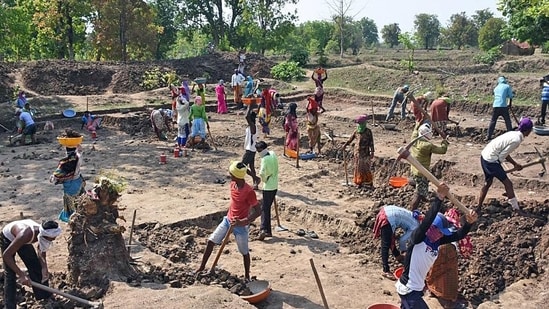
ANI file photo (ANI Photo)
The biggest current users of the MGNREGS currently are the richer states
This is perhaps the biggest indictment of the MGNREGS 20 years after it started. The highest person days generated under the scheme (per 1000 rural population) in 2023-2024 were in Kerala, Tamil Nadu, and Telangana among 20 states that are home to at least half a percent of India’s rural population. Their average rural monthly per capita expenditure (MPCE) in the same period, according to the Household Consumption Expenditure Survey (HCES) was also ranked the highest, fourth highest, and fifth highest. On the other hand, Bihar and Uttar Pradesh were near the bottom of the table in both the scheme’s usage and in MPCE. To be sure, not all poor states are laggards when it comes to using the scheme. Chhattisgarh, Odisha, and Rajasthan do better on this count.
MGNREGS workers may come from richer states, but they belong to social groups that are poorer on average
Richer states doing better in MGNREGS doesn’t mean the rich in these states do such work. Periodic Labour Force Survey (PLFS) data shows that Scheduled Castes (SCs), Scheduled Tribes (STs), and Other Backward Classes (OBCs), who are on average poorer groups, are over-represented among MGNREGS workers, across states. However, because even the deprived social classes in richer states earn more than the not so deprived in poorer states — the average MPCE of a rural SC person in Tamil Nadu is 1.3 times the average MPCE of a rural upper caste person in Bihar in the latest 2023-24 HCES — the really poor rural worker is somewhat underrepresented in the ranks of the MGNREGS in the PLFS data.
And the scheme’s usage is also not strongly correlated with unemployment rate
One would expect a job guarantee scheme to have high usage in a state with a high rate of unemployment. However, a comparison of person days generated per 1000 rural population with unemployment rates among rural adults (the scheme is meant only for rural adults) across states also shows no strong correlation. This could well be a result of systemic differences in the efficacy of the scheme’s functioning, with factors such as delayed payments discouraging really needy workers from seeking work under it and migration offering better earnings than what MGNREGS would.
MGNREGS employment generation is somewhat elevated since the pandemic
This can be seen by either looking at person days generated per 1,000 rural population or by the share of MGNREGS workers among adult workers. Both are at a higher level compared to the pre-pandemic period. To be sure, the former has been decreasing after the pandmemic induced spike in 2020-21 and was only slightly above 2019-20 levels in 2024-25, while the latter number continued to grow. It is not certain which of the two trends show the correct trajectory of MGNGREGS work after the pandemic, because neither number is perfect for tracking it. The former is adjusted with overall rural population (an age-wise breakup is not available in projected population for rural and urban areas separately) and the latter data is collected only for the week preceding the survey, which may not coincide with a person’s MGNREGS employment.
What do these trends suggest when read together? The empirical evidence on MGNREGS supports the narrative of geographical differences in its performance rather than a one-on-one correspondence between rural distress and job uptake. This is also something which was highlighted by the 2023-24 Economic Survey. However, what is also true is that in the 20 years of its existence, it has offered a cushion of support and, more importantly, a bargaining chip to the rural unskilled worker in India, clearly the most poorly paid and vulnerable when it comes to ensuring survival.
Abhishek Jha is Assistant Editor-Data at Hindustan Times. He uses statistical programming to generate newsworthy insights from large datasets. He is part of the team that produces Number Theory, a daily data story feature of the paper’s print edition. Since March 2024, he has been writing Weather Bee, a weekly column for the Hindustan Times website. He is a chemical engineer by training, who specialises in stories related to weather, climate, and the environment. Jha has been at HT since 2018, where he offers data-driven perspective and analysis on politics, environment, weather, climate, economy and society. His work includes data coverage of elections in India and abroad, including the 2019 and 2024 Lok Sabha elections; the disasters and extreme weather resulting from changing climate, such as floods, droughts, heat waves, cold waves, and dwindling snow cap in the Himalayas; the factors that drive poor air quality in northern India; the changing patterns of land use; the Covid-19 pandemic and its impact on labour market conditions; the changing pattern of consumer spending seen in the new consumer spending surveys; and social norms seen in the surveys such as the National Family Health Survey.
Unlock a world of Benefits with HT! From insightful newsletters to real-time news alerts and a personalized news feed – it's all here, just a click away! -Login Now!
Unlock a world of Benefits with HT! From insightful newsletters to real-time news alerts and a personalized news feed – it's all here, just a click away! -Login Now!
Home/Editors Pick/Who is an MGNREGS worker in India? | Number Theory
{{^htLoading}}
Advertisement
{{/htLoading}}
SHARE THIS ARTICLE ON
{{#usCountry}}{{/usCountry}}
Notifications
Get breaking alerts directly from the newsroom
Notifications are on!You'll be notified when news breaks