Dehradun: The Modi factor versus Harish Rawat dominated the Uttarakhand elections with Bharatiya Janata Party (BJP) returning to power in the state. The BJP did not even bank on its former chief ministers for campaigning and made Prime Minister Narendra Modi its face besides aggressively focusing on the developmental plank of the “double-engine” governments at the Centre and in the state.
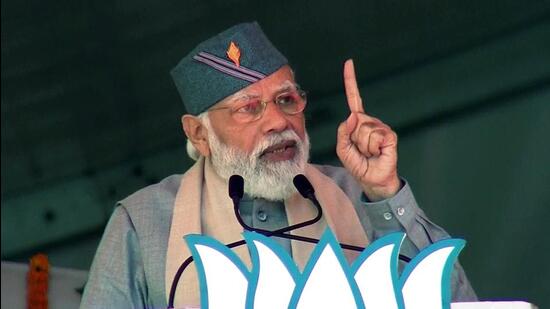
Even as chief minister Pushkar Singh Dhami lost the polls, BJP was effective in selling the development plank. BJP leaders focussed on development works including Char Dham all-weather road, Rishikesh-Karanprayag railway project, and Jal Jivan Mission for the piped water supply to 800,000 households. Modi conveyed his central message when he said at a rally that to continue the development of Uttarakhand and ensure its bright future, the people should vote for BJP.
Modi has taken a keen interest in the development of the Char Dham shrines, which he has been reviewing. At a rally, Modi said Congress never bothered about Char Dham when it was in power. He added it started talking about development works for the Char Dhams to garner votes. “But for BJP, the development works in Char Dham and Devbhoomi Uttarakhand is its faith, culture, and dedication for public service.”
Modi and other BJP leaders referred to Congress’s opposition to Uttarakhand’s creation when Atal Bihari Vajpayee was the Prime Minister. BJP leaders kept stressing Vajpayee made the state possible and Modi was developing it.
{{/usCountry}}Modi and other BJP leaders referred to Congress’s opposition to Uttarakhand’s creation when Atal Bihari Vajpayee was the Prime Minister. BJP leaders kept stressing Vajpayee made the state possible and Modi was developing it.
{{/usCountry}}As the state has a large number of people in the army, Modi and other BJP leaders focussed on this too. At a rally in Srinagar (Pauri Garhwal), Modi said Congress’s thinking is confined to power. “They have no value for sacrifice and service to the nation... it called the late former chief of Defence staff General Bipin Rawat a roadside rowdy when he was appointed as the army chief... When our jawans carried the surgical strikes on the terrorists across the border, Congress questioned it and wanted evidence.”
The BJP also benefitted from religious polarisation. After a Congress leader spoke about setting up a Muslim university, BJP accused the Congress of appeasement politics and recalled how Rawat as the chief minister in 2016 allowed Muslim employees a break for Friday prayers.
BJP leaders kept stressing that Congress wants to set up the university in the land of Gods, the Ganga. Uttarakhand has a 13.9 % Muslim population. Haridwar and US Nagar districts have over 34% and 22% Muslim populations.
Two days ahead of voting, Dhami said they will implement the Uniform Civil Code in the state when BJP returns to power. He said an expert will be formed to make it possible. In its manifesto, the BJP promised a “stringent love jihad law” and a special committee to “check illegal occupation of land affecting demographic balance”.
The manifesto, which focused on the core agenda of Hindutva, also promised ₹3000 monthly to the trained unemployed youths, ₹6000 pension, an insurance cover of ₹5 lakh for those working in the unorganised sector, three free cooking gas cylinders to the poor, and additional ₹2000 under Kisan Samman Nidhi to farmers.