
 E-Paper



Harry Belafonte: The Making of a Radical Performer
The country’s first Black pop superstar, Belafonte shattered barriers and paved the way for a generation of singers and actors.


 Prefer HTon Google


“USA250: The Story of the World’s Greatest Economy” is a yearlong WSJ series examining America’s first 250 years. Read more about it from Editor in Chief Emma Tucker.
The bright overhead lights were almost blinding, bleaching the stage as a young Black man stepped forward at “The Ed Sullivan Show” wearing nothing but belted trousers and an open velvet vest, his oak-colored skin glowing under the glare. From the wings, he had watched the audience settle—a sea of white faces dressed as if for Sunday service—and felt as though he were stepping onto a tightrope stretched across the country. But when the cameras rolled and the red light snapped on, he came alive.
You could feel the studio air shift. Behind him stood a faux Caribbean village—painted huts, dancers in island dress, even a live donkey. In that crafted scene he lifted his chin and belted a longing Caribbean ballad, “Jamaica Farewell.” He didn’t just sing it—he acted it, pacing the stage as if lost in memory. For a moment, the audience seemed transported to his island world.
It was 1956 and he was nothing like the shuffling caricature Hollywood expected of Black performers in the Jim Crow era. Instead of leaning into cliché or whitewashing, he radiated dignity, cultural pride and a new kind of Black romantic masculinity—sensual without becoming caricature.
America had never seen anything like Harry Belafonte.
Transformed by Vegas
The nation was tense that summer. The Cold War simmered, Emmett Till had been murdered less than a year earlier and in Montgomery, Ala., a young minister named Martin Luther King Jr. was challenging Jim Crow. Into that atmosphere of fear and possibility walked Belafonte.
Born in Harlem in 1927 and raised partly in Jamaica, Belafonte broke ground early. In 1954, he became the first Black man to win a Tony Award and starred opposite Dorothy Dandridge in the movie “Carmen Jones,” which was so popular with Black audiences that segregated Southern theaters added extra showings.
But it was Las Vegas in the early 1950s that transformed him. Venues on the Strip were whites-only. Belafonte often couldn’t lodge at the same resorts where he performed. He channeled his anger into his act. When he walked onstage, he scowled, staring the audience down and pouring everything he felt into a shouted “Timber!”—a call inspired by Caribbean loggers that he would later fold into the song “Jerry (This Timber Got to Roll).” Then he would flash his wide grin, cut the tension with a joke and glide into lighter songs like “Matilda” or “Hava Nagila,” a Jewish folk favorite he made his own.
He wasn’t the only Black star of that era. There were figures like Duke Ellington, Sammy Davis Jr., his friend Sidney Poitier and Nat King Cole. While Belafonte considered their progress remarkable, he also believed his peers were largely playing by the rules of the entertainment industry. He wanted to break them, and Las Vegas taught him how to work a white room without leaving himself behind.
Fresh off that Vegas breakthrough, New York’s Copacabana offered him a residency. Years earlier, Belafonte had been turned away from the whites-only nightclub as a patron. Raised by a Jamaican mother who insisted dignity was a right and mentored by the radical multitalented athlete, activist and performer Paul Robeson, he told the Copa “no.”
The Ed Sullivan gamble
According to Belafonte’s memoir, in 1953, fearing his politics had stalled his career, he met Ed Sullivan at his Park Avenue apartment. Sullivan—a gruff Irish-Catholic variety-show host who could make or break careers—dropped a folder on the table, a dossier of FBI and press clippings, and asked bluntly:
“Are you a Communist?”
“I’m not,” Belafonte said. “I fought for my country.” He reminded Sullivan he had served in the U.S. Navy during World War II. “I was born poor and Black. I will always fight for the rights of Black people and poor people.”
The meeting ended unresolved, but days later Sullivan booked him.
In 1956, Belafonte released the album ”Calypso” with the lead single “Day-O,” and he returned to Sullivan’s stage to promote it. The album, a collection of Caribbean folk songs that Belafonte wrote and interpolated, hit No. 1 and became the first in history to sell one million copies, holding the top spot for 31 weeks—a record that stood until Michael Jackson’s “Thriller.” It introduced Caribbean music and culture to the world and made Belafonte a bona fide pop star. In 1957, RCA offered him a $1 million contract, one of the largest ever given to a Black performer.
Belafonte hoped to replicate his musical breakthrough on-screen. He tried with “Island in the Sun” (1957), an interracial romance with co-star Joan Fontaine, but their romantic scenes were cut for fear of Southern backlash. He pushed further with “The World, the Flesh and the Devil” (1959), a post-apocalyptic film he starred in and produced, making him one of the first Black producers on a major studio picture. Still, his romantic scenes with white co-star Inger Stevens were cut.
Becoming an activist
Belafonte realized he couldn’t change America through entertainment alone. Belafonte later recalled that in the spring of 1956, on the cusp of superstardom, he got call from King.
“You don’t know me,” King began.
Belafonte laughed—everyone knew King.
According to Belafonte, they arranged a meeting in the basement of Abyssinian Baptist Church, where King told him he was almost out of money to fund the Montgomery Bus Boycott and asked for help. Belafonte agreed, staging fundraisers at the homes of show-business executives and in his own Manhattan apartment. Then, he went much further.
He financed the Freedom Rides, turned his West End Avenue apartment into a command center and raised bail money when King and other activists were jailed in Birmingham. In 1964, he helped organize Freedom Summer, sending hundreds of volunteers into Mississippi to register Black voters.
When three of them were murdered, Belafonte personally delivered emergency funds to local civil-rights organizers and volunteers, carrying the cash in a doctor’s bag. Poitier went with him. As they drove into Greenwood, armed Klansmen chased their car. Local activists formed a protective caravan.
As Belafonte later wrote, Poitier told him afterward, half joking, half shaken: “Don’t ever call me again for something like this.”
The Kennedy gambit
In 1960, Democratic presidential candidate John F. Kennedy was losing Black support. Baseball star Jackie Robinson, a hero in Black America, had endorsed Richard Nixon. The Kennedy campaign turned to Belafonte, who bluntly told Robert Kennedy, who was JFK’s campaign manager: If Kennedy wanted Black voters, he had to talk to King. The meeting was arranged but went nowhere. Then everything changed.
King was arrested in Atlanta and sentenced to four months on a chain gang. According to Belafonte, King’s wife, Coretta Scott King, called him and he reached out to the Kennedys. Robert Kennedy was equivocal on the phone about intervening. But without notifying anyone in King’s camp, he later called the judge, and King was released.
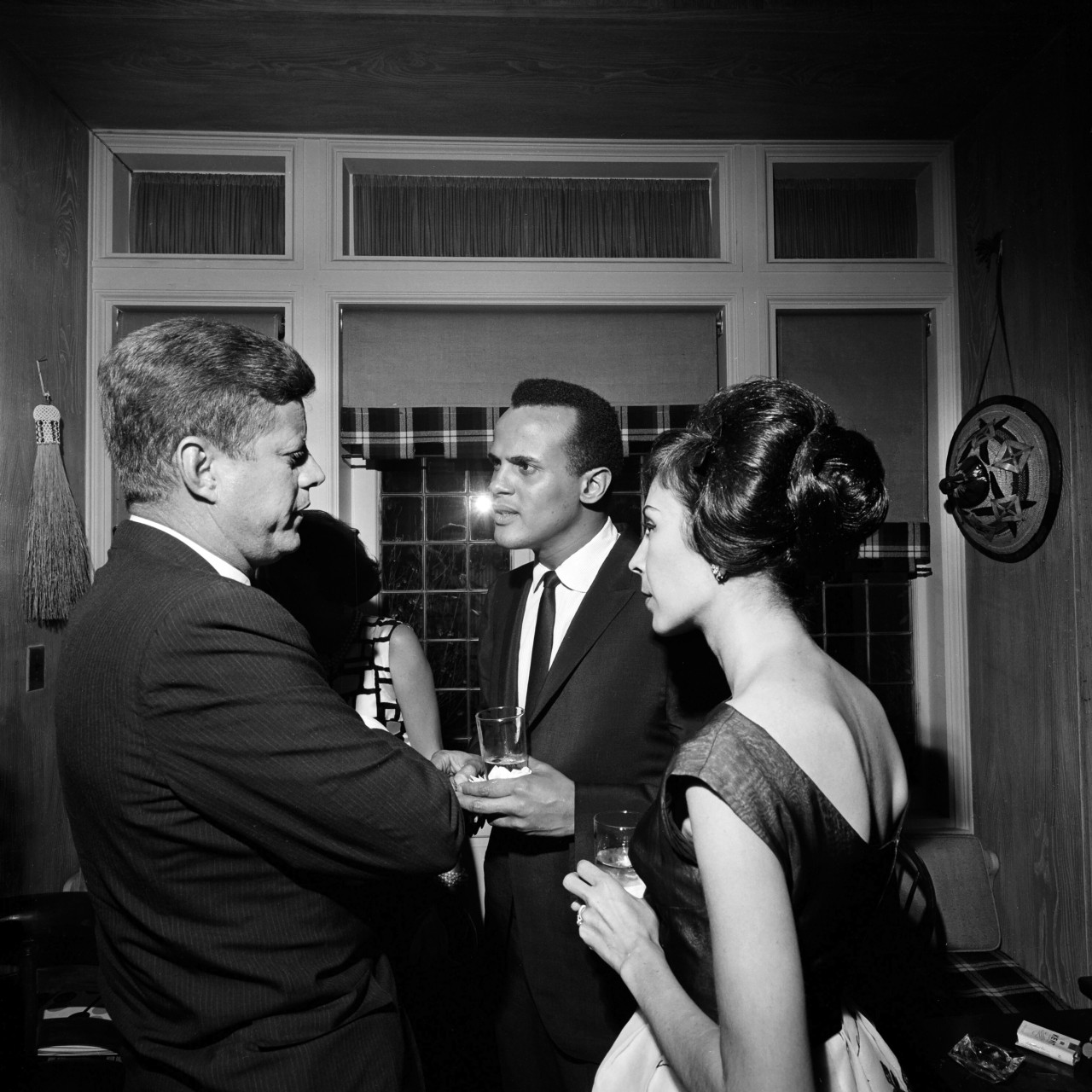
Belafonte recorded an appeal urging Black Americans to support Kennedy. King’s father, Martin Luther King Sr.—who, like many Southern Black Baptist pastors, had endorsed Nixon—switched his support. Kennedy prevailed in one of the tightest elections in history.
Belafonte later recalled that he cautioned King not to directly endorse Kennedy. “If he fails us,” he warned, “you’ll take the hit.”
King listened.
The Hollywood delegation
In spring 1963, after Kennedy endorsed sweeping civil-rights legislation, King planned a March on Washington to help push the bill through Congress.
They needed to bring the people out. They needed star power.
Belafonte called in every favor he had: Marlon Brando, a friend since their acting-class days at the New School; Poitier, his colleague from the American Negro Theatre in Harlem; and a roster of Hollywood allies, including Paul Newman, James Garner, Lena Horne, Diahann Carroll and Rita Moreno.
King reviewed the list and teased: “Very liberal…. Harry, what about Heston?”

Charlton Heston was Hollywood’s most visible conservative. Belafonte grasped the strategy immediately: The march had to look nonpartisan. “How can you lose with Moses on your side?” he later joked.
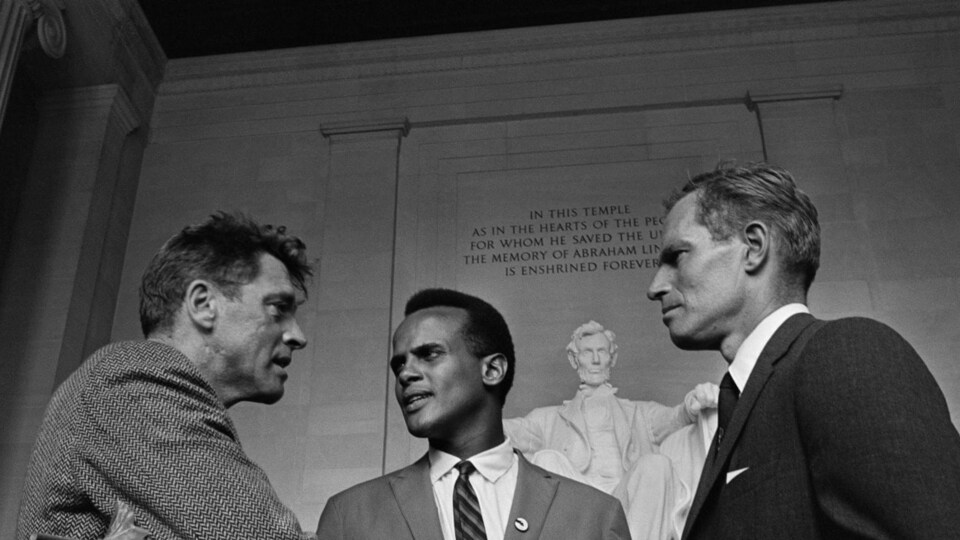
Heston agreed and co-chaired the delegation. At a press conference at Heston’s home in Pacific Palisades, they stood together with Brando, Poitier, Newman, Garner, Carroll, Moreno and Burt Lancaster—an improbable coalition.
On Aug. 28, 1963, when the Hollywood delegation walked toward the Lincoln Memorial, crowds recognized them and cheered. By noon, 250,000 people filled the Mall. The stars stood behind King as he began:
“I have a dream…”
Later years
I first interviewed Belafonte in 2012, in his office on the top floor of the SEIU building in Manhattan, during a wide-ranging conversation about his life and work. He was in his 80s then, but still vibrant—rarely seated, moving easily around the room and bantering with staff as they passed in and out.
When the conversation turned to what he believed was the key to progress, I saw the fire he had been known for in his youth in his eyes.
“We’ve got to fight,” he said, his voice suddenly sharp. Progress, as he understood it, meant refusing to be cowed by fear—a resolve he said he first witnessed among Jamaican anticolonial activists, and later on the front lines of the civil-rights movement. What troubled him now was the sense that people were surrendering that resolve. Today’s stars, he lamented, seemed far less committed to activism than he and his peers had been.
“Courage,” he said. “We need more courage.”
In his final public interview, on PBS NewsHour in April 2018, Belafonte reflected on the cost of a lifetime in struggle.
“I wasn’t wealthy,” he said. “But I spent what I had in the service of my people.”
A few days later, I saw him at the Toigo Foundation Gala, a gathering for Black professionals in finance at the Waldorf Astoria. He sat on a walker, much thinner than the last time I had seen him. His voice, once raspy and booming, had thinned to a gravelly whisper, but even then it drew people toward him.
Our conversation was sparse, interrupted as aides moved him between Yara Shahidi, the young star of “Black-ish,” and Robert F. Smith, the billionaire founder of Vista Equity Partners. Both leaned in as if listening to someone they knew they wouldn’t have much longer.
Belafonte’s life was shaped by the people who inspired him. Robeson taught him that an artist could “spin many plates in the air” and take creative risks. Belafonte did: He blended folk, pop and Caribbean traditions into a sound that remade the American airwaves. His exploration of island music helped clear a path for artists from Bob Marley to Rihanna, and his championing of global performers—from South Africa’s Miriam Makeba to Greece’s Nana Mouskouri—helped popularize what would later be marketed as “world music.”
Through Robeson, Belafonte met W.E.B. Du Bois, who impressed upon him the urgency of securing institutional power for Black Americans—in universities, in government, in diplomacy and in finance. And in King, Belafonte found a lifelong calling: the fight for racial justice, economic fairness and voting rights.
That night, he pressed those ideas onto the younger torchbearers around him as if passing a relay baton.
Belafonte died in 2023 at age 96. He never realized his dream of becoming Hollywood’s first Black romantic leading man, but he helped pave the way for actors like Denzel Washington, Will Smith and Michael B. Jordan. His lasting legacy would be his activism and his barrier-shattering breakthrough as America’s first Black pop superstar.
There may never be another Harry Belafonte—but he spent his final years trying to ensure there would be.
Shomari Wills is a TV news producer, journalist and author. He is the author of “Black Fortunes: The Story of the First Six African-Americans Who Survived Slavery and Became Millionaires.” He can be reached at reports@wsj.com.


