A day after a seven-year-old female elephant in Bhubaneswar’s Nandankanan zoo succumbed to Elephant endotheliotropic herpesviruses (EEHV), senior wildlife officials said the herpes virus attacks were first for any Indian zoo.
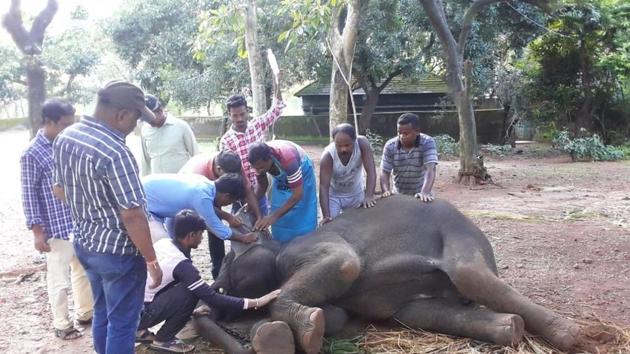
On Thursday, elephant Kamla had died while undergoing intensive treatment for the herpes virus, taking the death toll due to the deadly virus to three in less than a month. On August 25, a female elephant Julie in the zoo was the first to succumb to the disease followed by a 10-year-old male elephant Chandan on September 15, who showed symptoms such as reduced appetite, nasal discharge and swollen glands on both sides of its face.
Principal Chief Conservator of Forests (wildlife) HS Upadhyay said the experts in Assam, Kerala and US considered it to be the first such case of Herpes attacks in any Indian zoo.
“We had sent viscera sample of the two elephants that had died since August 25 to laboratories outside Odisha. We have got confirmation of Herpes virus in their body. Besides, the diagnostic symptoms have matched that of the virus,” said Upadhyay.
A highly fatal haemorrhagic disease, EEHV was first reported in an Asian elephant in 1988. It affects young Asian elephants and has a very high mortality rate. A quick administration of antiviral drugs has only been effective in a few cases.
{{/usCountry}}A highly fatal haemorrhagic disease, EEHV was first reported in an Asian elephant in 1988. It affects young Asian elephants and has a very high mortality rate. A quick administration of antiviral drugs has only been effective in a few cases.
{{/usCountry}}Assistant director of the zoo, Anjan Mohanty said the rest of the five elephants - all female- are being treated as per the protocol.
Zoo officials said once attacked by the virus, the platelet count of elephants drops considerably. “It leads to internal bleeding with little outward manifestation. The face and abdomen start swelling,” said an official. “The virus spreads when elephants come in physical contact with each other. Once attacked by the virus, the treatment has little impact,” he added.
Veterinary doctors in Bhubaneswar’s Odisha University of Agriculture and Technology said the first fatality due to EEHV occurred in a three-year-old Asian elephant from a Swiss circus in 1988. This was followed by more reports of EEHV infections in captive Asian elephants in the North America and the Europe.
The string of deaths of elephants in Nandankanan zoo come 19 years after another relatively unknown disease led to the death of 12 royal bengal tigers in the zoo. Between June 23 and July 7, 2000, twelve tigers perished to Trypanosomiasis disease. Trypanosomiasis is transmitted through flies and attacks the nervous system of tigers leading to paralysis. Eight of the 12 dead tigers were white tigers.