With many Americans undergoing needless thyroid biopsies, a team of experts have framed new clinical guidelines that would go a long way towards curbing the problem.
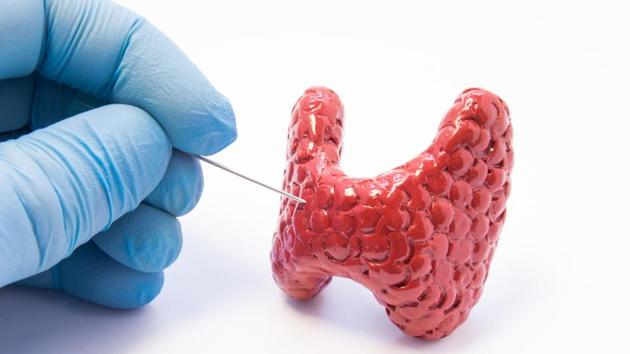
Nodules, a type of abnormality detected by ultrasound, are extremely common in the thyroid gland. Up to two-thirds of adults have nodules in this gland, and most are benign or only cause a slow-growing cancer that is no threat to life.
“If you have a cancer that is not going to harm you, and you are not aware of it, is it useful to do a fine-needle aspiration?” says University of Alabama at Birmingham’s Franklin Tessler. “People are asking, what are we doing? Are we using scarce resources wisely?” Thyroid cancers are greatly over-diagnosed in the United States. About three-quarters of thyroid cancers in women and nearly one-half in men would not, if the nodules had been left alone and not biopsied with a needle, resulted in symptoms or death.
Tessler and a national committee of experts published guidelines for an ultrasound-based risk stratification system to identify nodules that warrant a biopsy or sonographic follow-up. The guidelines, they write, are “designed to identify most clinically significant malignancies while reducing the number of biopsies performed on benign nodules.”
“This potentially will have a big public health effect,” said Tessler. Their Thyroid Imaging, Reporting and Data System or TI-RADS is modelled after the American College of Radiology’s BI-RADS, a widely accepted risk stratification system for breast lesions. The experts sought guidelines that are 1) founded on ultrasound features defined in their previously published lexicon; 2) easy to apply across a wide gamut of ultrasound practices; 3) able to classify all thyroid nodules; and 4) evidence-based, to the greatest extent possible, with the aid of underlying data on 3,800 nodules and more than 100,000 cancers.
{{/usCountry}}“This potentially will have a big public health effect,” said Tessler. Their Thyroid Imaging, Reporting and Data System or TI-RADS is modelled after the American College of Radiology’s BI-RADS, a widely accepted risk stratification system for breast lesions. The experts sought guidelines that are 1) founded on ultrasound features defined in their previously published lexicon; 2) easy to apply across a wide gamut of ultrasound practices; 3) able to classify all thyroid nodules; and 4) evidence-based, to the greatest extent possible, with the aid of underlying data on 3,800 nodules and more than 100,000 cancers.
{{/usCountry}}Their new guidelines follow many attempts over the past 15 years to create guidelines for whether to do a fine-needle aspiration biopsy. Most are based on details of the appearance and size of nodules that are visualized with high-resolution ultrasound. But “the plethora, complexity and lack of congruence of these systems has limited their adoption by the ultrasound community and inspired our effort to publish a classification system under the auspices of the American College of Radiology,” Tessler and colleagues wrote. The guidelines are published in Journal of the American College of Radiology.
Follow @htlifeandstyle for more
Catch your daily dose of Fashion, Taylor Swift, Health, Festivals, Travel, Relationship, Recipe and all the other Latest Lifestyle News on Hindustan Times Website and APPs.
Catch your daily dose of Fashion, Taylor Swift, Health, Festivals, Travel, Relationship, Recipe and all the other Latest Lifestyle News on Hindustan Times Website and APPs.