
 E-Paper



How Ccigmaa Lifestyle Pvt Ltd is building personal-care brands for India’s increasingly informed consumer
Emerging consumer trends in India’s beauty market have led Ccigmaa Lifestyle Pvt Ltd to develop distinct products for professional haircare

 Prefer HTon Google


The personal-care aisle has become a more complicated place. A consumer looking for a shampoo today is not necessarily looking only at the price or the brand name. There are questions around ingredients, hair type, formulation, frequency of use and whether the product is actually meant for a particular concern. For some, the first step is a Google search. For others, it is a salon professional, a social-media recommendation or a review from someone who has already used the product.
That change in behaviour is making the Indian beauty and personal-care market a very different business from what it was a decade ago. It is also creating room for companies that are willing to build brands around particular consumers instead of trying to make one brand mean everything to everybody.
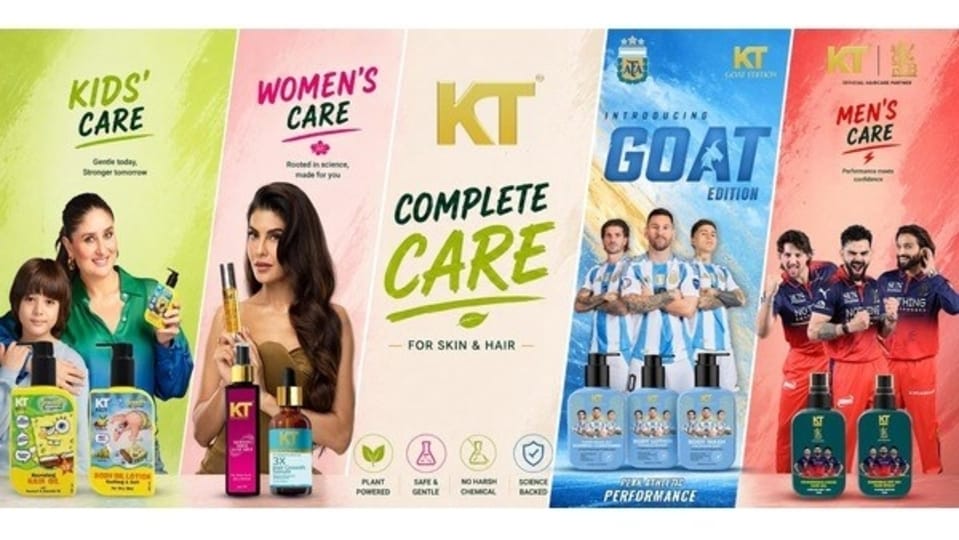
Ccigmaa Lifestyle Pvt Ltd is taking that route. Founded by Dhruv Sayani in 2019, the company started with a focus on personal care and professional haircare and has since expanded its portfolio under KT, with separate propositions for professional haircare, men's grooming and children's personal care. KT Professional, KT Men and KT Kids are aimed at very different consumers; the decision to keep them distinct is part of how Ccigmaa Lifestyle Pvt Ltd is approaching the market.
KT Professional is the closest to where the company began. Its focus is salon-grade haircare and the professional expertise associated with it. The opportunity here is fairly easy to understand: consumers who are more aware of haircare are also more willing to look beyond the basic shampoo-and-conditioner purchase and spend on products that address particular needs.

The salon continues to play a role in that journey, but it is no longer the only source of information. Consumers now see treatments, ingredients and haircare routines online and often arrive at a salon already knowing what they want to ask for.
Men's grooming is seeing a similar change, although the starting point is different. The old idea of men's grooming was fairly narrow, a haircut, shaving products, perhaps a fragrance. That is not how a younger consumer necessarily sees it today. Hair styling, skincare, body care and other products can all form part of the same routine.
KT Men has been developed for that market, with the brand also using sport and active lifestyles as part of its identity. The thinking is not to make men's grooming a separate world, but to recognise that the way men discover and use personal-care products has changed.
Children's personal care is another matter altogether. Here, the person buying the product and the person using it are usually different. A parent may spend considerably more time reading the
label, checking the product's suitability and understanding what it is meant to do before making a purchase.
That is why KT Kids is positioned separately from the adult portfolio. Children are not simply smaller versions of adult consumers, and the products intended for them cannot be approached in exactly the same way. There is a reason brands are paying closer attention to these distinctions now.
For Ccigmaa Lifestyle LifestylePvt Ltd, the response has been to work with the differences between consumers rather than ignore them. The personal care company has used celebrity and sports associations to build visibility around its brands, particularly as it expands the conversation around grooming beyond conventional beauty advertising. For KT Men, the association with sport fits naturally with the audience the brand wants to reach.
But Dhruv does not see visibility as the finish line. “Visibility can introduce a consumer to a brand, but it cannot replace the product experience. In the long run, consumers stay with brands that understand their needs and consistently deliver on what they promise,” he says.
That may be the more difficult part of the business. Getting a consumer to notice a product is becoming easier in one sense; there are more platforms, more creators and more ways to put a brand in front of people. Getting that person to buy the same product again is a different exercise.
It comes down to whether the product fitted into their routine, whether it delivered what they expected and whether they felt the price was justified. This is where the growth of routine-led consumption becomes important. Redseer's May 2026 analysis found that India's online beauty and personal-care market had reached ₹56,000 crore and was growing at about 35% year-on-year. It also found grooming growing at 37%, with repeat, routine-led purchases helping drive the category. Quick commerce, meanwhile, had increased its share of online BPC from around 9% in FY25 to approximately 18% in FY26.
For a company building personal-care brands, those numbers point to something beyond online sales. They suggest that more consumers are making these products part of their regular lives.
That is particularly relevant for the three segments Ccigmaa Lifestyle Pvt Ltd is working in. Haircare is a routine. Men's grooming is becoming one. Children's personal care is already a recurring household purchase. The opportunity, therefore, is not simply to sell more products as the market expands. It is to become part of the routine in the first place.
That is a harder proposition than it sounds. Indian consumers are also becoming more comfortable comparing homegrown brands with international names. They can discover a new Indian brand on a marketplace, compare its ingredients with a multinational competitor and make a decision without necessarily giving the global brand an automatic advantage.
For Indian companies, proximity to the consumer can be useful here. Local preferences, price points, climate, hair types, lifestyles and purchasing habits can all influence what works in the market. But being Indian by itself is not a differentiator anymore.
The product still has to earn its place. That is perhaps why Ccigmaa's decision to build separate propositions is significant. KT Professional has a reason to exist beyond simply being another haircare brand. KT Men is built around a consumer whose grooming habits are changing. KT Kids addresses a category where the parent's expectations are very different from those of an adult buying for themselves.
The categories may sit under the same company, but they do not have to be marketed in the same voice or sold for the same reason. For Dhruv, that is ultimately the larger opportunity in personal care: understanding the consumer closely enough to know that different people can want very different things from what appears, on the surface, to be the same category.
India's beauty and personal-care market is expected to keep expanding. The bigger question for brands will be where they fit within that growth.
For Ccigmaa Lifestyle Pvt Ltd, the answer so far has been to build around specific consumer groups and let each proposition develop its own identity. Whether that approach can turn KT into a larger personal-care portfolio will depend on the usual things, product performance, distribution, pricing and repeat purchases. But the underlying bet is clear. The company is not treating personal care as one market. It is treating it as a collection of markets, each with its own consumer, its own habits and, importantly, its own reason to buy.
***
Note to readers: This article is part of HT's paid consumer connect initiative and is independently created by the brand. HT assumes no editorial responsibility for the content, including its accuracy, completeness, or any errors or omissions. Readers are advised to verify all information independently.
Want to get your story featured as above? click here!


