
 E-Paper



Media Shala: India’s first-of-its-scale media literacy curriculum for schools
Media Shala, a media literacy program at Manav Rachna International Schools, engages students in hands-on learning and AI integration.

 Prefer HTon Google


In today’s digital age, where news often circulates on reels before appearing on television, Indian teenagers are spending 90 minutes daily online, as per The Internet and Mobile Association of India (IAMAI, 2024) report. It projects that by 2025, India will have a significant number of internet users. From Instagram reels to AI-generated deepfakes, the constant, unfiltered flow of content underscores a challenge: how do we equip students not only to consume information but to question, verify, and create responsibly?
A 2023 UNESCO study found that 79% of young people aged 15–24 worldwide are internet users, affirming Media and Information Literacy (MIL) as a core competency for responsible citizenship. While countries worldwide are integrating MIL as a core subject, in India it remains largely limited to workshops on cyber safety and digital awareness sessions.
At the heart of this shift is Media Shala, a first-of-its-scale media literacy programme formally embedded into the curriculum at Manav Rachna International Schools (MRIS). Designed as a South Asian model for scalability and cultural adaptability, Media Shala, with its continuously evolving curriculum, adapts global MIL best practices and AI-driven media tools to deliver learning through a dynamic pedagogy.
A Media Lab Inside Schools
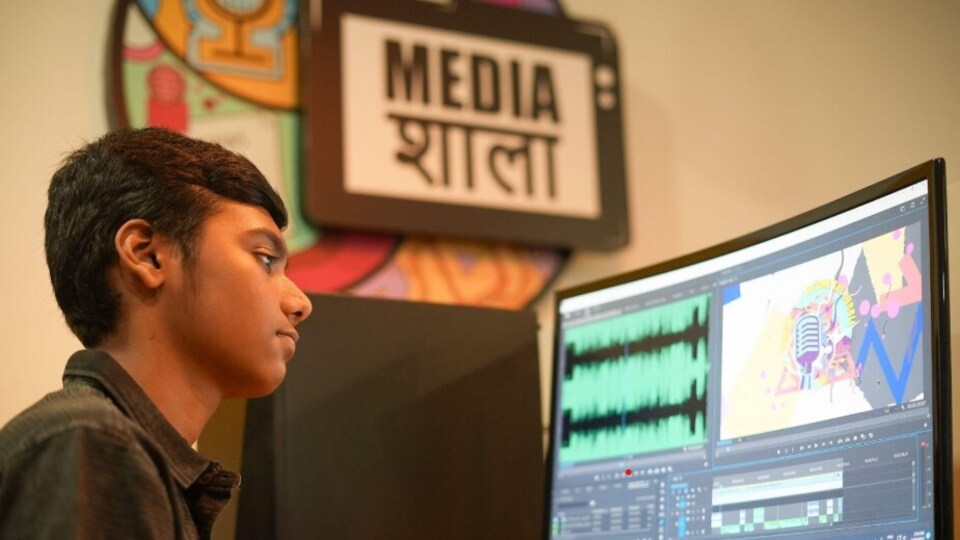
Media Shala is a space with continuous activity. Instead of silent rows of children taking notes, you see students huddled over storyboards, microphones and editing tools. One group may be planning a podcast on body image stereotypes, while another scripts a video report on climate change. In another corner, a team debates whether an online viral claim is fact or fiction before putting together a short explainer for their peers.
The programme is designed around role-based tasks: students become anchors, fact-checkers, photographers, editors, and even campaign strategists. This is not learning by lecture but learning by doing. Dr. Prashant Bhalla, President, Manav Rachna Educational Institutions (MREI), says, “The Media Shala experience is less about perfecting technical skills and more about building a mindset, questioning narratives, balancing perspectives and articulating before sharing.”
Building Skills and Voice
Educators who facilitate Media Shala sessions note a change in students. The outcomes are concrete with an upward learning curve. Students publish blogs, produce short films, take up school-wide campaigns, apply their takeaways from industry visits and run media clubs that provide peer support to juniors. Many take these skills forward by competing in inter-school events, winning recognition and even exploring internships in media-related fields. Media projects demand collaboration, often requiring students to negotiate differences and work towards a common output.
Jasmita Oberoi, Chief Creative Officer, Media Shala, says, “Children who were once hesitant to speak up in class grow comfortable addressing an audience when anchoring a segment. Those who did not see themselves as ‘creative’ discover strengths in podcast editing or campaign design. Media literacy helps to give them both skills and voice.”
Industry Connect
Drawing from their media experience, the educators at Media Shala aim to bridge the gap between industry and academia. For many students, it is their first experience of how professional media actually works, giving them exposure to current practices, trends and professional standards. Dr. Amit Bhalla, Vice President, MREI, says, “To ensure relevance, educators also undergo continuous faculty development workshops, keeping the approach aligned with the evolving media landscape and pedagogical developments.”
The AI Co-Educator
Media Shala integrates AI in everyday learning. The AI avatar is not a replacement for teachers but a co-educator. Its role is to complement educators by stepping in when lessons may seem less interesting. When a class on filmmaking stages or anchoring feels more theoretical, the AI anchor delivers an engaging segment that aims to hold attention.
Students describe these avatars as “fun” and “different,” but the real impact is in how they spark curiosity. Concepts introduced by digital co-anchors are followed up by classroom discussion and hands-on projects that make the learning memorable, giving students a blended learning experience. Educators report that it helps sustain attention, and students apply concepts in their assignments.
“Importantly,” adds Jasmita Oberoi, “the programme also teaches children to be critical of AI itself and assess algorithms, how content is generated using AI, and ways to evaluate it. In that sense, the avatar is not just a teaching tool but a conversation starter.”

A Continuum of Learning
The approach at school level connects with Manav Rachna’s larger innovation ecosystem, particularly the Centre for Media and Communication (CFMC) at its university campus. Together, these initiatives aim to offer students a continuum of learning, from the first experience of running a podcast in middle school to advanced experimentation with media technologies in higher education.
What unites both is a culture of adoption and responsible use of technology. Whether through technical equipment, hands-on projects or AI-assisted learning, the focus is on ensuring that students are not passive users of tools but active, informed creators.
A Shift in Educational Priorities
Parents and educators may have questioned whether subjects like media literacy deserve space alongside Maths and Science.. Far from diluting academics, media literacy potentially strengthens it. When students learn to research, question sources and articulate responsibly, they are also becoming better at science projects, understanding history and civic debates.
Prashant Bhalla adds, “Inside Media Shala, students are already rehearsing for this future. They are not just learning how to score marks but how to question, create, and lead conversations in a world where the power to inform is as widespread as the power to mislead.” The ability to think critically about information, to communicate responsibly and to understand the technologies shaping public discourse is not peripheral. It is central to education and to citizenship. Media Shala equips children to grow into responsible, informed citizens in today’s AI-driven media-saturated age.
Note to the Reader: This article is part of Hindustan Times' promotional consumer connect initiative and is independently created by the brand. Hindustan Times assumes no editorial responsibility for the content.


