
 E-Paper



‘Sardar@150’ Unity March culminates at the Statue of Unity after an 11-day journey
Vice President C. P. Radhakrishnan leads valedictory event at Ekta Nagar; leaders highlight Sardar Patel’s role in national integration.

 Prefer HTon Google


To mark the 150th birth anniversary of Sardar Vallabhbhai Patel, the ‘Sardar@150’ Rashtriya Ekta Padyatra, which began from Karamsad on 26 November, concluded at the Statue of Unity in Ekta Nagar on 6 December after an 11-day march through parts of Anand, Vadodara and Narmada districts.
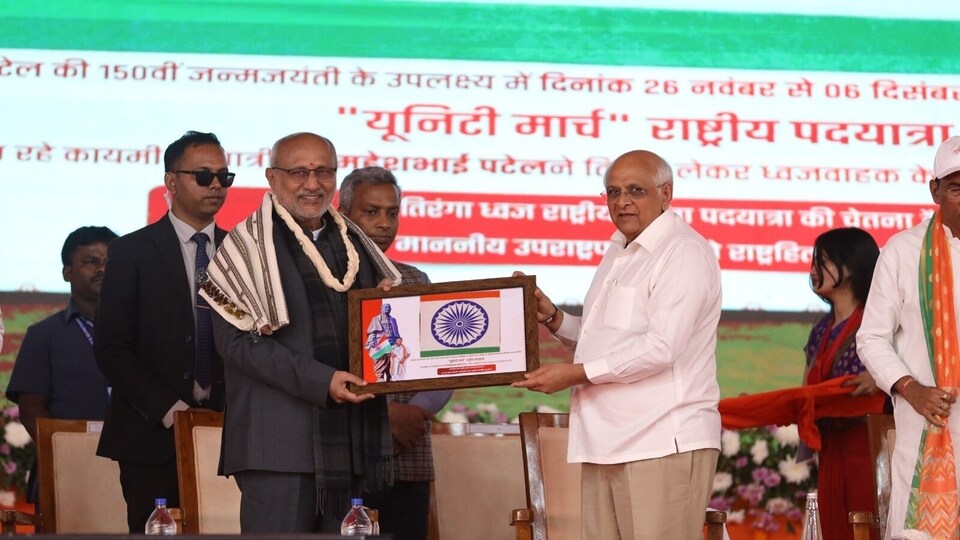
Vice President C. P. Radhakrishnan chaired the closing ceremony, which was attended by Gujarat Governor Acharya Devvrat, Chief Minister Bhupendra Patel, Union Minister for Youth Affairs and Sports Mansukh Mandaviya, Union Minister Rajiv Ranjan Singh, Ministers of State Raksha Khadse and Tokhan Sahu, and other elected representatives and officials.
Addressing the gathering, the Vice President described the Ekta Padyatra as a celebration of India’s “enduring spirit”, and said it had served as a platform to bring people together around the values of unity, duty and nation-building. He noted that Sardar Vallabhbhai Patel, India’s first Home Minister, played a central role in integrating more than 560 princely states after Independence, and said his contribution to creating a united India would remain relevant for future generations.
Radhakrishnan underlined the large-scale participation in the nationwide programme, stating that more than 14 lakh young people had joined over 1,300 unity marches organised across the country. According to him, these marches have carried messages of national integration, brotherhood and the vision of “Ek Bharat, Shreshtha Bharat” and “Atmanirbhar Bharat” to a wider public. He also referred to Sardar Patel’s emphasis on agriculture and rural India, and his role in binding the country “with the thread of unity”.
The Vice President said India’s youth, who constitute about 65% of the population, represent a significant reservoir of energy and aspiration. Urging them to stay away from drugs and similar addictions, he called on young people to channel their abilities into sports, social responsibility and disciplined conduct, and to contribute to nation-building with the spirit of “Ek Bharat, Shreshtha Bharat, Sashakt Bharat”.
Gujarat Governor Acharya Devvrat, in his remarks, recalled the Bardoli Satyagraha as a turning point in Patel’s public life. He said Patel left a successful legal career to lead farmers’ resistance to a colonial tax hike, travelled extensively across Bardoli to organise them, and eventually emerged as a national figure, earning the honorific “Sardar”. Devvrat described the Statue of Unity at Ekta Nagar as a symbol of national unity and said the foot marches would continue to draw inspiration from Patel’s work.
Chief Minister Bhupendra Patel said the 150th anniversary year had become an occasion to revisit Patel’s legacy, alongside celebrations such as the 150th birth anniversary of tribal icon Birsa Munda. He linked the National Unity March’s timing—from Constitution Adoption Day on 26 November to Dr B. R. Ambedkar’s Mahaparinirvan Diwas on 6 December—to the constitutional values of fraternity and national integration. The Chief Minister reiterated the state government’s view that measures such as the abrogation of Article 370 in Jammu and Kashmir and the construction of the Statue of Unity reflected a push towards “one nation, one Constitution”. He urged participants to uphold Patel’s principle of “nation first” in efforts towards “Viksit Bharat @2047”.
Union Minister for Youth Affairs and Sports Mansukh Mandaviya said he had joined the final 150-km stretch of the foot march from Karamsad to Ekta Nagar. He highlighted the participation of 150 core walkers along with large numbers of youth and women who joined for shorter segments, and said the march had, in his view, become a “journey of ideas”. He noted that local residents, including farmers, had welcomed the marchers along the route and used the occasion to showcase natural farming practices.
At the closing ceremony, participants took a pledge to promote Swadeshi and support efforts towards an Atmanirbhar and developed India. The unity march, which passed through both rural and urban settlements in three districts, involved youth groups, social organisations, volunteers and local citizens, who used the route events to convey messages on national integration, cleanliness and environmental initiatives such as the “Ek Ped Maa Ke Naam” campaign.
Over the past decade, Patel’s legacy has been marked through initiatives such as the establishment of the Statue of Unity and recurring national unity observances. The ‘Sardar@150’ Rashtriya Ekta Padyatra added to these efforts by linking local participation with a broader narrative of national cohesion and development.


