
 E-Paper



The Decisions Behind the Growth of a South Indian Travel Agency
Dimaak Tours, led by Srivathsan G K, is reshaping travel industry norms by prioritizing customer relationships over growth.

 Prefer HTon Google


Most travel agencies in India fail on the same problem. They spend to acquire customers faster than they can deliver on what was sold. Srivathsan G K knew people it happened to, and built Dimaak Tours around avoiding it.
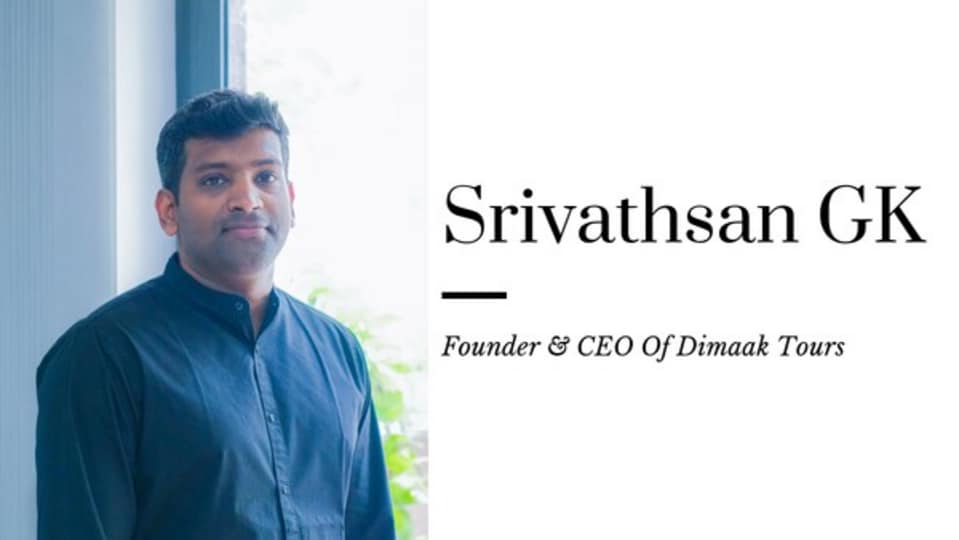
His years in Thailand between 2014 and 2021 shaped that view. Travellers from Tamil Nadu had few companies they could rely on when planning a trip there, and too many arrived on holidays that looked nothing like what they had paid for.
Those lessons did not become a business plan overnight. They evolved into three principles that have guided every major decision at Dimaak Tours.
Trust before growth
When Srivathsan started Dimaak Tours, he made a conscious decision to prioritise customer relationships over rapid growth.
He decided to build the company on trust from day one.
"Growth without trust is borrowed momentum," he says. "Marketing, discounts and bold promises may bring customers in quickly. But if the experience doesn't match what was promised, customers leave, referrals slow down, and every new sale becomes more expensive."
That philosophy shapes how Dimaak works. Instead of pushing travellers towards a booking, the team walks them through hotel options, flights, visa requirements, inclusions, exclusions and the practical realities of the trip. Quotes clearly distinguish confirmed prices from estimated ones, and customers receive updates throughout the booking process until they return home.
He believes this level of transparency is one reason many travellers consider Dimaak Tours as one of the best international travel agencies in Chennai.
The same approach is reflected in a short Bangkok holiday as much as a longer multi-country itinerary. The same commitment to transparency extends to the company’s website, where destination packages clearly outline what the quoted price includes and any additional costs travellers should expect.
His advice to founders who think growth should come first is straightforward.
"Trust is not something you build after growth. Trust is what makes growth repeatable. Grow fast, but never faster than your ability to deliver what you promised."
Going digital before the industry did
The push towards digital came from an unlikely place, the 2021 Tamil Nadu Assembly elections. Srivathsan noticed how political parties were investing in social media and digital platforms. To him, it was a sign that if organisations built on public trust were embracing digital at that scale, the travel industry would inevitably follow.
Instead of relying on just advertisements, Dimaak focused on educating travellers. "When a customer knows what we are talking about, they are ready to give us the business," he says.
Dimaak Tours publishes guides on destination costs, visas and itineraries and reaches over 1,00,000 readers each month.
The investment wasn't limited to customer-facing content. Dimaak developed its own CRM to manage sales, operations, finance and customer support, allowing every enquiry, booking and payment to be tracked in a single system.
Technology was never meant to be an add-on for marketing. It was built into the business from the beginning.
Building through the shutdown
The third decision is often described as a rebuilding story, but Srivathsan sees it differently. Dimaak was barely six months old when COVID brought international travel to a halt.
"There was nothing to rebuild," he says. "There were no old processes, no legacy structure. We had to define everything from scratch once the industry started to recover."
Instead of waiting for travel to resume, the team used the shutdown to build the company they wanted for the long term. They developed processes, systems and roles that could support future growth instead of patching things under pressure as business returned.
What kept them going was a simple belief.
"Building this company is a long game. It takes a minimum of ten years to make even a small dent in this market."
When travel resumed, he was clear about what that period had actually given them.
"The only advantages we had were the customers' trust and a strong social presence."
For a young company competing with travel operators that had been around for decades, those two advantages proved enough to build momentum.
The principle that connects all three
Looking back, Srivathsan sees a common principle behind all three decisions. Whenever the company had to choose between short-term gains and long-term customer relationships, he chose the latter.
The question guiding those decisions has remained the same: Will this make customers trust Dimaak five or ten years from now?
He believes that question will become even more important as AI reshapes the travel industry. Finding destinations, comparing hotels, generating itineraries, and checking prices will take seconds.
"But planning a trip is not only an information problem," he says.
"Customers still need someone who understands their preferences, tells them what is genuinely suitable, takes responsibility for the booking, and supports them when something does not go to plan. In ten years, I do not want Dimaak Tours to be known merely as a company that sells holiday packages. I want it to be the most trusted travel partner for Indian travellers."
He sums up his philosophy in a few lines.
“Build for the long term, earn trust before demanding growth, and never let technology replace accountability. Businesses may be built through speed and scale, but enduring brands are built when customers know that someone will stand behind every promise. That is the kind of company I want Dimaak to become.”
Note to readers: This article is part of HT's paid consumer connect initiative and is independently created by the brand. HT assumes no editorial responsibility for the content, including its accuracy, completeness, or any errors or omissions. Readers are advised to verify all information independently.
Want to get your story featured as above? click here!


