A shipment of F-35 fighter jet components sent from Australia to the US for repairs was diverted to Hong Kong this summer, triggering a Pentagon investigation and briefings for congressional staff, Politico reported on Sept 18.
The Pentagon, the report said, confirmed that some components from the shipment were missing.
The shipment included an F-35 canopy, which carries technology tied to the aircraft’s stealth capabilities. Politico reported that the incident has raised concerns about possible exposure of sensitive F-35 technology. It is not yet clear why the shipment was rerouted, who currently holds the components or whether Chinese authorities gained access to them.
About the aircraft
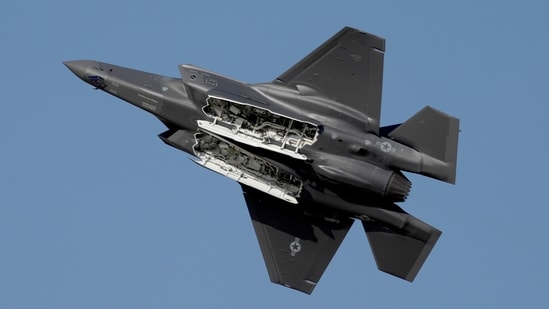
The F-35 Lightning II is a family of fifth-generation fighter aircraft developed by Lockheed Martin for the US military and allied forces. It combines low observability, advanced sensors, electronic warfare systems and the ability to gather and share information with other military platforms.
Lockheed Martin, the American defence and aerospace manufacturer, says the aircraft brings together stealth, sensors and information fusion in a single platform.
The jet is produced in three variants: the F-35A, for conventional take-off and landing; the F-35B, for short take-offs and vertical landings; and the F-35C, for aircraft carrier operations.
{{/usCountry}}The jet is produced in three variants: the F-35A, for conventional take-off and landing; the F-35B, for short take-offs and vertical landings; and the F-35C, for aircraft carrier operations.
{{/usCountry}}F-35s are also operated by or being acquired by the UK, Australia, Denmark, Norway, Poland, Germany and Finland.
Stealth and how the canopy contributes to it
The F-35 is harder to detect because of two key reasons – its design and the use of radar-absorbent materials.
The design component includes specially aligned edges, internally carried weapons and fuel and reduced engine signature.
The radar absorbent component also includes the canopy, the transparent shell covering the cockpit. In the F-35A, it is made of stretched acrylic with a thin layer of transparent radar-absorbent material on the outside, the US Air Force.
The US Air Force has said this material helps keep the aircraft hidden from enemy radar. In some earlier production batches, the coating degraded, peeled and separated, creating a radar vulnerability and forcing canopy replacements, the Air Force reported. That makes the canopy far more than a conventional cockpit cover.
Two people familiar with the matter told Politico that the canopy in the diverted shipment contained stealth technology available only to the US and its allies. JJ Gertler, a former House Armed Services Committee staff member and Congressional Research Service military aviation analyst, told Politico that possessing an actual component could allow an adversary to verify or refine information already obtained through other means.
There is, however, no evidence that any other country has obtained the diverted components.
Also read: US approves USD 24.3 billion sale of 48 F-35 fighter jets to Saudi Arabia
Why was an F-35 shipment in Hong Kong?
The F-35 programme runs on a global supply chain of manufacturers, maintenance facilities, warehouses and commercial shipping providers across multiple countries. Politico reported that the shipment was travelling from Australia to the US for repairs when it was rerouted across the Pacific and ended up in Hong Kong. Lockheed Martin, which manages the programme’s overall supply chain and uses commercial shippers to move parts, said it could not discuss individual shipments for security reasons but that it follows US regulations governing the transport of aircraft components.
The programme also draws on a shared global pool of spare parts. The US Department of Defense owns the parts until they are installed on an aircraft, while Lockheed Martin manages the pool.
That arrangement has previously drawn scrutiny. A 2023 US Government Accountability Office (GAO) report found that more than one million F-35 spare parts worth over $85 million had been reported lost by one prime contractor since May 2018, and that the F-35 Joint Program Office had reviewed less than 2% of those losses. The finding concerned accountability and management, rather than the theft or compromise of more than a million sensitive or classified components.
Also read: China to try and steal F-35 tech amid pending Saudi deal? Report says US intel issued warning
Why is China a concern?
The Hong Kong destination has drawn particular concern because Hong Kong is a Chinese special administrative region and because Washington and Beijing have long-running tensions over military and technology security.
US officials have previously flagged Chinese espionage aimed at sensitive defence programmes, including the F-35, according to the Center for Strategic and International Studies (CSIS). CSIS has reported that Chinese espionage campaigns have targeted US defence technology, including the F-35; it noted that data relating to the fighter's design, performance and electronic systems was among information compromised in a 2009 cyber intrusion. Gertler said China had aggressively sought F-35 data through electronic espionage and other means.
The current incident does not establish that Beijing has obtained the components. The F-35 Joint Program Office said it was “aware of a shipment issue of unserviceable F-35 Lightning II components” and was working with US authorities and industry partners to retrieve them, investigate what happened, and introduce safeguards against a recurrence.