“I have no one left waiting for me. Everything and everyone is gone. The end,” Dibga Tamang said, a day after a glacial collapse high up in the Himalayas unleashed a tsunami-like flood that ripped through Nepal and bordering Tibet. Tamang was among the last people rescued from Rasuwa, airlifted along with three others to an army camp in Nuwakot, Nepal.
Two days on, the scope of the Himalayan disaster is only beginning to emerge. “Sadly, we’re only seeing the beginning of this tragedy,” Unicef spokesperson Ricardo Pires told reporters on Friday.
The International Federation of Red Cross and Red Crescent Societies puts the number affected at roughly 93,000. Its Nepal delegation head, David Fisher, called the trauma “enormous”.
Confirmed deaths on Friday night stood at 579 in Nepal and five across the border in Tibet. Kathmandu's disaster authority listed 1,924 people as missing, nearly twice more than its tally from the day before. On the Chinese side, 558 were unaccounted for in Gyirong county in Tibet. And ten bodies were pulled from rivers flowing south into Uttar Pradesh, police told Reuters.
At least 540 of those missing across both countries are foreigners, many of them Indian pilgrims who had set out for Mount Kailash and Lake Mansarovar. New Delhi said 320 Indians were still missing.
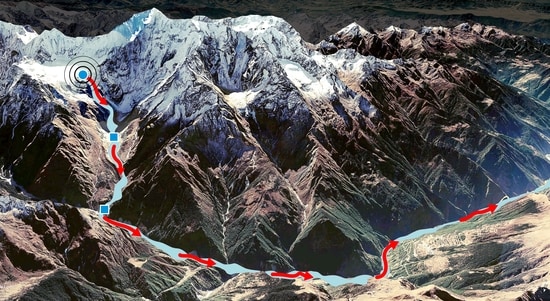
Investigators studying seismic and satellite data say the deluge began with the collapse of a Himalayan glacier and its bedrock. The break registered as a 5.2-magnitude tremor and sent ice, rock and mud crashing down the river systems that link Kathmandu with Lhasa.
United Nations officials estimate over 40 bridges have been destroyed or badly damaged, and more than 40km of road obliterated. At least eight hydropower projects have taken hits.
The debris has since dammed river channels into unstable lakes. On Friday, rescue teams were forced to halt operations after one of the two lakes (see infographic) began spilling into the Lhende and Trishuli rivers.
Work resumed once the immediate threat was judged manageable, though a Chinese government geohazards expert warned that more than 100 glacial lakes in the area could still be vulnerable.
Also read: After Nepal says no to foreign help, India to send tunnel rescue team ‘on request’