From Thursday, fuel stations across Delhi-National Capital Region will stop selling fuel to vehicles without a valid Pollution Under Control (PUC) certificate. The Commission for Air Quality Management (CAQM), the panel that coordinates pollution control measures in Delhi and its neighbouring areas, ordered in May that “no fuel shall be dispensed” to such vehicles, with number-plate cameras or other technology to enforce it.
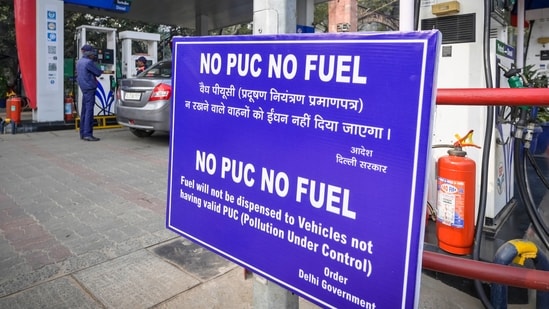
Delhi ran a version of the rule last December, when more than 3,700 vehicles were fined on the first day.
The certificate records a test that checks two gases in petrol cars while the engine idles, and the darkness of exhaust smoke in diesel ones.
Research has repeatedly found that this approach misses much of what vehicles emit because an idling engine behaves unlike one on the road, and the test cannot detect nitrogen oxides or the fine particles that escape a modern diesel’s filter.
Vehicles emit 81% of the nitrogen oxides produced within Delhi, according to a 2018 source study by The Energy and Resources Institute (Teri) and the Automotive Research Association of India (ARAI). Those gases go on to form fine particles and ozone in the air.
What is a PUC certificate?
Under Rule 115 of the Central Motor Vehicles Rules, 1989, every vehicle more than a year old “shall carry a valid ‘Pollution under control’ certificate”. It is valid for six months, or 12 months for vehicles built to the Bharat Stage IV (BS-IV) and BS-VI emission standards. Private testing centres authorised by state transport departments issue the certificates.
{{/usCountry}}Under Rule 115 of the Central Motor Vehicles Rules, 1989, every vehicle more than a year old “shall carry a valid ‘Pollution under control’ certificate”. It is valid for six months, or 12 months for vehicles built to the Bharat Stage IV (BS-IV) and BS-VI emission standards. Private testing centres authorised by state transport departments issue the certificates.
{{/usCountry}}Driving a vehicle that breaks the standards can bring a fine of up to ₹10,000, up to three months in jail, or both.
What does the test measure?
For petrol, CNG and LPG vehicles, a technician pushes a probe into the tailpipe while the engine idles. An analyser reports carbon monoxide (CO), a poisonous gas that forms when fuel burns without enough oxygen, and hydrocarbons (HC), fuel that leaves the engine unburnt.
A car built to BS-IV or later may emit no more than 0.3% CO and 200 parts per million of hydrocarbons. Older vehicles and two-wheelers are allowed more. Newer cars are also tested at “high idle”, with the engine held at about 2,500 rpm, where CO must stay under 0.2% and a reading called ‘lambda’ must fall between 0.97 and 1.03.
Lambda compares the air in the engine with the amount needed to burn the fuel completely. A value of 1 means the mix is chemically exact, the narrow band in which a catalytic converter, the device that cleans exhaust gases, works.
Diesel vehicles get a smoke test. With the vehicle stationary and the engine warm, the technician floors the accelerator several times while a smoke meter shines a beam of light through a sample of the exhaust and measures how much the smoke blocks.
Also read: Ammonia emissions worsening Gurugram air pollution, study finds
What makes Delhi’s winter haze?
The haze is mostly particulate matter 2.5 (PM2.5) – particles less than 2.5 micrometres across, small enough to pass deep into the lungs. Some are released as particles: soot from engines, smoke from burning crop residue, wood and rubbish, ash from coal, and dust from roads, soil and building sites. Others form in the air, as gases from chimneys, exhausts, farms and drains react with one another. Scientists call these secondary particles. In winter, cold and still air near the ground holds both kinds close to the surface.
The most recent major study of Delhi's winter air, led by IIT Kanpur with IIT Delhi and TERI for the Delhi government, analysed the city's particles hour by hour from November 2022 to February 2023. PM2.5 in this timeframe averaged 192 micrograms per cubic metre, more than three times the national 24-hour standard of 60. The study attributed it to:
Secondary inorganic particles, 32%: sulphate, nitrate and ammonium “formed in the atmosphere from the interaction of various gases” from “powerplants, refineries, brick kilns, vehicles, industry, agriculture, organic waste decomposition, and open drains”. An estimated 83% came from outside Delhi, from sources more than 30km from the monitoring site.
- Biomass burning, 24%
- Vehicles, 17%
- Coal and fly ash, 7%
- Burning of municipal waste, 3%, and household fuel, 3%
- Soil and road dust, 2%
- Other sources, 12%
An earlier TERI-ARAI study, using a different method, ranked transport second in Delhi’s winter PM2.5 at 28%, behind industry and power plants at 30%.
Vehicles add to the haze in four ways. They emit soot directly from the tailpipe. They emit nitrogen oxides and hydrocarbons, which react in the air to form new particles and ozone. Their catalytic converters release ammonia, which combines with those gases to form more particles. And their brakes, tyres and wheels throw off dust that causes PM10 pollution.
Nitrogen oxides also help form ozone, a gas that irritates the lungs. The Centre for Science and Environment (CSE), a Delhi-based research and advocacy group, found that Delhi breached the eight-hour ozone standard on 92 days between March and May 2025.
Can the test see nitrogen oxides?
A 2002 World Bank review of the programme found that the idle test “does not represent typical engine operating conditions”. Nitrogen oxides form at high combustion temperatures. An idling engine runs light and relatively cool and produces little of them, which is why idle tests are not used to measure nitrogen oxides.
The Netherlands tests older petrol cars against limits identical to India’s for BS-IV vehicles. A 2022 report by the Dutch research organisation TNO, drawing on its tests of high-mileage petrol cars, found that none of the high emitters of nitrogen oxides would have failed.
A faulty catalytic converter can raise a car's nitrogen oxide emissions tenfold or more, TNO found. In its tests, the 6% of cars with faulty converters produced 36% of all the nitrogen oxides. A clean CO reading, TNO concluded, is no sign that a car's nitrogen oxides are low.
Between December 2022 and April 2023, the TRUE Initiative, with analysis by the International Council on Clean Transportation (ICCT), took about 111,000 roadside readings of vehicle exhaust in Delhi and Gurugram. BS-VI CNG vehicles emitted between 1.5 and 14 times the nitrogen oxides their laboratory limits allow; one class of light goods vehicles reached 14.2 times. The PUC test for a CNG vehicle does not measure nitrogen oxides.
Can the test see particles?
On older diesel vehicles without filters, the darkness of the smoke broadly tracks how much soot the engine emits, at least under heavy load, a 2024 study of one old pickup truck found.
Newer diesel vehicles carry particulate filters, which trap soot before it leaves the tailpipe.
The European Commission, in a 2025 assessment, said: “Even in a Euro 4 vehicle equipped with a defective DPF, the exhaust’s opacity may be lower than the instruments’ resolution.”
A car with a broken filter can emit smoke too faint for the meter to register. Belgian inspections in 2022 found close to 10% of recent diesel cars with defective filters; The cars’ diagnostic systems had flagged a fault in 0.72% of cases. Belgium, the Netherlands, Germany and Switzerland now count the particles in the exhaust of filter-equipped diesel cars at inspection.
The test in India measures only how dark the smoke is.
Also read: Reimagining transport policy to check pollution in Delhi-NCR
Where does the test work well?
Carbon monoxide remains a problem in Delhi. Vehicles produce about 83% of the city’s CO emissions, according to a 2016 IIT Kanpur study, and CSE found that about 22 monitoring stations breached the eight-hour CO standard on more than 30 of the 59 days between October 1 and November 15, 2025.
Hydrocarbons help form ozone and particles, and a 2024 study at a Delhi site found that petrol cars and two-wheelers were the source of about half the particle-forming potential of the hydrocarbons it measured, though some of those escape as fuel vapour, which a tailpipe test does not see.
The test also catches some of the worst offenders. In two-stroke engines, which burn lubricating oil with the fuel, much of the particle emission is unburnt oil, so hydrocarbons and particles tend to rise together, and a high reading is likely to flag a smoky engine. A completely failed catalytic converter can push CO, hydrocarbons and nitrogen oxides up together, and an idle test can flag such a car. The test misses the car whose CO and hydrocarbons look normal at idle while its nitrogen oxides or particles are high.
Questions about the readings
The Comptroller and Auditor General’s audit in Delhi, tabled in April 2025 and covering 2015 to 2020, found that 108,000 petrol, CNG and LPG vehicles were passed “despite emitting CO/HC beyond the permissible limits”, and that 538,000 of 2.21 million diesel vehicles were certified with no test values recorded.
In 76,865 cases, testing and certification took one minute. Of 53,655 fines issued for visibly defaulting vehicles between November 2018 and October 2020, 98% went to vehicles with a valid certificate.
A 2018 CSE survey of centres in NCR reported “fake software, false passes and inappropriate tests”, “ill-maintained equipment” and a “lack of documentation on calibration”, the routine checking of analysers against a gas of known strength. A 2002 World Bank review described how easy it was to cut a reading “by withdrawing the probe slightly from the exhaust pipe” so that outside air diluted the sample.
What do other countries do?
India adopted idle testing in the 1980s, beginning in Mumbai in 1984. US cities ran inspection programmes before 1974, and idle testing spread because, as a 2017 review by University of Utah law professor Arnold Reitze notes, it “is easy to perform and requires minimal technical training.”
India has tightened the limits since and kept the method.
Since 2001, US states have been allowed to replace tailpipe tests on cars made from 1996 with a check of the car’s on-board diagnostics, the computer that monitors its own emission controls.
China’s standards, in force since 2019, test petrol vehicles on rollers under load and measure nitrogen oxides. Hong Kong uses roadside sensors to flag high-emitting petrol and LPG vehicles, whose owners must pass a test on rollers within 12 working days or lose their licence. In April 2025, the European Commission proposed replacing the smoke test for filter-equipped diesels with particle counting, and adding nitrogen oxide tests and roadside remote sensing.
What changes now?
The road transport ministry’s draft rules of July 2026 would let a private BS-VI vehicle go three years between tests until it turns six. Reports on the draft describe no change to the test.
HT found no published Indian study that has matched individual vehicles' on-road emissions against their PUC results, the direct test of whether the certificate identifies polluting vehicles. The Delhi Assembly has asked the city’s transport department to report by January 31, 2027, on the action taken on its Public Accounts Committee's recommendations on the CAG audit.