India is preparing a new production-linked incentive (PLI) scheme for polysilicon, the high-purity silicon used to make solar cells. It is the part of the solar supply chain that India still buys almost entirely from abroad, mostly from China, and closing that gap has become a priority as the country pushes towards its aim of 500 gigawatts (GW) of non-fossil power by 2030.
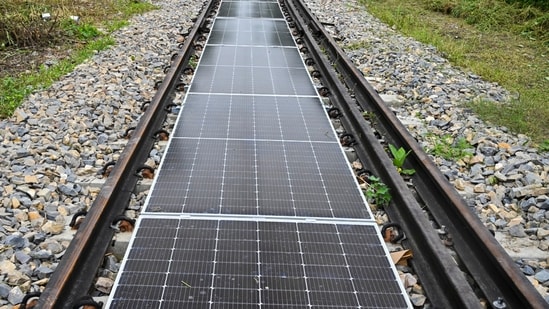
The ministry of new and renewable energy (MNRE) secretary Santosh Kumar Sarangi said last month that the government was aiming for at least 30 GW of domestic polysilicon capacity by 2030, an addition that could draw about ₹25,000 crore in investment.
A single gigawatt of polysilicon capacity, along with metallurgical-grade silicon, costs about ₹850 crore to build, Sarangi had said.
An earlier PLI round that covered polysilicon, wafers, cells and modules is expected to deliver only a small amount of upstream capacity, which is why a dedicated scheme is being drawn up, he said.
Also Read: Solar manufacturing at a critical juncture
Where India stands
India has built more than 200 GW of solar module capacity and over 32 GW of solar cell capacity, and another 100 GW of cell capacity is due within a year, Sarangi told a Confederation of Indian Industry event in New Delhi on August 7, according to a Reuters report. The government is also targeting at least 80 GW of ingot and wafer capacity by June 2028.
Wafers, ingots and polysilicon, the three stages that feed cell production, are still imported almost entirely from China. India’s polysilicon import dependence stands at close to 100%, and wafer import dependence at above 90%, according to a NITI Aayog report. That leaves the Atmanirbhar Bharat pitch for solar largely a downstream one.
{{/usCountry}}Wafers, ingots and polysilicon, the three stages that feed cell production, are still imported almost entirely from China. India’s polysilicon import dependence stands at close to 100%, and wafer import dependence at above 90%, according to a NITI Aayog report. That leaves the Atmanirbhar Bharat pitch for solar largely a downstream one.
{{/usCountry}}India was the world’s second-largest solar growth market in 2025, adding 37 GW of capacity behind China’s 315 GW and ahead of the US’s 34 GW, according to the International Renewable Energy Agency (IRENA). India’s installed solar capacity was 162 GW as of June 2026, MNRE data shows, making solar the country’s largest source of renewable power. That scale makes the upstream gap harder to ignore.
Also Read: Trying to diversify supply chains, reduce dependence on China: Ajay Mathur
What is polysilicon? Why is it hard to make
Polysilicon is produced by refining ordinary quartz or silica sand through smelting and chemical vapour deposition, a capital-intensive process that runs on continuous electricity. The refined material is cast into solid ingots, sliced into thin wafers, processed into solar cells, and finally wired together into modules.
Progress on the domestic PLI has been slower at this upstream end because the chemistry is harder, the plants cost more to build, and they need very large, uninterrupted volumes of power. China’s share in the key manufacturing stages of solar panels — including polysilicon, ingots, wafers, cells and modules — exceeds 80%, according to the International Energy Agency, with production clustered in provinces where power is cheap and continuous.
Also Read: Solar sustainability as a path to an energy independent future
Why the push
A NITI Aayog report published on August 13, titled Key Sectors to Position India as a Global Manufacturing Hub, said China’s dominance of the polysilicon market poses both a supply-chain and a national-security risk for India, and that Chinese cost advantages make commercially viable Indian capacity difficult to build without government support. The report puts China’s 2024 share at 93–98% of installed and new polysilicon production capacity, 95% of wafer capacity, 91% of cell capacity and 82% of module capacity.
The government has already committed about ₹240 billion in PLI outlays for solar modules and cells. A 30 GW polysilicon build at ₹850 crore per GW would be of comparable scale.
Polysilicon has another use that strengthens the case for local production. It is also a feedstock for semiconductor manufacturing, a sector the government is separately pushing under its Atmanirbhar Bharat programme.