US President Donald Trump welcomed Chinese leader Xi Jinping to the White House on Thursday, as the two met for high-stakes talks despite divisions over the war in Iran and inability to find common ground on trade and the rapid advances of artificial intelligence (AI).
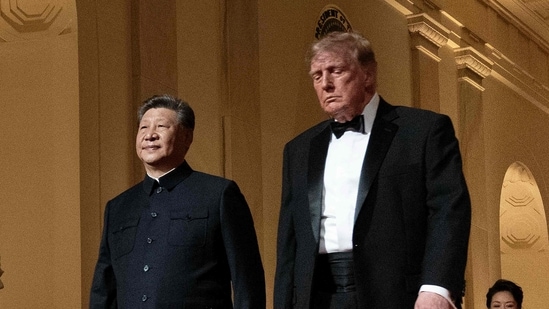
This is Xi's first trip to Washington since 2015, having arrived for a two-day summit as part of a three-day state visit.
HT examines what the talks between the two superpowers achieved on day 1 of the summit, what fell short, and how countries like India are likely to assess the progress.
Track updates on the Trump-Xi meeting live here
How the summit played out
The day began with President Trump and First Lady Melania Trump welcoming President Xi and Chinese First Lady Peng Liyuan to the White House, as the Chinese leader was greeted by hundreds of US military personnel, including a flyover by a stealth bomber and fighter jets.
Trump and Xi then addressed the media, with both leaders largely emphasising the need for stability and cooperation in the US-China relationship.
{{/usCountry}}Trump and Xi then addressed the media, with both leaders largely emphasising the need for stability and cooperation in the US-China relationship.
{{/usCountry}}Deep Dive
What was the main outcome of the Trump-Xi summit regarding trade relations?
Why did Xi Jinping emphasize the importance of healthy competition between the US and China?
How will the US and China collaborate on artificial intelligence following the summit?
This was followed by a bilateral meeting that lasted several hours. A state dinner followed, attended by some of the most high-powered officials and politicians from both the US and China. Several of America's best-known tech CEOs, including Alphabet's Sundar Pichai, Microsoft's Satya Nadella, Nvidia's Jensen Huang, and OpenAI's Sam Altman, also attended the dinner.
What was achieved?
A key announcement was made before the Trump-Xi summit, when US Treasury Secretary Scott Bessent revealed that the trade truce between Washington and Beijing – originally set to expire in November – would be extended by two months to January.
This will keep tariffs on Chinese goods entering the US largely stable, while ensuring America continues to receive a steady supply of critical minerals and rare earths.
Besides, a statement later released by China’s Foreign Ministry stressed that Washington and Beijing should maintain a dialogue on AI.
After years of US-China tensions, the meeting largely maintained a tone of civility while underscoring the need for stability in relations between the two superpowers. President Xi called for increasing the number of areas under “win-win cooperation” and ensuring “competition is kept within proper limits”.
President Trump echoed the rhetoric, with a focus on a more balanced trade relationship and discussions on AI and technology.
On the soft power front, Xi announced that China would loan two pandas to the Atlanta Zoo, continuing its tradition of "panda diplomacy," and proposed bringing 100,000 American students to China.
ALSO READ | ‘Not a wrestle’: Xi Jinping warns Trump against ‘win-or-lose’ rivalry
Reaction to the summit
Domestic divisions marked day 1 of the summit, to say the least — America's opposition Democratic Party criticised the summit for achieving little of substance.
“At a time when Americans are struggling with rising costs of gas, electricity and groceries, President Trump rolled out the red carpet for Xi. Rather than confronting China’s unfair trade practices, technology theft, complicity in attacks against our troops or economic and military aggression against our allies, President Trump opted for pageantry over purpose—trading tough diplomacy for a ballroom tour and a lavish dinner with his billionaire friends,” 19 US Senators said in a joint statement.
Analysts mostly agreed that the summit was heavy on pomp and ceremony, leaving the US-China relationship no better and no worse off than before. Many viewed the two-month extension of the bilateral trade truce, at best, a modest achievement.
ALSO READ | Xi-Trump meeting: How US-China AI rivalry is pushing China’s tech industry forward
How countries like India see the summit
Throughout the summit, Trump has steered clear of any explicit references to a "G2" with China — the notion that the US and China would jointly settle the world's key questions between them.
The concept of a G2 – which runs the risk of sidelining concerns US partners like India and allies like Japan have about China’s rapid geopolitical rise – has been a source of worry for New Delhi.
ALSO READ | Trump slammed for ‘wincing’ during flypast video with China's Xi: ‘Embarrassment on world stage’
Analysts, however, have noted that Trump has gone to considerable lengths to court Xi. For instance, he travelled to Andrews Air Force base to personally welcome Xi on his arrival in the US – a gesture he has not extended to any foreign leader, including from countries the US considers friends and allies.
China watchers in Washington and elsewhere pointed out that gestures like these have allowed Beijing to send a pointed message to Asian countries, which are already uneasy about Trump's perceived reluctance to back them in confrontations with China.