
 E-Paper



Preparing India for extreme climate events
Climate change poses unprecedented challenges to human-made and natural ecosystems as well as to anthropocentric and economic activities. The article has been authored by Abinash Mohanty.

 Prefer HTon Google


Climate change poses unprecedented challenges to human-made and natural ecosystems as well as to anthropocentric and economic activities. The most obvious evidence, arguably, is the surge in the frequency of extreme events. Extreme weather events resulting
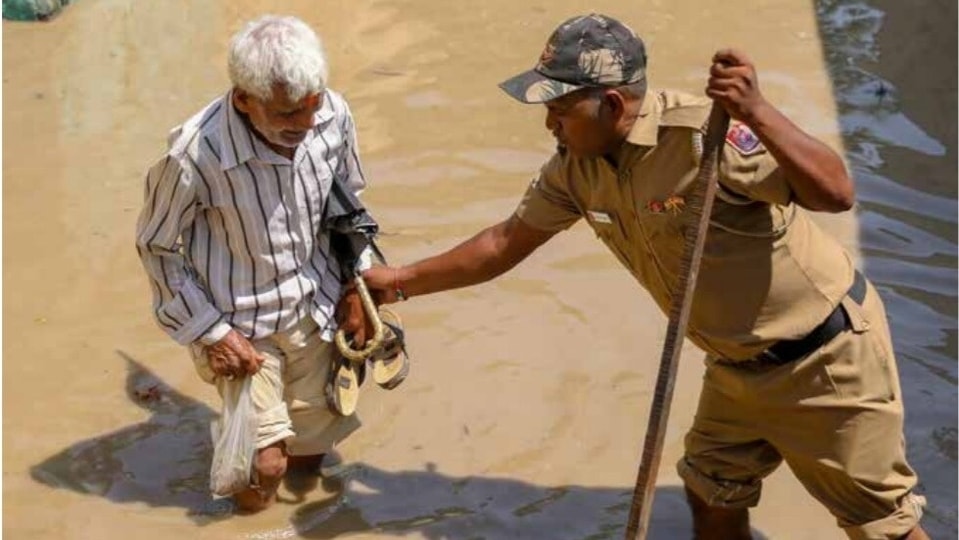
from climate change led to 495,000 human deaths across the world in 1999–2018. Further, more than 12,000 extreme weather events led to losses worth USD 3.54 trillion (measured in terms of purchasing power parity or PPP) during this period. Against this backdrop of changing climate, the frequency, intensity, spatial extent, duration, and pattern of weather and climate events are also changing, leading to unprecedented climate extremes (Zhai et al. 2018).
According to the Climate Risk Index, 2018, India jumped nine places in climate vulnerability rankings and was ranked the fifth-most climate-vulnerable country in the world (German Watch, 2018). Storms are escalating into cyclones, droughts are affecting more than half of the country, and floods of an unprecedented scale are causing catastrophic damage. There is no denying that the climate is changing – and fast.
Global, regional, national, and subnational climate actions are geared toward limiting any further increase in the earth’s temperature to 2 °C. However, we must also consider the consequences of this “target” temperature increase, given that the current trends in extreme events are the result of a 0.6 °C rise in the last 100 years (IMD 2019).
This report presents a micro-level hazard assessment of climate extremes in India. Through geospatial, temporal analysis, we provide a detailed assessment of the impact of extreme events at a district level. We use the pentad decadal analysis of extreme events in India (1970–2019) to identify district hotspots and climate change landscape for extreme events (see Figure ES1). The study argues that comprehensive risk assessments at the localised level are the need of the hour and should be undertaken for all districts in India. This study looks at the combined risk of hydro-met disasters and their compounded impacts. As per our analysis, the Indian subcontinent has witnessed more than 478 extreme events since 1970 and an acceleration in their frequency after 2005.
This study provides an micro-level hazard assessment for India at a historical timescale.
According to our analysis, India experienced an exponential increase in extreme events during the period 1970–2019, with a marked acceleration in 2000–2019. We considered 2005 the reference year for the pentad decadal analysis primarily because of the availability of attribute base maps for 2005, which we procured from ISRO (Indian Space Research Organisation). However, this study focuses on only hydro-met disasters due to gaps in the data on other phenomena. We developed the district-level roster of extreme events for 1970–2019 in line with Emergency Events Database (EM-DAT) criteria and further updated it using data from the India Meteorological Department (IMD), National Disaster Management Authority (NDMA), Press Information Bureau (PIB), and the Ministry of Agriculture.
Our analysis found that floods and droughts have become increasingly common in many regions across various climatic zones in India. We infer that in the post-2005 period, at least 55 or more districts in India witnessed extreme flood events year-on-year (≈ 97.51 million people are exposed to extreme flood events in India annually). Increased precipitation levels are triggering a surge in extreme flood events, thereby causing severe damage to infrastructure and disrupting the socioeconomic fabric by causing extensive loss and damage to lives, livelihood and property.
Similarly, 79 districts witnessed extreme drought events year-on-year (≈ 140.06 million people are exposed to extreme drought events), and 24 districts witnessed extreme cyclone events yearly (≈ 42.50 million people were exposed to storm surges, intense cyclones, and associated events). In the period 1970–2005, there were 250 extreme events; the post-2005 period witnessed 310 extreme and its associated events (which includes slow onset events like heat waves and cold waves). Frequent floods and droughts pose a severe challenge to food and water security in India. The empirical evidence generated from our analyses coincides with the weakening of monsoons due to rising micro-temperatures. This further can be validated by the fact that states like Maharashtra, Karnataka, and Uttar Pradesh saw severe water scarcity during 2015 due to record-breaking temperatures during summer and weakening monsoons.
We find that the pattern of extreme events is changing across some regions (districts) in India – some drought-prone districts are becoming flood-prone and vice versa. Rajkot, Surendranagar, Ajmer, Jodhpur, and Aurangabad, among others, are a few districts where we observed a shifting trend from floods to drought. A few districts in Bihar, Uttar Pradesh, Odisha, and Tamil Nadu observed the simultaneous occurrence of drought and floods. The trends are alarming and demand a comprehensive risk assessment at the local level, which requires a grid-level climatological analysis to identify the compounded impacts.
Our analysis reveals that microclimatic1 zones are shifting across various regions (districts) in India. The microclimate zones, categorised according to the Köppen-Geiger classification, are shifting due to climate change. It is important to note that a shift in microclimate zones may lead to severe disruptions across sectors. For instance, every 2°C rise in annual mean temperature will reduce agricultural productivity by 15–20 per cent. Flood- and cyclone- prone districts fall under the category Cwa (monsoon-influenced humid subtropical climate), and drought-prone districts under Bsh (hot semi-arid climate). The flood-based climatic zones are shifting towards Aw tropical, which is characterised by its dry season, thus validating empirically that flood-prone areas are becoming drought-prone. On the one hand, cyclone hot spots are changing from Cwa to Aw tropical climatic zones; on the other, the urban heat island (UHI) effect and increase in sea level are pushing cyclonic disturbances towards warmer regions, as is evident from the climate zone shift. Drought events are becoming more intense, and empirical evidence from the analysis suggests that southern, western, and some parts of central India are becoming increasingly prone to drought.
While the frequency and intensity of extreme events are increasing, we are left with less than a decade to adhere to the Sendai Framework; course correction and policy implementation need to have a razor-sharp focus on curtailing the compounded impacts of climate change. Principles of risk assessment must form the core of India’s strategy to build resilience.
While actions at the global, national, and subnational levels are targeting a well below
2°C limit, it is imperative to outline the chronic challenges that these extreme events pose, especially to the vulnerable sections and sectors. Extreme events are devastating since they are non-linear and disrupt natural and human-made ecosystems. Our analysis suggests some key recommendations that can trigger efforts towards a resilient pathway.
Some of them are developing a comprehensive climate risk atlas, mainstreaming climate risk assessments at all levels across sectors; bridging financing gaps through innovative risk financing instruments; and enhancing resilience and adaptive capacity, among others. It is time to rethink and reorient our approach to mitigate disaster risks and prepare better for the impending climate uncertainties.
(The article has been authored by Abinash Mohanty)


