
 E-Paper



As Indo-US relations deepen so will public scrutiny
This article is authored by Tara Kartha, Distinguished Fellow, Institute of Peace and Conflict Studies, New Delhi.

 Prefer HTon Google


At one level, it seems there’s nothing but bad news in the Indo-US relationship. India’s alleged plot to assassinate a Khalistani activist, seems to be ‘trending’ in Washington DC. Senators and Congressmen of various hues have joined the chorus, with one group ‘pleading’ with President Biden to condemn India on religious freedoms. More such statements are likely as politicians will use the issue for their own electoral or other motives. All this is naturally making the Indian public furious, thus reducing the space for manoeuvre for leaders and their officials on both sides. What is notable is that both have reacted with maturity, and quietly gone on with the business in hand, which is to develop the partnership, each for its own reasons.
First, the obvious irritant, which is the Gurpatwant Singh Pannun incident, who till the time of Canadian Prime Minister Justin Trudeau’s public accusations, was a fringe element in India, despite a noisy demand for a ‘referendum’ for an independent Khalistan. That referendum did not include Pakistani Punjab, which in itself should make Congressmen and the US media suspicious. But no, all both parties did was talk of India targeting those wanting ‘independence’. The newest in that quiver is an emotional plea from the US Commission on International Religious Freedoms (USCIRF) which recently “implored” the government to designate India as a “Country of Particular Concern’ (since 2020) and has stated that “The Indian government’s alleged involvement …..(in Canada and the United States) are deeply troubling, and represent a severe escalation”. It might at least have waited till the charges were proven. The organisation has produced a lot more in recent days including an Annual Report that even raises the hijab protests. Never mind that the world is praising the Saudis for loosening restrictions on women including the ‘abaya’. More seriously, it also called out the Citizenship Amendment Act (CAA) aimed as it says at removing “undocumented” Muslims from Assam. The CAA has its strong opponents inside India, but consider that Europe has virtually outsourced its border security to countries like Turkey, stopping refugees in advance even as children and women drown in ill-equipped boats. UK's Prime Minister Rishi Sunak warned of a wave of refugees, even he signed an agreement to send migrants to Rwanda. Italy’s PM Giorgia Meloni recently stated that there was a problem of compatibility between Islam and Europe. And these ‘migrants’ are the result of wars that Europe and the US have backed. In our case, we didn’t start the fires. All of this is ignored by the arbiters of religious freedoms. Also the fact that some 25,000 Sikhs died in the so called Khalistani violence in the 1990’s. Nobody wants that period regurgitated.
Second, in recent days has been the statement from a group of Indian American members of Congress. While ‘welcoming’ India’s setting up of a Commission of Inquiry into US charges of an Indian assassination attempt, and noting that the relationship has made a “meaningful impact’ upon the lives of people on both sides, it also warns that if the actions outlined in the indictment if not properly addressed, could “cause significant damage to this very consequential partnership.” This follows a Senate hearing on “Transnational repression” presented by Freedom House, which originally concentrated on China, Iran and a host of ‘top tenners’, also included questions on India. That session was far from inimical to India and some of the Senators involved were those rooting for the Indo-US partnership. But the questions remain.
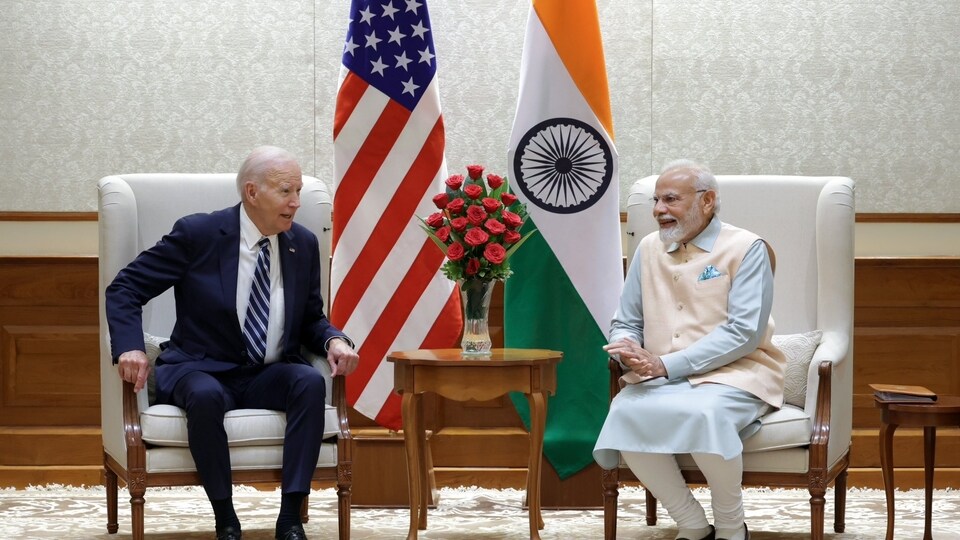
Now consider the flip side, which is the uninterrupted and ongoing cooperation between the two. It’s not just the triumphant visit to the US by Prime Minister Modi to the US, or the overwhelming hospitality apparent, its what is in black and white. The November 2+2 statement is staggering in its scope. Media tends to focus on the big-ticket items like the manufacture of GE-F414 engines in India – undoubtedly a first for both sides. But read on. There is industry interest in increasing our MRO (maintenance repair overhaul) capacity in India. That is a key role in the Indo-pacific construct. While RAND analysts point out that India will not take part in a war that doesn’t directly involve them (which is true) but the point is that it could assist, and very profitably, in other roles. That fits neatly into the PM’s pioneering Aatmanirbhar programme. Supporting this is the Security of Supply Arrangement (SOSA) to integrate the defence industrial ecosystems of both countries while strengthening supply chain resilience. And then on to the ever-expanding INDUS -X (India-US Defence Acceleration Ecosystem) with private investors being welcomed to fund critical technologies using a special hub created for the purpose. Two key areas have already taken off, in the maritime domain that includes underwater communications with the Indian navy, and multi-sensor fusion algorithms for detecting oil spills in near real-time with the Coast Guard, both with the US Department of Defence. Consider the oil spill recently in Chennai that threatened livelihoods in the coastal areas following a devastating cyclone. There’s a whole bagful more, including India signing on to the Artemis Accords for joint space exploration. These are hard practical issues that face both. In terms of defence, the scope is steadily widening – from a 2019 exercise in disaster management – to the present Vajra Prahar that had special forces on both sides in Himachal Pradesh, among other locations. Notably, the Press Information Bureau rather unusually noted it as “significant in terms of security challenges faced by both Nations in the backdrop of the current global situation”. That’s plain speaking. In sum, the US is preparing to share a great deal with India, for its own interests, both strategic, and business sense. That continues, to the chagrin of those who would want to see it end. India is slowly inching towards its so far unstated goal of dealing with a China that seems intent on threatening it on multiple fronts. That is not something the country can handle alone.
All this is puzzling to those who have been hailing the close relationship with the US. Many also might wonder why Pakistan is not even among Freedom House’s list of top worst countries, or even why chief of army staff Gen. Asim Munir is being hosted by secretary of state Anthony Blinken (rather than just the Defence Department) but the truth is this. The relationship between India and the US has reached a level unseen in decades. And as that continues to happen, Congressional oversight will only increase, as will lectures on freedoms, even as the US public remains completely unaware of the strong emotions raised by the Khalistan issue, particularly from those who have seen it upfront. Delhi has to consider a strong and sustained effort to ensure that the Indian views are presented in think tanks, in Congress and in the media, in a manner that is transparent and equitable. In other words, this cannot be restricted to those who agree with Delhi. A little dissent is the stuff of verisimilitude. That is especially so when the objective is to address opinion in what is still one of the most powerful democracies in the world.
This article is authored by Tara Kartha, Distinguished Fellow, Institute of Peace and Conflict Studies, New Delhi.


