
 E-Paper



India’s role as the custodian of Buddhist heritage
This article is authored by Cchavi Vasisht, associate fellow, Chintan Research Foundation, New Delhi.

 Prefer HTon Google


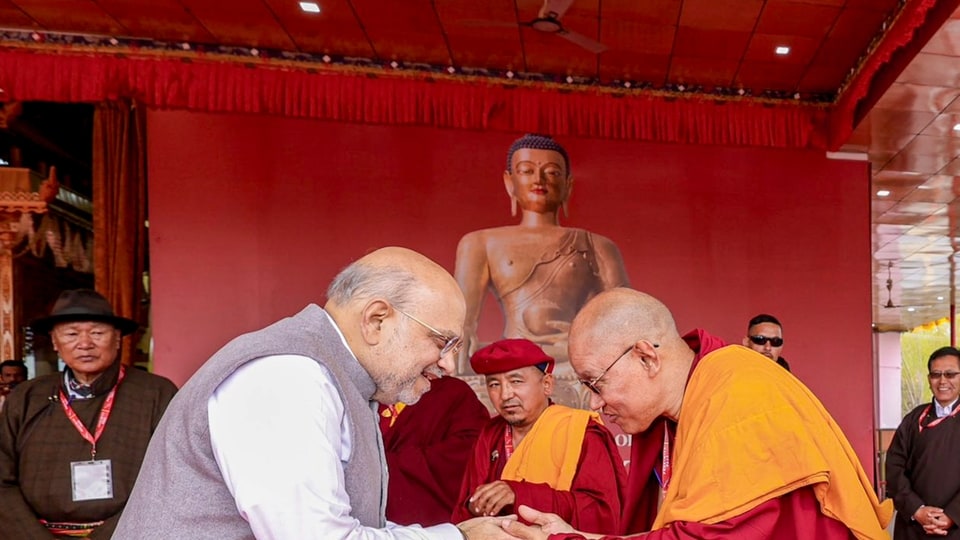
At the first-ever international exposition in India, titled Sacred Exposition of the Holy Relics of Tathagata: Peace Beyond Borders, Union home minister Amit Shah bowed before the sacred Piprahwa relics at Jivetsal in Leh on May 1. He addressed the gathering of monks and devotees that “it is as if Buddha himself is present here today.” This statement is a powerful yet civilisationally grounded expression that India is home to the Buddha’s soul.
The repatriation of the Piprahwa relics, after 127 years, was genuinely historic and had a journey of its own. In May 2025, Sotheby’s Hong Kong auctioned ‘The Piprahwa Gems’ which were unearthed in 1898 by British colonial surveyor William Claxton Peppé at Piprahwa that is in present-day Uttar Pradesh. The Brahmi inscriptions on it were identified as being associated with Gautama Buddha himself which consisted of bone fragments and offerings placed at the time of his Mahaparinirvana. Soon India’s ministry of culture intervened to halt the auction and repatriated the relics to India on July 30, 2025. To celebrate this, Prime Minister Narendra Modi inaugurated the international exposition titled ‘The Light and the Lotus: Relics of the Awakened One’ at the Rai Pithora Cultural Complex in New Delhi on January 3, 2026. He said “After a wait of 127 years, India’s heritage has returned, and the nation’s treasured legacy has come back home.”
For this Buddha Purnima, the choice of Ladakh as the site for the first-ever domestic exposition of the Piprahwa relics is not incidental. It is significant; it is a land of four active Tibetan Buddhist sects (Nyingma, Kagyu, Sakya, and Gelug), of monasteries older than most nations, of a history that runs from Emperor Ashoka's envoys through Gandhara and Kashmir to the Silk Route. The Silk route especially was not just a trade artery, it was a corridor of ideas, of monks, manuscripts, and artistic traditions.
Buddhism emerged in the 5th-6th century BCE in the Gangetic plains of what is now India. Lord Buddha’s life, from being born in Lumbini (in present-day Nepal) to Bodh Gaya (enlightenment), Sarnath (first sermon), and Kushinagar (Mahaparinirvana) is spread across India. These sites form the core of global Buddhist pilgrimage. And India exported Buddhist philosophy through traders, monks, and scholars, to Sri Lanka, Southeast Asia, Central Asia, China, Korea, and Japan.
Ashoka, was considered as one of the first great practitioners of what we call today i.e. Buddhist diplomacy. He sent his son Mahinda and daughter Sanghamitta to Sri Lanka in the 3rd century BCE, sharing teachings not as an act of conquest but as an offering. Over the centuries, scholars from across Asia made the pilgrimages to Indian universities. Even Chinese scholars like Xuanzang and Yijing traveled many routes to study at Nalanda, Takshashila, and other mahaviharas. Nalanda was an Indian institution, founded in the 5th century CE in present-day Bihar, that became what historian William Dalrymple called “the undisputed scholarly centre of the Mahayana Buddhist world.” And today, India is restructuring and reinvigorating this legacy, not as revivalism, but as civilisational continuity.
The relics exposition is the most emotionally and symbolically charged element of India’s Buddhist strategy. The Indian government facilitated two major expositions in the past two years. In Thailand, between February 22-March 19, 2024, relics of the Buddha and his disciples were displayed at four venues, drawing over 40 lakh devotees. In Vietnam, from May 2-June 2, 2025, relics from Nagarjunakonda in Andhra Pradesh were displayed across nine locations during Vesak celebrations, drawing an estimated 1.8 crore visitors.
Similarly, in Mongolia, India's Buddhist diplomacy has deep institutional roots. From 1990 to 2000, India appointed Bakula Rinpoche, political leader from Ladakh as its ambassador, a decision that deepened India-Mongolia ties through cultural and spiritual channels. In Russia's Buddhist republics of Buryatia, Kalmykia, and Tuva, the relics' passage drew similar scenes of deep reverence. The Ladakh exposition builds on this, drawing global devotees and boosting spiritual tourism and fosters people-to-people ties.
Complementing this is the Buddhist Circuit linking sacred sites Lumbini and Kapilavastu to Bodh Gaya, Sarnath, Nalanda, and Kushinagar. In 2025 alone, Uttar Pradesh’s Buddhist Circuit recorded over 61 lakh visitors in just the first nine months. The international airport at Kushinagar now provides direct connectivity to Buddhist-majority nations across Southeast Asia. It is also interesting how the Northeast is being integrated through a dedicated Buddhist circuit across six states, positioning India’s eastern flank as a civilisational bridge to ASEAN. The year 2025 was designated the ASEAN-India Year of Tourism, with India committing $ 5 million from the ASEAN-India Fund to support cultural and tourism initiatives across the region.
Under the Mekong-Ganga Cooperation framework, the MEA organised a nine-day familiarisation trip for 50 travel industry representatives to Buddhist sites in Uttar Pradesh and Bihar. A high-level Thai delegation visited Gujarat in June 2025, deepening cultural ties in a relationship that dates back to the era of Ashoka's own missions. Additionally, the India-Myanmar-Thailand Trilateral Highway, the Bodhi Yatra initiative, and the restoration of the Ananda Temple in Bagan, are not isolated development projects. They are the architecture of a Buddhist corridor, connecting the birthplace of the Dhamma to the regions where it blossomed.
The Second Global Buddhist Summit was held in New Delhi, organised by the International Buddhist Confederation and the ministry of culture in January 2026. Attended by diplomats and monks from around 40 countries, the summit offered a platform for India to articulate its custodianship of Buddhist wisdom at the highest multilateral level. These initiatives/efforts are the means to Dhamma diplomacy, a civilisational strategy that India has been slow to name but is finally executing as cost-effective pillars of soft power.
For over two decades now, China has been promoting Buddhist diplomacy via organising international Buddhist forums, funding monastery restorations across Southeast Asia, courting Theravada communities, and weaving Buddhist outreach into the Belt and Road Initiative. China has projected itself as the global headquarters of the Buddhist world. But it is ironic that the State has suppressed religion at home, dismantled the institutional foundations of Tibetan Buddhism, and humiliated thousands of Tibetan monks and nuns during the Cultural Revolution.
And as scholar Sana Hashmi has noted, China has been trying to forge religious diplomacy with countries that have Buddhism as their main religion, but its actual goal is achieving political objectives. The Buddhist Association of China is overseen by the United Front Work Department of the CCP which mandates that all clergy must pledge allegiance to the Party and to socialism. A 2007 regulation requires State approval for all reincarnate lamas, directly interfering with centuries-old Tibetan religious tradition. Since 2020, under Xi Jinping's leadership, the CCP has intensified a formal Sinicisation campaign, a policy designed to bring Buddhist doctrine into line with CCP ideology.
India needs to reiterate its Buddhist roots and pursue its Dhamma diplomacy with much rigour and assert its rightful place as the cradle and custodian of Buddhist heritage. Under Modi's leadership, 642 antiquities have been repatriated to India. Each repatriation is a small act of civilisational recovery and the relics diplomacy is connecting nations across geographies.
Even the presence of the Dalai Lama in India is, in fact, India’s greatest asset. Since 1959, India has been home to the Tibetan government-in-exile and one of the great living centres of Tibetan Buddhist learning, scholarship, and practice. It has attracted students, practitioners, and seekers from across the world. In many ways India has offered the Dhamma a home.
Furthermore, the Buddhist Circuit is being built strengthening India-Nepal ties. The Northeast is being treated as a civilisational gateway. What can be done now is to set up an institutional machinery to coordinate efforts under a coherent doctrine, one that explicitly positions India as the Dhammabhumi, the land of the Dhamma, in every multilateral forum where Buddhism is discussed. This is soft power. It aligns with Act East Policy, Neighbourhood First, and global outreach to Buddhist nations.
(The views expressed are personal)
This article is authored by Cchavi Vasisht, associate fellow, Chintan Research Foundation, New Delhi.


