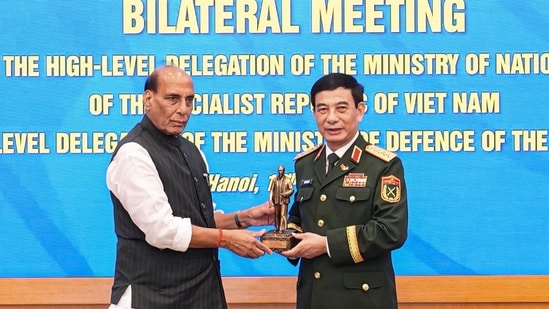
Recent high-level engagements between India and Vietnam underline a shared commitment to strengthening bilateral ties and deepening strategic convergence against regional geopolitical flux and maritime coercion. General Secretary and President of Vietnam, To Lam, undertook a State Visit to India on May 5-7, 2026 during which the two countries signed multiple agreements spanning science and technology, critical minerals, healthcare, and cyber security. Hardly ten days had elapsed when Indian defence minister Rajnath Singh paid an official visit to Vietnam on May 18-19, 2026 underscoring the robust relationship between the two countries.
Vietnam is a critical pillar of India's Act East Policy and a key strategic partner in the Indo-Pacific region. Strategically, both nations share deep concerns over maritime security and freedom of navigation in the South China Sea, leading to robust defence cooperation, joint military exercises, and defence technology transfers. Economically, Vietnam serves as a booming market for Indian exports like pharmaceuticals, machinery, and agricultural products, while also offering a crucial alternative for supply chain diversification. Furthermore, their relationship is anchored in strong historical and cultural ties, rooted in the ancient Cham civilisation and shared Buddhist heritage. Together, this multifaceted partnership allows India to expand its geopolitical footprint in Southeast Asia while balancing regional power dynamics.
At the heart of Rajnath Singh’s visit is the mutual recognition that both India and Vietnam hold vital stakes in the security of the Indo-Pacific region. Facing overlapping geopolitical concerns and the need for unimpeded freedom of navigation, a robust security partnership between New Delhi and Hanoi serves as a stabilising force. By discussing ways to expand maritime cooperation, joint exercises, and information sharing, India and Vietnam are taking proactive measures to safeguard their maritime interests and counter unilateral assertions of dominance in regional waters. By nurturing a robust defence partnership with a frontline Southeast Asian state, India successfully projects its strategic outreach while supporting Vietnam’s defence resilience.
The China factor is the primary geopolitical catalyst driving India and Vietnam together. Both nations share land or maritime borders with China, face territorial disputes with Beijing, and seek to manage regional power imbalances by deepening their Enhanced Comprehensive Strategic Partnership (ECSP). While a shared wariness of Chinese regional dominance drives New Delhi and Hanoi into a closer strategic embrace, both nations deliberately calibrate their partnership to avoid provoking Beijing into open conflict.
{{/usCountry}}The China factor is the primary geopolitical catalyst driving India and Vietnam together. Both nations share land or maritime borders with China, face territorial disputes with Beijing, and seek to manage regional power imbalances by deepening their Enhanced Comprehensive Strategic Partnership (ECSP). While a shared wariness of Chinese regional dominance drives New Delhi and Hanoi into a closer strategic embrace, both nations deliberately calibrate their partnership to avoid provoking Beijing into open conflict.
{{/usCountry}}India and Vietnam officially signed the ECSP agreement on May 6, 2026 during the visit of General Secretary and President of Vietnam, To Lam. The landmark agreement builds on previous milestones, specifically the 2007 Strategic Partnership and the 2016 Comprehensive Strategic Partnership. The upgrade in 2026 was marked by the signing of $135 million in defence credit lines and 13 Memorandums of Understanding (MOUs), including pacts for digital payment cooperation and rare earth minerals. The bilateral roadmap sets an ambitious trade target of $ 25 billion to be achieved by the year 2030.
The ESCP has several critical advantages for India, foremost among them being maritime and trade security. It directly safeguards India's maritime and trade security by ensuring unhindered sea lines of communication, securing critical supply chains, and integrating India into the broader Indo-Pacific security architecture. Positioned along the South China Sea, Vietnam is central to keeping vital trade arteries open. The pact enhances information sharing, joint naval exercises, and capacity-building to ensure freedom of navigation.
Moreover, the ESCP will promote India-Vietnam cooperation in defence production and joint research, sharing expertise in domains like cybersecurity and military technology. It focuses on prioritising core-technology domains and providing the expertise needed to manufacture high-tech defence equipment. The ESCP establishes collaborative production lines to design and build defence equipment and materials, promotes joint research initiatives and the co-development of new defence technologies and facilitates the efficient supply and procurement of equipment and materials between the two countries' domestic defence industries.
Facing similar regional security challenges, both countries advocate for a free, open, and rules-based Indo-Pacific, providing India with a reliable strategic gateway into Southeast Asia. By emphasising maritime security, defence modernisation, joint technology sharing in AI and quantum computing, and logistics support, the diplomatic dialogue solidifies India’s Act East policy and highlights both nation’s shared geopolitical interests in a stable, free, and open Indo-Pacific.
Rajnath Singh’s visit to Vietnam actively operationalised the ECSP by translating high-level political trust into tangible defence, technology, and maritime agreements. During his official visit, Singh held key bilateral meetings in Hanoi with President To Lam and defence minister Phan Van Giang, laying the groundwork for concrete military cooperation.
The visit advanced the ECSP framework through several key steps:
Technology & Innovation: Both nations exchanged a Memorandum of Understanding (MoU) focused on emerging fields like Artificial Intelligence and quantum technology.
- Operational agreements: Officials reviewed and expedited key operational mechanisms, including the Mutual Logistics Support Agreement and the agreement on Submarine Search and Rescue, to strengthen regional interoperability.
- Capacity-building: The leaders jointly inaugurated a new Language Lab at the Air Force Officers College and advanced the utilisation of India's Defence Lines of Credit to boost Hanoi's local defence manufacturing capabilities.
Through these initiatives, the visit directly served the strategic goals of the partnership, anchoring both countries’ shared vision of maritime security, peace, and stability in the Indo-Pacific.
Rajnath Singh’s diplomatic visit to Vietnam was far more than a routine bilateral exchange; it was a calculated geopolitical manoeuvre that fortified India's stature as a net security provider in the Indo-Pacific. By deepening ties in maritime security, defence modernization, and cutting-edge technologies, India and Vietnam are successfully carving out a robust framework for regional stability and long-term mutual defence. As regional security challenges evolve, this steadfast partnership stands as a stabilising force, reinforcing the rules-based international order. Driven by shared maritime security concerns and mutual goals for strategic autonomy, the future will see deepened defence ties, expanded technology collaboration—including critical minerals and AI—and a push toward a target of $25 billion in bilateral trade by 2030.
(The views expressed are personal)
This article is authored by Prabhu Dayal, former ambassador, New Delhi.