
 E-Paper



Trade deals to trade corridors: IMEC holds the key to India’s growth story
This article is authored by Col Rajeev Agarwal (Rtd), senior research consultant, CRF.

 Prefer HTon Google


Two issues have dominated global headlines, over the last 12 months, especially since Donald Trump took over as the 47th President of the US in January 2025. The first one has to be the frequent and mostly disruptive policy announcement by the US targeting and often dismissing the well-established rules based global order. The utter disregard for the legitimacy and effectiveness of global institutions like the United Nations, World Trade Organisation (WTO) and the climate preservation efforts have left most countries and organisations grappling with multiple questions on issues of global relevance in a rapidly changing world order. Unilateral tariffs, especially by the US, inability of well-established dispute resolution mechanisms at the WTO to counter it and threat of economic sanctions are forcing countries to look beyond the US in order to diversify trade options and seek newer markets.
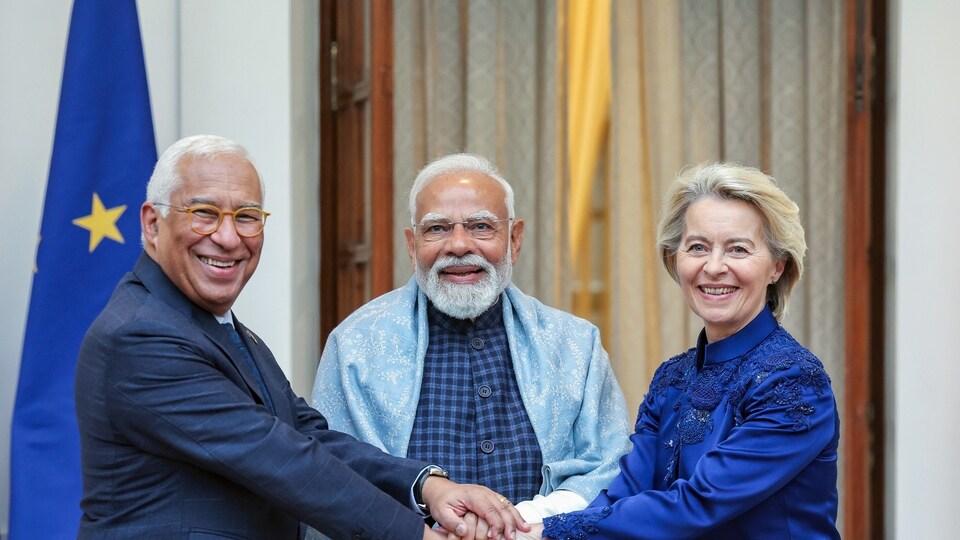
The second set of developments which have made headlines, especially in India, is the slew of very high valued and strategically placed trade deals. Prominent among them are the India-UK Free Trade Deal (FTA) in July 2025, the Comprehensive Economic Partnership Agreement (CEPA) with Oman in December 2025 and the India-EU FTA signed on January 27, 2026, called the ‘Mother of all deals’. And, finally the really surprising announcement on February 2, by President Trump that the US and India have finalised the contours of a trade deal, ‘Father of all trade deals’. The announcement was followed by the release of the initial framework through a joint statement on February 6, 2026. But anything on the US trade deal will have to be watched as many more layers could unfold before the deal is finally signed later in the year.
What is common about both these sets of developments? While the first is forcing countries to look beyond the traditional trade partners, the second set of developments has the potential for countries with converging interests to look for new alignments and transnational connectivity corridors like the India-Middle East-Europe Economic Corridor (IMEC) as the rapidly increased flow of trade volumes would soon be beyond the capacity of existing trade routes. When you add to the mix that many of the existing trade routes (by sea) are often being blocked or restricted by conflicts and sanctions, the situation poses greater challenges.
For India, these developments present challenges as well as opportunity. Challenge, because with increased trade volumes, additional trade routes would be required which are not only safe from conflict but are faster and more efficient than the traditional trade routes. Developing such transnational routes is no easy task as it not only requires a huge corpus of funds but also very detailed coordination with partner countries. However, the opportunity too is huge as it forces India to think beyond the existing options, towards new trade corridors which are shorter, faster, modern, technology enabled and steer clear of traditional choke points and conflict zones.
Let us take each of the deals in context. The India-UK FTA, signed in July 2025, removes tariffs on nearly 99% of Indian exports to the UK and 90% of UK exports to India. It aims at doubling the current bilateral trade of $56 billion by 2030. It provides an unprecedented duty-free access to 99% of India’s exports to the UK, covering nearly 100% of the trade value. This includes labour-intensive sectors such as textiles, leather, marine products, gems and jewellery, and toys as well as high-growth sectors like engineering goods, chemicals, and auto components.
Under the India Oman CEPA, signed in December 2025, Oman will provide zero-duty access on 98.08% of its tariff lines, benefiting key Indian exports like engineering products, electronics, textiles, pharmaceuticals, gems and jewellery, and agricultural items. Also, it aims to significantly increase the bilateral trade which is currently pegged at $10.6 billion (FY 2024-25), once again highlighting the requirement for more containers and shipments. However, unlike the UK, Oman is located just across the Arabian Sea and therefore, the logistics can be easily managed.
Next is the India EU FTA. Bold in nature and extremely huge in terms of trade opportunities, this FTA aims at enabling deeper market integration between the world’s fourth and second largest economies. It brings together a combined market estimated at over $24 trillion and unparalleled opportunities for the two billion people of India. The FTA delivers unprecedented market access for more than 99% of India’s export by trade value, aiming to increase and perhaps double the current bilateral trade of $136.54 billion (FY 2024-25) in the next decade.
In the middle of all this, the president of the UAE too visited India on January 19. Key highlights were the signing of Letter of Intent towards the conclusion of a Strategic Defence Partnership and the decision to increase the bilateral trade from $115 billion currently to $200 billion by 2032. How did this happen? It is courtesy the CEPA which was signed with UAE in February 2022 which had aimed to increase the trade to $115 billion by 2027 but the target was achieved by the end of 2024-25 only.
What do all these trade deals imply for India and the region? To fully harness the advantages of the deals, the goods will also have to move faster and more efficiently, especially bulk items like grains which tend to deteriorate faster than other goods. Also, the increased value of trade will mean increased volume of trade requiring additional containers to be transported. It is here that the search of a multimodal transport corridor comes in which not only traverses across the regions where such deals have been signed but also promises faster, shorter, cheaper and more efficient transportation. And, it is here that the IMEC comes into play.
The IMEC, launched at the G20 Summit in New Delhi in September 2023, is a bold vision to connect India with Europe across the deserts of the Arabian Peninsula. It envisions a multi-modal economic corridor integrating railways, ports, highways, energy networks, and digital infrastructure to enhance trade, investment, and connectivity. Unlike conventional transport corridors, IMEC is envisioned as a holistic and multidimensional infrastructure project, which, in addition to sea and rail links, includes value additions like undersea links for high-speed data connectivity, green hydrogen pipelines, and transnational energy transmission grids.
The project’s success involves developing ports, connecting and developing a seamless and integrated railway network and an efficient regulatory mechanism. Plans also include the incorporation of infrastructure for electricity and digital connectivity, as well as pipelines for green hydrogen export.
When implemented in full, IMEC has the potential to facilitate faster and more efficient movement of goods, bypassing existing bottlenecks, reducing shipping delays, lowering greenhouse gas emissions, and cutting costs. It also aims to secure regional supply chains, improve trade accessibility and facilitate the economic prosperity of people and countries along the alignment of the project.
IMEC was conceived keeping a number of factors in mind, key among them being to provide an alternate and safe route vis-à-vis the Suez Canal and the Red Sea and unlock the economic potential of integrating the region together through connectivity corridors and trade linkages. It was also pitched as an expression of India’s rise as a global power, both politically and economically, almost coinciding with it becoming the 5th largest global economy. The potential of this corridor to reduce transportation time, logistics costs, and the potential to boost trade volumes between participating nations over the next decade were important factors too.
In terms of trade between the EU and India, the IMEC is being seen as an economic game changer and an opportunity to strengthen strategic partnerships. The President of the European Commission, Ursula von der Leyen, during her visit to India in March 2025, had pitched for the IMEC as an important cornerstone for enhancing India-EU trade. She described IMEC as “a modern golden road - directly connecting India, the Arabian Gulf, and Europe.” Even at the signing of the India EU FTA, the significance of IMEC was highlighted in clear terms.
The IMEC has been stalled for the past three years due to the Gaza war. With the war now ending and the trade deals being signed, there is strong expectation that the IMEC is ready to take off. At the first meeting of the IMEC sherpas on August 5-6, 2025, hosted by the Indian NSA in Delhi, there was general consensus that IMEC cannot wait any longer. The fact that the India-US stand off on trade and tariffs finally seems to be heading for closure means that President Trump might be willing to come to India later in the year for the first IMEC summit.
India, meanwhile, has not been sitting idle. It has already started work on modernising its ports and integrating them with internal road and rail infrastructure within the country. Plus, it has already started work bilaterally with the UAE through initiatives like MAITRI (Master Application for International Trade and Regulatory Interface), is a digital platform that connects existing trade portals in both countries, aiming for seamless and paperless connectivity. MAITRI is part of the India UAE Virtual Trade Corridor, a comprehensive regulatory mechanism involving customs, transit fees, security issues etc needs to be framed concurrently so that shipments once loaded from a point in IMEC, do not face delays enroute due to regulatory issues.
The trade deals which India has concluded in recent times hold key to its continued growth as the fastest growing major economy in the world. As these deals materialise, there will be massive increase in trade volumes, something that the existing ports, infrastructure and trade routes may find it difficult to handle. Plus, any future disruptions due to conflicts and blocking of critical choke points (like the Red Sea during the Gaza war) will add to delays and huge cost implications. It is here that modern, multimodal economic corridors like IMEC will become important. A transnational connectivity corridor like IMEC which does not merely transport containers but integrates economies and ensures shared prosperity along its alignment, will be the key to India growth in the 21st century.
This article is authored by Col Rajeev Agarwal (Rtd), senior research consultant, CRF.


