
 E-Paper



Freedom of the press or freedom from responsibility?
This article is authored by Shishir Priyadashi, president, Chintan Research Foundation, New Delhi.

 Prefer HTon Google


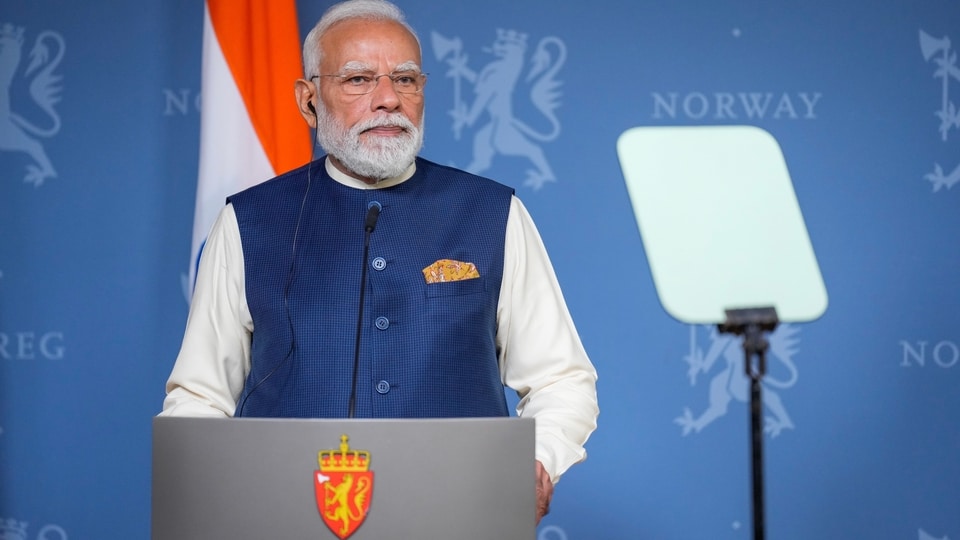
The recent media interaction involving officials accompanying Narendra Modi during his visit to Norway may appear, at first glance, to be a minor diplomatic episode. A journalist asked a pointed question. An Indian official began responding. The journalist repeatedly interrupted him. Voices rose, clips circulated online, and social media predictably transformed the exchange into a spectacle.
But beyond the fleeting outrage and predictable digital polarisation lies a deeper and more uncomfortable question: When does freedom of the press cease to serve democratic accountability and begin serving performance, provocation, and personal visibility?
This is not an argument against press freedom. Democracies cannot survive without an independent and fearless media. Investigative journalism has exposed corruption, challenged authoritarianism, uncovered corporate malpractice, and amplified voices otherwise ignored by power. From the Watergate scandal in the US to the Panama Papers, investigation spanning multiple countries, journalism at its finest has strengthened democratic institutions rather than weakened them.
Yet the strength of a democratic principle lies not merely in its existence, but in the ethical culture surrounding its exercise. Freedom without responsibility eventually mutates into entitlement.
The modern media ecosystem is no longer governed solely by the pursuit of truth. It is increasingly shaped by algorithms, virality, outrage, and visibility. In this ecosystem, interruption becomes a strategy. Aggression becomes branding. Rudeness becomes authenticity. The objective is often no longer to obtain an answer, but to create a moment.
The Norway incident reflects precisely this transformation. The question itself was not the issue. Democratic societies must encourage difficult questions, uncomfortable scrutiny, and robust public interrogation of State power. The concern arose from the manner of engagement. When an official begins answering and is continuously interrupted, the exchange ceases to be journalism in the classical sense.
The problem with theatrical journalism is that it privileges spectacle over substance. It rewards confrontation more than comprehension. It produces headlines without necessarily producing understanding.
In such situations, the journalist is no longer acting merely as a democratic intermediary between the public and power. The journalist becomes the story itself. That shift should concern all democracies.
Political philosophers from John Stuart Mill to Hannah Arendt consistently emphasised that freedom in democratic societies cannot survive without norms of restraint, mutual respect, and civic responsibility. Rights do not operate in isolation from duties. Indeed, rights become sustainable precisely because societies collectively agree to exercise them responsibly.
Curiously, modern public discourse increasingly celebrates freedom while dismissing restraint as weakness.
This is particularly visible in sections of contemporary western media culture, where interruption, sarcasm, visible hostility, and performative aggression are often interpreted as markers of journalistic courage. Yet many societies across Asia, Africa, and the Global South continue to place high value on civility, attentiveness, and respectful disagreement. These values are not signs of democratic inferiority.
They are democratic values in themselves.
For decades, developing countries have been assessed through frameworks largely constructed in western intellectual and institutional spaces. Nations are ranked on press freedom, democratic openness, civil liberties, and media independence; all important measures. But an equally important question is seldom asked: How responsibly is that freedom exercised?
Should not democracies also evaluate the ethical quality of media conduct? Should there not exist discussions around the misuse of press freedom.
The global discourse surrounding media freedom is often binary. Either one supports unrestricted journalistic conduct, or one is accused of undermining democracy itself. This framing is intellectually shallow.
Every freedom can be misused.
Economic freedom can enable exploitation. Political freedom can enable demagoguery. Social media freedom can enable misinformation. Why should press freedom alone be treated as immune from ethical scrutiny?
Misuse of media power does not occur only through censorship or propaganda. It can also emerge through sensationalism, selective outrage, reputational coercion, deliberate provocation, misinformation by omission, trial by media, or the conversion of journalism into ideological performance.
In parts of the developing world, media misuse can take the form of blackmail journalism or political capture. In parts of the developed world, it may manifest as aggressive performative journalism designed more for social media amplification than genuine inquiry. Both are distortions. Yet only one side of this global imbalance is regularly discussed in international forums and rankings.
Perhaps it is time for democratic societies and media scholars to begin discussing not merely freedom of the press, but also responsibility in the exercise of press freedom. Perhaps media ecosystems should also be evaluated on standards such as factual integrity, civility of engagement, willingness to allow responses, correction culture, and separation between journalism and performance activism.
None of this implies that governments should decide what constitutes acceptable journalism. That would be dangerous. The state must never become the arbiter of journalistic legitimacy. But democratic societies themselves have the right to debate standards, ethics, and conduct.
The right to question is sacred; but so too is the obligation to listen. Ultimately, the health of democracy depends not only on whether questions are asked, but also on whether meaningful answers can emerge. If public discourse degenerates into interruption, provocation, and viral confrontation, democracies risk producing more noise than truth.
The Norway episode should, therefore, not be viewed merely as a diplomatic irritation involving an Indian official and a foreign journalist. It should be understood as part of a larger global transformation in media culture; one where visibility increasingly triumphs over wisdom, and performance over seriousness.
Democracies deserve fearless journalism. But they also deserve journalism mature enough to understand that freedom and responsibility were never meant to be adversaries.
(The views expressed are personal)
This article is authored by Shishir Priyadashi, president, Chintan Research Foundation, New Delhi.


